
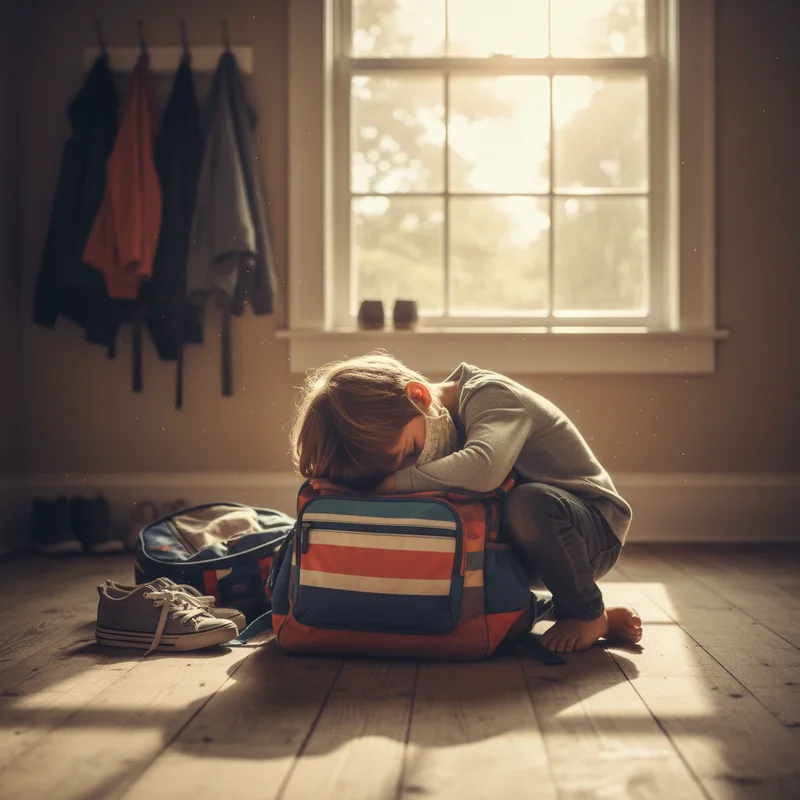
It was Tuesday, October 15th, when my normally "good" ADHD daughter completely fell apart over a broken crayon. Not just tears — full-body meltdowns, throwing things, screaming that everything was "stupid and hard." This from my kid who'd been holding it together at school for weeks.
I thought she was just having a bad day. What I didn't realize was that she'd been silently burning out for months, using every ounce of her energy to appear "normal" at school while her ADHD brain slowly depleted its reserves.
Your child's "difficult" behavior isn't defiance — it's often their nervous system finally releasing the pressure they've been holding in. ADHD isn't bad behavior — it's brain chemistry, and burnout is what happens when that brain chemistry gets pushed beyond its limits.
What ADHD Burnout Actually Looks Like in Kids
Unlike adult burnout, ADHD burnout in children rarely looks like withdrawal or depression. Instead, it shows up as explosive behavior, increased hyperactivity, or complete refusal to do things they used to manage.
The signs I missed in my daughter:
- Regression in skills: Tasks she could do before suddenly became "impossible"
- Emotional volatility: Going from fine to nuclear meltdown in seconds
- Physical complaints: Constant headaches, stomachaches, saying she was "too tired"
- Sleep disruption: Either couldn't fall asleep or wanted to sleep all the time
- Resistance to activities they used to enjoy: "I don't want to" became her default response
I kept thinking, "She was doing so well at school — what's wrong at home?" That was exactly the problem.
The Masking Trap: When 'Good Behavior' at School Costs Everything at Home
Many ADHD kids become masters at masking — appearing neurotypical by suppressing their natural impulses and hyperactivity. Teachers praise them for being "well-behaved," but this creates a devastating cycle.
Every moment of masking depletes their dopamine and serotonin reserves. By the time they get home, their brain's regulatory systems are completely exhausted. That's why ADHD children often save their worst behavior for home — you're getting the emotional overflow from eight hours of internal struggle.
The child who holds it together at school isn't "better behaved" there — they're using survival mode that can't be sustained long-term.
How Chronic Stress Depletes Dopamine and Serotonin Reserves
Your ADHD child's brain already struggles with four key neurotransmitter pathways: dopamine (motivation and focus), serotonin (mood regulation), GABA (calming responses), and norepinephrine (alertness). When they're constantly masking, these systems become chronically depleted.
Think of it like a phone battery that starts each day at 60% instead of 100%. By midday, they're running on fumes. By evening, they're in complete shutdown mode — which looks like oppositional behavior but is actually neurological exhaustion.
The research shows that chronic stress in ADHD children creates a vicious cycle: stress depletes dopamine, which makes focus and impulse control harder, which creates more stress. Without intervention, this spiral can continue for months.
The Recovery Phase Nobody Warns You About
Here's what I wish someone had told me: when you finally recognize burnout and start supporting your child's recovery, things often get worse before they get better.
My daughter's recovery looked like this:
- Week 1-2: Complete emotional dysregulation — tears, anger, sleeping 10+ hours
- Week 3-4: Gradual return of baseline functioning, still very sensitive
- Week 5-8: Slow rebuilding of resilience and emotional regulation
This isn't regression — it's their nervous system finally feeling safe enough to show you how exhausted it really is. Sleep disruption during this phase is completely normal as their brain tries to repair depleted neurotransmitter systems.
Natural Support for Nervous System Restoration
During my daughter's recovery, I focused on supporting all four of her brain's regulatory pathways naturally. Research suggests that compounds targeting multiple neurotransmitter systems simultaneously may be more effective than single-pathway approaches.
The 2019 study by Baziar and colleagues found that saffron, which works on dopamine, serotonin, GABA, and norepinephrine pathways, showed comparable efficacy to methylphenidate for ADHD symptoms. Unlike stimulant medications, saffron may support natural neurotransmitter production rather than artificially boosting levels.
Other natural support strategies that helped:
- Protein-rich breakfasts: Supports dopamine production throughout the day
- Magnesium supplementation: Though magnesium alone won't fix meltdowns, it supports GABA function
- Consistent sleep schedule: Essential for neurotransmitter recovery
- Reduced stimulation: Fewer activities, quieter environments, more downtime
The Energy Budget Approach to Preventing Future Burnout
Now I think of my daughter's daily energy like a budget. Masking at school "costs" more than being authentic at home. High-stimulation activities cost more than quiet ones. New environments cost more than familiar ones.
When her energy budget gets low, I see the warning signs earlier: increased interrupting, hyperactivity ramping up in the evening, or becoming emotionally reactive to small changes.
The goal isn't to eliminate all stress — it's to ensure her recovery time matches her energy expenditure. Some days she can handle birthday parties and homework. Other days, we skip the birthday party so she has energy left for family dinner without melting down.
Your child isn't being dramatic when they say they're "too tired" for normal activities. Their brain may literally be too depleted to handle additional demands.
Parent Training — Limited Spots
You're Not Failing. You're Running on Empty.
The Unbreakable ADHD program helps you support your child AND protect yourself. Learn the framework that helps ADHD families stop surviving and start connecting. By licensed therapist Anneliese.
87 of 100 spots taken · 9 video modules · $9.99 trial
START YOUR $9.99 TRIAL →Is Your ADHD Child Showing Signs of Burnout?
If you're seeing increased meltdowns, emotional volatility, or resistance to activities they used to enjoy, our free assessment can help identify whether burnout might be affecting your child's behavior.
TAKE THE FREE ASSESSMENT →

