
Oliver's teacher told me he was doing great. Participating in class. Keeping his hands to himself. Following the schedule.
Then he walked through our front door at 3:45 PM and dissolved into a forty-five-minute screaming meltdown because I cut his apple into wedges instead of slices.
For months, I assumed I was doing something wrong at home. That I was too permissive, or not structured enough, or somehow triggering him the moment he arrived. I felt like a failure every single afternoon.
I wasn't. And if this is happening in your house, you aren't either.
What Oliver was experiencing has a name: after-school restraint collapse. And once I understood what was actually happening in his nervous system, everything changed — including how I responded to it.
What restraint collapse actually is — and why ADHD kids are especially vulnerable
Here's what nobody tells you: school is an extraordinary act of self-regulation for an ADHD child.
For six hours, Oliver was suppressing impulses, tolerating sensory input, managing transitions, sitting still, tracking instructions, and holding his emotions together — all in an environment that wasn't built for his brain. That takes enormous neurological effort.
By the time he got home, his regulatory reserves were completely depleted. The meltdown wasn't defiance. It wasn't manipulation. It was his nervous system finally reaching safety and releasing everything it had been holding.
This is why ADHD kids save their worst behavior for home — home is where they feel safe enough to fall apart. It's actually a sign that they trust you, even when it doesn't feel that way.
As a former pediatric OT, I'd seen this pattern in clinical settings. But seeing it in your own child, every single day, is a different experience entirely. It's exhausting. It's demoralizing. And it's almost impossible not to take personally.
The 5 warning signs your child is heading toward an after-school collapse
Once I knew what to look for, I could see the collapse coming before it arrived. That 20-minute window between car pickup and full meltdown became something I could actually work with.
Watch for these signals the moment they get in the car or walk through the door:
- Silent shutdown. Oliver would go completely quiet — not calm, but eerily flat. That sudden absence of noise was my first warning.
- Backpack throwing. The bag didn't just get dropped. It got launched. His body was already dysregulated before he said a word.
- Hypersensitivity to small things. If the wrong show was on, or a sibling was in "his" spot, or dinner smelled different — everything became an emergency.
- Refusing snacks he normally loves. When Oliver turned down Goldfish crackers, I knew his system was overloaded. Blood sugar and regulation are deeply connected.
- Physical restlessness with no direction. He'd move from room to room, touching things, unable to settle — his body desperately seeking input it couldn't name.
These aren't signs of a bad day. They're signs of a nervous system that has run out of fuel. Recognizing them as such is the first step toward responding instead of reacting.
It's also worth knowing whether anxiety is amplifying what you're seeing — the two are closely intertwined and can make after-school collapse significantly worse.
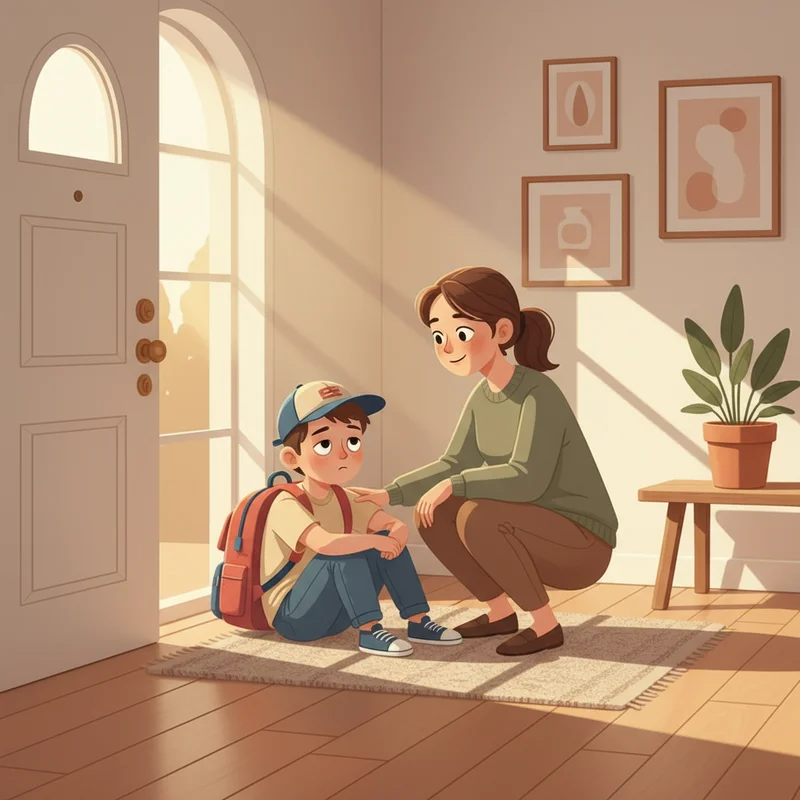
The 20-minute decompression window — and what NOT to do when they walk in
The single biggest shift in our household came when I stopped treating 3:45 PM like a normal time of day.
That first twenty minutes after school is not the time for homework questions, behavior reports, conversation, or requests of any kind. Oliver's brain cannot process any of that. Trying to engage him is like asking someone to do calculus mid-panic-attack.
What actually helped us:
- Car silence. No questions about his day. No recap of what's coming tonight. Just music he likes, or nothing at all. I let him lead.
- Designated crash space. When we got home, he had one spot — his beanbag in the corner of the living room — that was his and only his for decompression. No siblings allowed. No interruptions.
- Predictable snack, no choices. I put the same snack out every day without asking what he wanted. Decision fatigue is real, and by 3:45, his brain had already made thousands of micro-decisions. I removed one more.
- Physical input before cognitive demands. If I could get him outside for ten minutes — shooting hoops, jumping on the trampoline, anything that used his body — the collapse was significantly less severe. Deep pressure input was especially effective for Oliver.
The things that made it dramatically worse: asking "how was school," launching into homework immediately, having his sibling demand his attention, or — and I learned this one the hard way — trying to process the morning's argument the moment he walked in.
If you're also dealing with homework meltdowns stacking on top of after-school collapse, that combination is its own crisis that deserves its own strategy.
The after-school routine framework that actually holds — and when collapse signals something bigger
After about six weeks of trial and error, we landed on a framework that held consistently. It's not complicated. Complicated doesn't survive contact with a dysregulated ADHD child.
Arrival protocol (first 20 minutes): Snack ready. Crash space available. No demands. Oliver decides how he uses this time — screen, movement, quiet — with no commentary from me.
Transition signal (minute 20-25): I'd give a five-minute heads-up before expecting anything from him. "In five minutes I'm going to need you to unpack your bag." That's it. No lecture. No preview of the evening.
Homework block (after movement): We never do homework before movement. Never. Even a 10-minute walk changes his neurological state enough to make homework survivable. This completely transformed our evenings.
What this framework is not is a cure for every hard afternoon. Some days the collapse happens anyway, and that's okay. The goal isn't a perfect transition — it's a shorter, less intense one.
But if the after-school collapses are escalating — getting longer, more violent, or happening even on low-demand days — that can signal something specific is happening at school that needs attention. A new seating arrangement, a social conflict, a change in the classroom schedule. ADHD burnout often surfaces first through intensified after-school behavior before parents see it anywhere else.
If you suspect school is part of the problem, knowing what accommodations your child is entitled to can open doors you didn't know existed. And if you're getting regular teacher complaints layered on top of the home collapse, a structured check-in system with the teacher can help you see patterns before they become crises.
The hardest thing I had to accept was that I couldn't fix the school day. I could only build a landing pad for when it was over.
That's not failure. That's strategy.
The meltdown at your door isn't a judgment on your parenting. It's proof that your child held it together all day — and that home is where they finally feel safe enough to let go.
If you want to understand more about why ADHD behavior isn't bad behavior — it's brain chemistry, that piece changed how I see almost every hard moment with Oliver. And if you're drowning in the daily grind of this, you're not alone — the guilt ADHD parents carry is real and it deserves to be named.
Parent Training — Limited Spots
Turn After-School Chaos Into a Routine That Actually Holds
This course walks ADHD parents through the exact frameworks — decompression windows, transition protocols, homework systems — that stop the afternoon meltdown cycle for good.
87 of 100 spots taken · 9 video modules · $9.99 trial
START YOUR $9.99 TRIAL →Is your child's after-school behavior connected to how their brain is regulated all day?
Take the free 2-minute assessment to understand what's driving your child's specific patterns — and what kinds of support tend to help most.
TAKE THE FREE ASSESSMENT →

