
It was 11:47 PM and Oliver was still talking to himself through the baby monitor. He was eight years old. I was sitting on the kitchen floor in the dark, too exhausted to move, eating crackers over the sink and wondering what I was doing wrong.
Nothing. You are doing nothing wrong. If your ADHD child won't go to sleep at night, that is not a discipline failure. It is a neurological one — and the difference matters enormously for how you fix it.
Why "just go to sleep" was never going to work
The night I finally understood this, Oliver's sleep doctor used three words that changed everything: delayed sleep phase.
ADHD brains don't experience the same melatonin rise neurotypical brains do. While most kids' bodies start signaling sleepiness around 8 or 9 PM, research suggests many ADHD kids don't get that signal until 11 PM or later. It's not stubbornness. Their brain genuinely isn't tired yet.
On top of that, the same dopamine dysregulation that drives daytime hyperactivity makes ADHD brains turn ON at night when stimulation drops. The quiet of bedtime is actually activating, not calming.
So every time I said "just close your eyes," I was essentially asking Oliver to fall asleep with his foot on the gas pedal.
What I tried first — and why it all failed
I tried everything the parenting books recommended. Consistent bedtime. Dim lights. No screens after 7. Lavender everything.
Oliver would lie in the dark and his brain would detonate. He'd call out for water. Then a different blanket. Then he needed to tell me something important about Minecraft. Then he was scared. Then hungry. Then his socks felt wrong.
The popular ADHD evening routines I'd read about assumed a child who could self-soothe once the routine was done. Oliver couldn't. His nervous system was still running hot, and my firm "it's bedtime, goodnight" only spiked his cortisol — which made falling asleep even harder.
Here's what I didn't understand then: the words I was using at bedtime were the problem. I was triggering a stress response right when I needed his brain to power down.
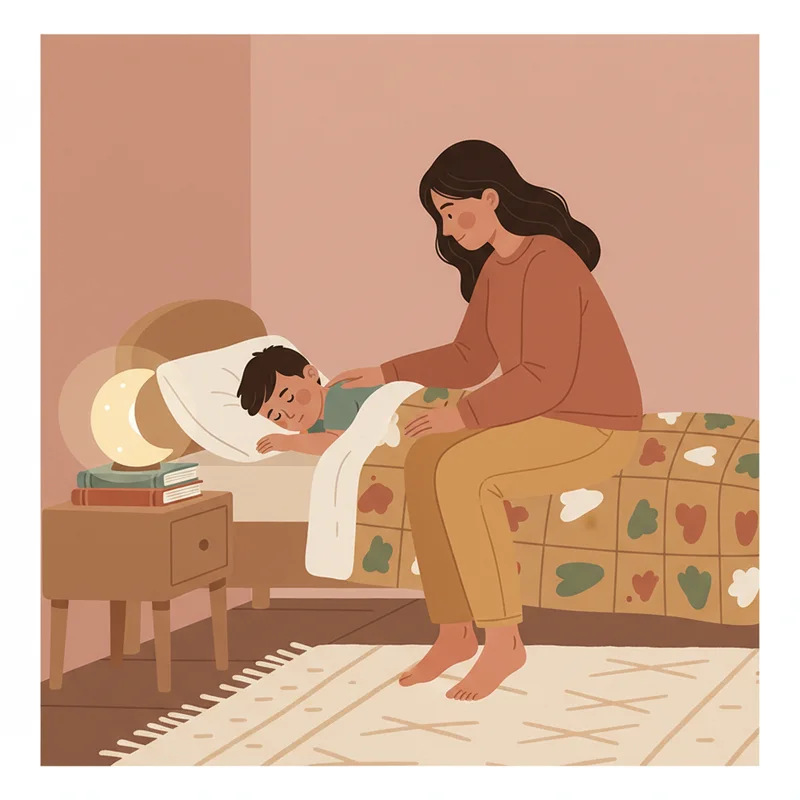
The bedtime resistance script: exact words that lower cortisol instead of spiking it
This is the actual script I use. It sounds almost too simple. That's the point.
Phase 1: The transition warning (30 minutes before)
"Hey bud. In 30 minutes we're going to start getting cozy. Not bed yet — just getting cozy. You've got time."
That phrase — "you've got time" — is doing enormous work. ADHD kids live in a state of time blindness and low-grade panic about transitions. Telling him he has time lowers his guard immediately.
Phase 2: The 10-minute warning
"Ten minutes, then we start the cozy routine. What do you want to do with your last ten minutes?"
Giving him choice in those ten minutes means he doesn't feel ambushed. He's not being dragged to bed. He's finishing on his own terms.
Phase 3: The transition itself
"Okay, cozy time. Let's go get your body ready to rest."
Notice I don't say "sleep." Sleep feels like a demand. "Rest" feels optional — and his nervous system responds completely differently to it.
Phase 4: In the room
"Your only job right now is to let your body be still. Your brain can do whatever it wants."
This one was a game-changer. Oliver's biggest bedtime battle was being told to stop thinking. When I gave his brain permission to wander, he stopped fighting the process. He'd lie there spinning stories in his head — and within 20 minutes, he was out.
Building the 30-minute wind-down that actually sticks
The script only works inside a consistent wind-down. Ours looks like this:
- 7:30 PM: Screens off. Low light. Oliver picks a podcast or audiobook (no video). This handles the stimulation need without revving him back up.
- 7:45 PM: Shower or bath — warm water is genuinely regulating for ADHD nervous systems. Not a rule, just a fact.
- 8:00 PM: Dim room. I do 5 minutes of what we call "heavy work" — deep pressure on his shoulders, arms, legs. If you've never tried deep pressure for ADHD hyperactivity, start here. It's the single most effective physical tool we have.
- 8:10 PM: Script begins. I read to him or he listens to his audiobook while I sit nearby.
- 8:30 PM: Lights out. I leave the room with: "I'll check on you in ten minutes." (I do check. He knows I will. It eliminates the "I need you" calls.)
The whole thing took about three weeks to stick. The first week was rough. The second week he started reminding ME when it was 7:30.
What to do when they get out of bed
They will get out of bed. Here is the no-power-struggle response:
Say nothing. Walk them back. Tuck them in. Say "I love you. Your body needs rest." Leave.
Every word beyond that is fuel. ADHD kids escalate when they sense emotional charge — even the charge of a frustrated whisper-yell. The less you say, the faster it resolves.
If he gets out repeatedly, I sit in the hallway visible through the door crack. My presence is regulating. I don't interact. I just exist nearby. Within ten minutes, he's usually asleep.
The goal isn't to make him stop fighting sleep. It's to stop making sleep feel like a fight.
Where we are now — and what still doesn't work
Oliver is ten now. Most nights he's asleep by 9:15. We still have blowups — usually when something big happened at school, or when our routine got disrupted. Bedtime explosions still happen. I'd be lying if I said they didn't.
Sleepovers are still a disaster. Summer is harder. Anything that disrupts the routine for more than two days means we're rebuilding from scratch.
But the baseline? Completely different from that kitchen floor at midnight. If you're there right now — crackers, dark, wondering what you're doing wrong — I want you to know it's not you. And it can change faster than you think.
If bedtime is connected to bigger evening struggles, the homework meltdown reset and morning routine framework work on the same principle: lowering cortisol instead of raising it. Start there.
Parent Training — Limited Spots
Stop the Bedtime Battle for Good
The Unbreakable ADHD course walks you through the full evening regulation system — scripts, routines, and what to do when everything falls apart.
87 of 100 spots taken · 9 video modules · $9.99 trial
START YOUR $9.99 TRIAL →Is something deeper driving your child's bedtime resistance?
Take the free 2-minute assessment to find out what's going on in your child's brain — and what kind of support actually fits their specific profile.
TAKE THE FREE ASSESSMENT →