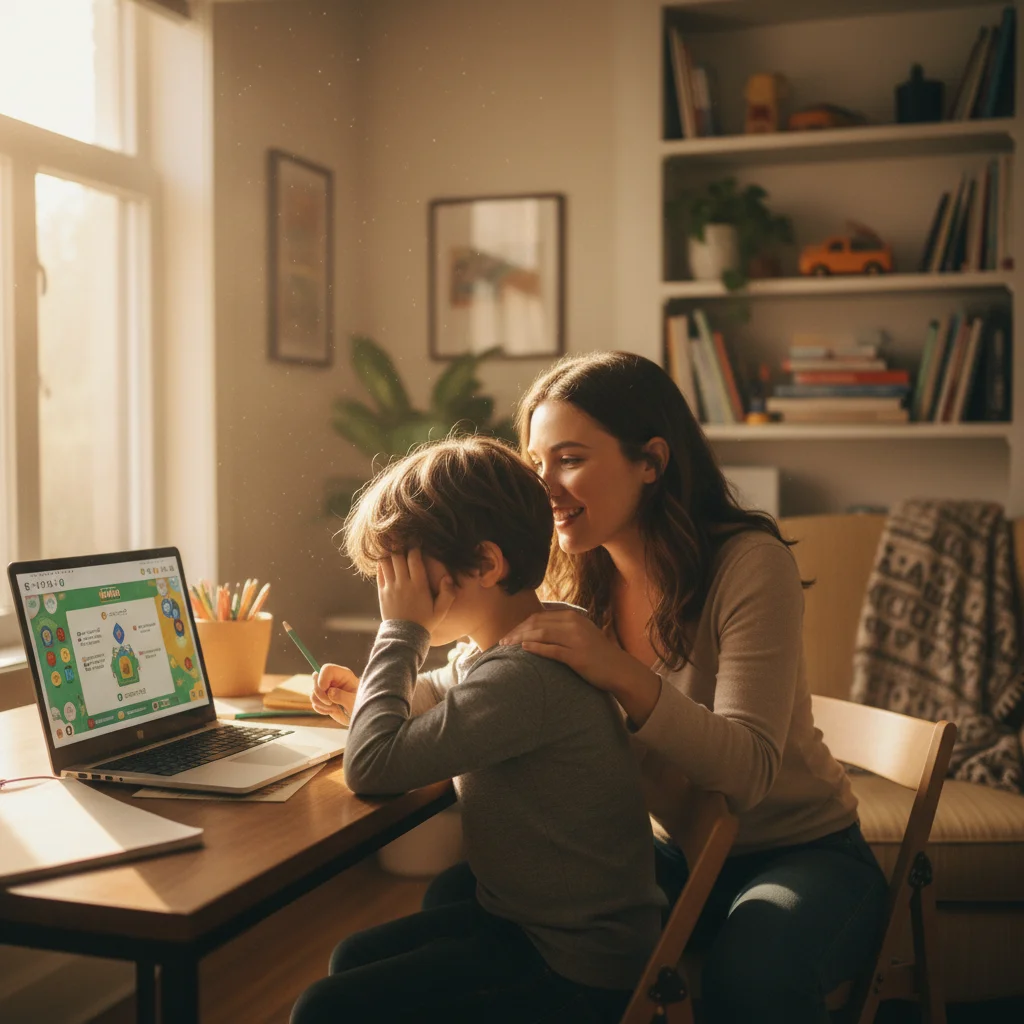
Your ADHD child sits down for virtual school and within 10 minutes, they're under the desk. Or spinning in their chair. Or "listening" while building a Lego tower off-camera.
You're thinking: "They can focus on video games for hours, but can't handle a 20-minute Zoom lesson?" Here's what's really happening—and it's not defiance.
Online learning triggers a specific neurological cascade in ADHD brains that makes focus nearly impossible. Once you understand the mechanism, everything clicks.
Why Online Learning Is Kryptonite for ADHD Brains
Virtual classrooms create what neuroscientists call "understimulation with high cognitive demand." Your child's brain needs more sensory input than a screen provides, but the lesson still requires full attention.
It's like asking someone to listen to a whisper in a noisy restaurant—the signal is too weak for the environment.
In a physical classroom, ADHD brains get constant micro-stimulation: the rustle of papers, classmates shifting in chairs, the teacher's proximity. These tiny inputs actually help the ADHD brain maintain alertness.
Remove those inputs? The brain goes into what researchers call "default mode"—essentially daydreaming to create its own stimulation.
The Dopamine Paradox: Why Screens Both Help and Hurt ADHD Focus
Here's the confusing part: your child can hyperfocus on YouTube or video games but can't watch a math lesson. Both are screens, so why the difference?
It's all about dopamine delivery. Video games provide constant micro-rewards—points, levels, visual effects. Each one triggers a small dopamine hit, keeping the ADHD brain engaged.
Educational content, even when well-designed, can't compete with that reward frequency. A math lesson might have one "aha moment" per 20 minutes. A video game has 50 dopamine hits in that same timeframe.
The ADHD brain, which already produces 30% less baseline dopamine than neurotypical brains, simply can't sustain attention without those frequent rewards.

How Virtual Classrooms Trigger Understimulation
Most parents think their ADHD child is overstimulated during online school. Actually, they're severely understimulated.
The ADHD nervous system needs what occupational therapists call "optimal arousal"—the right amount of sensory input to maintain alertness. Too little input, and the brain essentially falls asleep. Too much, and it becomes overwhelmed.
Virtual learning strips away crucial sensory inputs:
- Movement feedback: No walking between classes, no fidgeting with physical materials
- Social energy: Muted microphones eliminate the subtle social stimulation of peer interaction
- Environmental variety: Same chair, same room, same visual angle for hours
- Teacher proximity: No physical presence to provide natural accountability
Without these inputs, the ADHD brain starts seeking stimulation elsewhere—hence the under-desk adventures.
The Missing Sensory Input That In-Person Learning Provides
Physical classrooms provide what neuroscientists call "embodied learning"—your child's whole nervous system is engaged, not just their eyes and ears.
Research shows ADHD children have differences in their vestibular (balance) and proprioceptive (body awareness) systems. In-person learning naturally supports these systems through:
- Walking to different stations or classrooms
- Physical manipulation of materials
- Adjusting body position in response to the teacher's movement
- Natural postural changes throughout the day
Online learning eliminates all of this. Your child sits in a static position, receiving input through only two sensory channels while their other systems essentially go offline.
As one occupational therapist explained to me: "It's like asking a symphony orchestra to perform with only the violins and flutes. The music technically happens, but it's missing the foundation."
Why Traditional 'Pay Attention' Strategies Backfire Online
Most school guidance for online learning comes from neurotypical assumptions: sit still, eliminate distractions, focus on the screen. For ADHD brains, this advice is counterproductive.
ADHD isn't bad behavior—it's brain chemistry. When we eliminate all movement and sensory input, we're actually making it harder for the ADHD brain to process information.
Here's why common strategies fail:
- "Sit still and look at the screen": Reduces the proprioceptive input the ADHD brain needs for alertness
- "Put away all toys and fidgets": Removes the micro-stimulation that helps maintain attention
- "Turn off all other devices": Eliminates alternative dopamine sources without replacing them
These strategies work for neurotypical children because their brains don't require additional sensory input to maintain alertness. But they're like removing the engine from a car and wondering why it won't start.
The 4-Pathway Approach to Boosting Virtual Learning Engagement
Instead of fighting the ADHD brain's wiring, we need to support its four key neurotransmitter pathways during online learning:
Dopamine pathway: Create micro-rewards throughout lessons. I use a visual checklist where my son checks off each activity segment. Small wins = dopamine hits.
Norepinephrine pathway: Incorporate gentle alertness boosters. We do 30 seconds of arm circles between lesson segments. Movement naturally boosts norepinephrine.
GABA pathway: Include calming sensory input. A weighted lap pad during lessons helps regulate the nervous system without being disruptive.
Serotonin pathway: Maintain emotional regulation through predictable structure. Our online school routine is exactly the same every day, reducing anxiety and supporting mood stability.
This approach addresses the neurological reality of ADHD rather than trying to override it. When all four pathways are supported, focus becomes naturally more sustainable.
Micro-Breaks and Movement Protocols That Actually Work
The key insight: ADHD brains need movement during learning, not just between lessons. Here's what works:
The 15-Minute Rule: Every 15 minutes of virtual learning, include 30 seconds of movement. This can be as simple as standing up and sitting down five times.
Fidget Strategy: Provide silent fidgets that don't require visual attention—stress balls, thinking putty, or a textured fabric strip taped under the desk.
Body Position Variety: Allow different working positions throughout the session. Standing desk for one subject, exercise ball for another, floor with clipboard for a third.
One mom in my support group discovered her daughter could focus perfectly during virtual lessons when allowed to pace behind her chair. The movement provided the vestibular input her brain needed for attention.
Creating the Optimal Home Learning Environment for ADHD Brains
Your home learning setup can either support or sabotage ADHD focus. Here's what makes the difference:
Lighting: Natural light is crucial for maintaining circadian rhythms that regulate attention. Position the learning space near a window if possible.
Background stimulation: Complete silence actually makes focus harder for many ADHD children. Try very low-volume instrumental music or white noise.
Visual organization: Keep only necessary items visible. Too many visual elements compete for attention, but a completely bare space can feel unstimulating.
Sensory tools within reach: A small basket with appropriate fidgets, a water bottle, and healthy snacks eliminates the need to leave the learning space.
The goal isn't to create a perfect, distraction-free environment—it's to create an environment that provides optimal stimulation for the ADHD nervous system.
When to Advocate for In-Person Accommodations
Sometimes, despite all strategies, online learning simply doesn't work for your ADHD child. That's not a failure—it's neurological reality.
Consider advocating for in-person accommodations if your child:
- Shows significant regression in academic progress during virtual learning
- Develops school avoidance or anxiety around online lessons
- Can't maintain attention for even short virtual sessions despite support strategies
- Has coexisting conditions like dyslexia that make online learning particularly challenging
Remember: academic "behind" has different meanings for neurodivergent kids. If online learning is causing significant stress without educational benefit, it's time for a different approach.
Many schools offer hybrid options or specialized programs for students who need more sensory-rich learning environments. Your child's IEP or 504 plan can include provisions for in-person instruction when virtual learning isn't effective.
Is your ADHD child struggling with more than just online learning?
Focus challenges, emotional meltdowns, and school difficulties often stem from the same four brain pathways. Find out which areas need the most support.
TAKE THE FREE ASSESSMENT →

