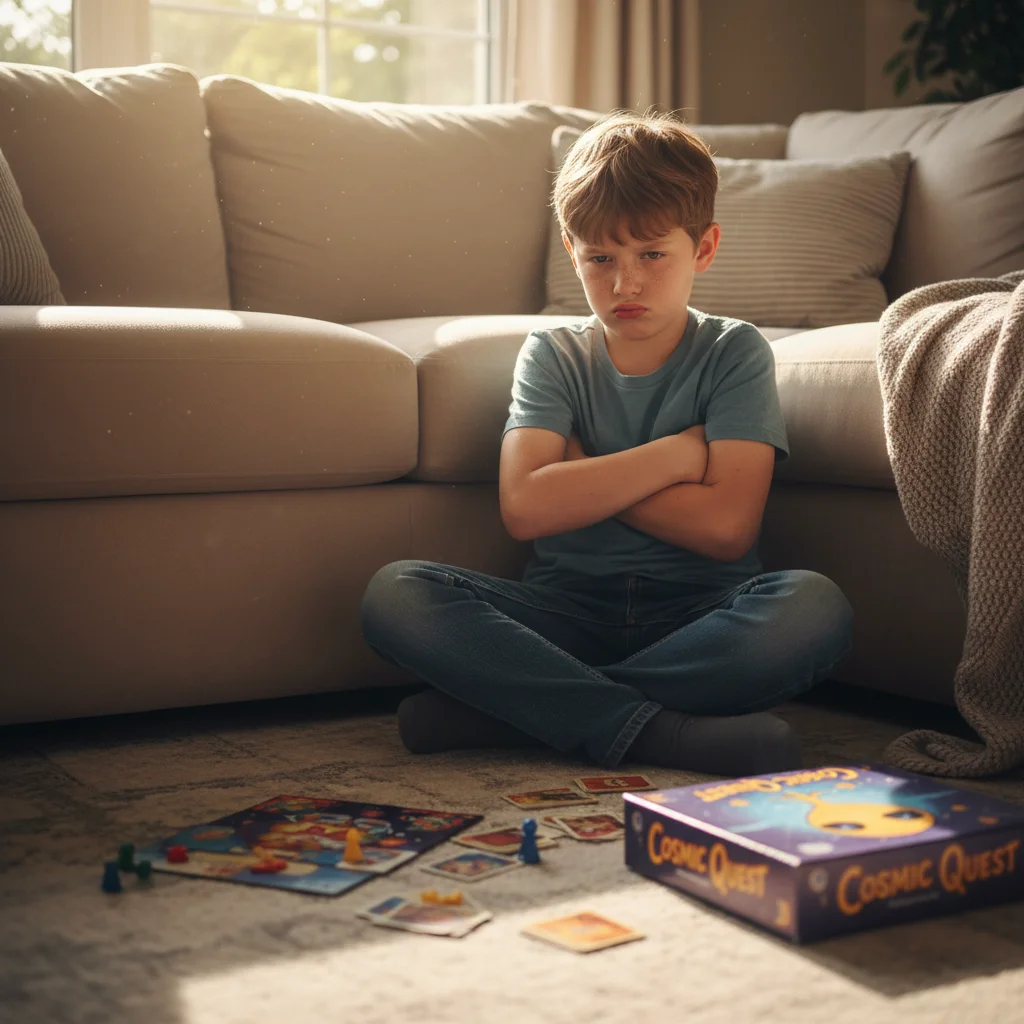
Oliver was nine when his best friend stopped calling. I didn't find out why until weeks later — another mom gently told me at pickup that her son felt like he "couldn't say anything" around Oliver without it turning into a fight.
Oliver had gotten into an argument about the rules of a card game. He was wrong. His friend pointed it out. And Oliver — my sweet, creative, funny kid — completely fell apart. Yelling, name-calling, storming off. His friend never invited him back.
If this sounds familiar, I need you to hear this first: your child is not a bully, and you are not raising a bad kid. What's happening in their brain when they're corrected is genuinely different from what happens in a neurotypical child's brain — and once I understood that, everything changed.
Why being wrong feels like a threat — not a correction
Here's the piece that stopped me cold when I first read it: for many ADHD kids, being corrected activates the same threat-response system as physical danger.
It's not stubbornness. It's not a character flaw. The ADHD brain struggles to regulate the emotional signal that says "this is fine" versus "this is an emergency." So when a friend says "actually, that's not how the game works," your child's nervous system can process that as an attack — and the fight-or-flight response kicks in before logic has a chance.
This is why reasoning with them in the moment never works. You can't talk someone down from a fire alarm with logic. The alarm has to stop first.
As I wrote in ADHD isn't bad behavior — it's brain chemistry, the emotional flooding that looks like defiance is almost always a regulation problem, not a willful choice. That reframe matters enormously when you're figuring out how to respond.
Rejection sensitive dysphoria — and why most parents haven't heard of it
There's a specific name for what Oliver experiences: rejection sensitive dysphoria, or RSD.
RSD is an intense emotional response — usually pain, shame, or rage — triggered by the perception of being criticized, corrected, rejected, or failing. The key word is perception. Your child doesn't have to actually be rejected. They just have to feel like they might be.
Being wrong in front of someone they care about hits every single one of those triggers at once. Criticism. Potential rejection. Failure. All in a single moment.
The explosion isn't about the card game. It's about the unbearable feeling that they're not enough — and that the person they care about now sees that too.
If your child also struggles when they lose at games, you'll want to read ADHD child can't handle losing games — the rejection sensitive dysphoria connection. It's the same mechanism, different trigger.
How it plays out — at school, at home, with friends
At school: Teacher corrects a wrong answer in front of the class. Your child argues, shuts down, or cries — and ends up in trouble for "disrespecting" the teacher. The actual problem was never the wrong answer.
At home: You point out that they forgot to put their shoes away. Somehow this becomes a 45-minute standoff involving screaming and slamming doors. You're genuinely baffled at how a shoe became a crisis.
With friends: A peer corrects something minor during play. Your child argues, escalates, and the playdate ends badly. The friend tells their parent they don't want to play with your kid anymore.
I've written about how social misreading can break friendships for ADHD kids — but the being-wrong explosion is even more socially costly, because it looks intentional. Other kids can't understand why their friend just exploded at them for something small. It feels scary. So they pull back.
Over time, this pattern can leave your child increasingly isolated — and increasingly convinced that something is fundamentally wrong with them. That's the part that breaks my heart. Because I watched it happen to Oliver, and I watched his confidence erode alongside his friendships.
If your child is already struggling socially, my ADHD son can't keep friends — here's what I learned goes deeper on the broader social skills piece.

What NOT to do when your child explodes after being corrected
I got this wrong for years. Here's what makes it worse:
- Continuing to explain why they're wrong. When the alarm is going off, information doesn't land. You're talking to a wall — a screaming wall.
- Saying "calm down." This communicates that their feelings are wrong too, which piles shame on top of shame.
- Bringing up past incidents. "This is just like last week at Jake's house." Now they're flooded AND defensive.
- Demanding an apology in the moment. They cannot access genuine remorse while they're dysregulated. It will come out hollow — or it will make the explosion worse.
- Punishing the explosion itself without addressing the trigger. Consequences without understanding don't change the pattern. They just add humiliation.
If you've been doing any of these — welcome to the club. I did all of them. For years.
Scripts that actually de-escalate in the moment
The goal in the moment is not to correct the record. It's to help their nervous system come back online. Accuracy can wait.
When they first start to escalate:
"I can see this feels really unfair right now. We don't have to figure it out this second."
That's it. You're acknowledging the feeling without agreeing with their version of events. You're buying time for their regulation system to catch up.
If they push — "I WAS right!" — don't argue. Try:
"Maybe. Let's both take a break and we can look it up together in a few minutes."
You've given them an exit ramp that preserves their dignity. That's the key. RSD explosions escalate when the child feels cornered. Give them a way out that doesn't require them to lose face right now.
After they've calmed down (not before):
"I noticed things got really big earlier. Can you tell me what that felt like on the inside?"
You're building self-awareness, not relitigating the facts. This is where learning actually happens.
For moments when your child shuts down instead of exploding, ADHD child shuts down when confronted has additional scripts that work.
Building a "being wrong is safe" environment at home
The long game is changing your child's baseline belief that being wrong equals being worthless.
That starts at home. Specifically:
- Model being wrong out loud. "Oops, I got that wrong. Oh well — now I know." Say it casually. Frequently. Let them see that mistakes don't destroy you.
- Praise the correction, not just the right answer. "Nice — you caught your own mistake. That's actually really hard to do."
- Create low-stakes practice. Play games together where you model graceful losing and good-natured error. Board games, trivia, card games — with zero stakes and a lot of laughter at your own wrong answers.
- Name RSD explicitly (when they're calm). Around age 8-9, many kids can handle a simplified version: "Sometimes your brain tells you that being wrong means people won't like you anymore. That's not true — but your brain doesn't know that yet. We're going to practice helping it learn."
This also connects to why traditional discipline approaches often backfire with ADHD kids — I wrote about that in why punishment doesn't work for ADHD kids. When shame is already their default response to mistakes, punitive consequences just add fuel.
When to bring in a therapist or school counselor
The strategies above help — a lot. But if your child's RSD is so intense that friendships are consistently ending, school is a daily conflict zone, or they're starting to say things like "I'm stupid" or "nobody likes me," please don't try to carry this alone.
A therapist trained in ADHD — specifically one familiar with RSD and emotional dysregulation — can work with your child on the shame piece in a way that parents genuinely can't. Not because you're not good enough. Because you're too important to them. The stakes feel too high with you. A neutral adult is sometimes exactly what they need.
At school, a counselor can also help create a safety plan — a quiet signal your child can use when they feel a correction coming and need a moment. If your child has a 504 plan, this can be written in. The complete ADHD 504 plan guide walks through what's possible.
Oliver is eleven now. He still struggles with being wrong — probably always will, to some degree. But last month, his friend corrected him about something during a video game, and he said "oh yeah, you're right" and kept playing. His friend later told him he was "actually really fun to play with."
That took two years of work. It was worth every minute.
Parent Training — Limited Spots
Stop the Explosion Cycle Before It Costs Another Friendship
Learn the exact regulation strategies that help ADHD kids handle correction, conflict, and mistakes — without the meltdown. Nine modules, built for overwhelmed parents.
87 of 100 spots taken · 9 video modules · $9.99 trial
START YOUR $9.99 TRIAL →Is emotional dysregulation the root of your child's ADHD struggles?
Take the free 2-minute assessment to understand what's driving your child's reactions — and what kind of support fits their specific brain.
TAKE THE FREE ASSESSMENT →