
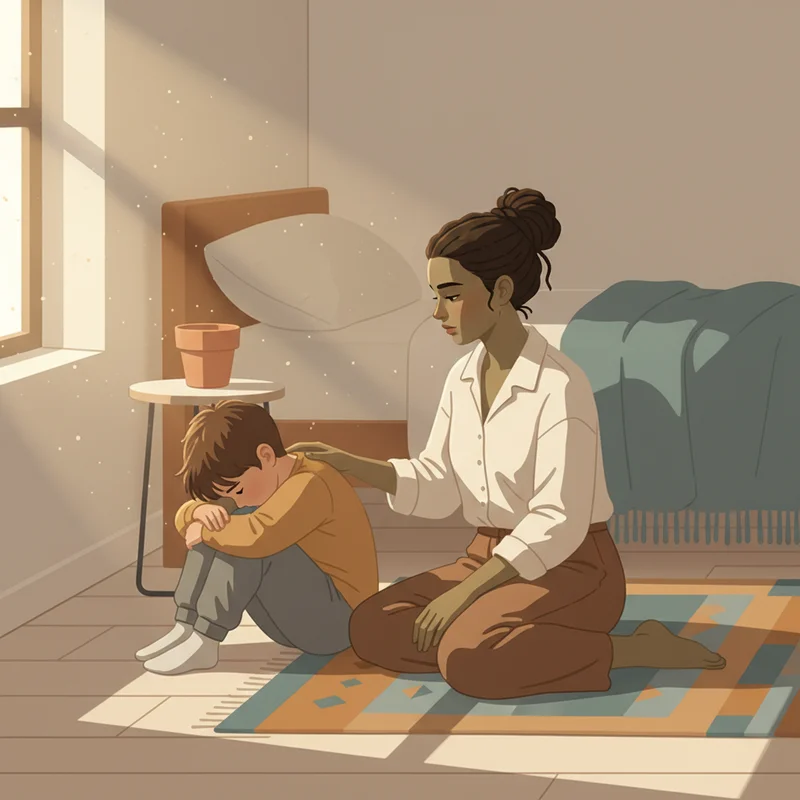
It was a Tuesday afternoon, and Oliver had been talking about that Friday playdate for six straight days. He'd planned what games they'd play. He'd reorganized his Lego bins so his friend could pick first. When the text came in — "So sorry, Jake has a soccer thing, can we reschedule?" — he heard me read it aloud and immediately crumpled onto the kitchen floor, sobbing like something had been taken from him permanently.
I stood there holding my phone, genuinely not knowing what to say. He was eight. It was a rescheduled playdate. And yet.
Here's what I want you to know before anything else: this is not your child being dramatic. It is not a manipulation tactic. And it is absolutely not a reflection of your parenting. What you're watching is a neurological response — and once I understood what was actually happening in Oliver's brain, everything shifted for me.
What rejection sensitive dysphoria actually is — and why ADHD kids feel it so intensely
Rejection sensitive dysphoria (RSD) is an intense emotional response to perceived or actual rejection, criticism, or failure. The keyword is perceived — your child's nervous system can fire the same alarm for a cancelled playdate as it would for genuine social exclusion.
For kids with ADHD, the emotional regulation circuits in the brain are working differently. The prefrontal cortex — the part responsible for putting feelings into perspective — has a harder time pumping the brakes. So what gets filed under "mild disappointment" for most kids lands as overwhelming grief for yours.
This is the same reason your child can't handle losing games or why they explode when they're corrected in front of a friend. It's one pattern showing up in different situations. And it's neurological, not behavioral — a distinction that matters enormously when you're deciding how to respond.
The term RSD was popularized by Dr. William Dodson, a psychiatrist who spent decades working with ADHD patients. He describes it as one of the most impairing — and least discussed — features of ADHD. Most parents I talk to have never heard of it until they're already deep in the trenches.
The signs your child's friend grief goes beyond normal disappointment
All kids feel sad when plans fall through. But there are specific signs that what you're seeing is RSD, not ordinary disappointment:
- The reaction is immediate and total. There's no gradual disappointment — it's zero to devastated in seconds.
- Reassurance doesn't help. Telling them "we'll reschedule" or "Jake still likes you" doesn't register. The brain is flooded.
- They catastrophize the friendship. "He hates me." "Nobody wants to be my friend." "I'm never going to have friends." The story jumps from one cancelled playdate to social annihilation.
- Physical symptoms appear. Stomach aches, headaches, or a kind of exhausted shutdown are common. The physical symptoms of ADHD anxiety and RSD overlap heavily.
- Recovery takes disproportionately long. A 30-minute emotional spiral over a one-hour rescheduled playdate isn't rare.
- It shows up in other "rejection" moments too. Not being picked first, a teacher's correction, a sibling who won't play — all can trigger the same response.
If this sounds familiar, you're not imagining it. And you're not alone — many ADHD kids struggle with the social piece in ways that go far deeper than simple shyness or poor social skills.
What I said in the moment that made things worse — and what finally helped
My instinct in those early months was to fix it fast. I'd say things like: "It's not a big deal, buddy, we'll see Jake next week." Or worse: "You need to calm down — it's just a playdate."
Both of those responses, though completely understandable, made things worse. Here's why: when you minimize the feeling, you confirm his brain's worst fear — that his emotional experience is wrong and he is too much. That shame layer on top of the grief is what turns a five-minute cry into a forty-minute meltdown.
What actually helped was a two-part shift.
First: name the feeling before doing anything else. Not "I understand you're sad" — that's too generic. Something specific: "You were so excited about Friday. You had the whole thing planned. Of course this feels awful right now." When Oliver heard me say that, his body would visibly release some tension. He didn't need me to fix it. He needed me to see it.
This is what's sometimes called co-regulation — and it's the foundational skill behind almost every strategy that works for emotionally dysregulated kids. It's also a core piece of what I cover in the parenting module of the course below, if you want to go deeper.
Second: give the feeling a name — but make it a superpower, not a diagnosis. I started telling Oliver that his brain "feels things big." That the same sensitivity that makes a cancelled playdate feel huge is also what makes him the most loyal friend in the room, the kid who notices when someone else looks left out, the one who cries at movies and means it. We didn't pathologize it. We contextualized it.
That reframe — ADHD isn't bad behavior, it's brain chemistry — is something I come back to constantly as a parent. It changes how you respond. And it changes how your child sees themselves.
Scripts, frameworks, and the friendship structure that actually protected him
Once I understood RSD, I got proactive instead of reactive. A few things made a measurable difference:
Pre-cancellation prep. Before any anticipated playdate, I started doing a brief "what if" check-in: "What would we do if Jake had to cancel?" Just naming the possibility out loud — when Oliver's nervous system was calm — gave his brain a script to reach for if it happened. The first time we did this and a playdate actually did fall through, he cried for five minutes instead of forty. I almost cried myself.
Scripts for the moment of cancellation. We practiced what to say when a friend cancels. Something simple: "Oh, that's okay — maybe another time." Role-playing this when he was regulated meant he had language available when the flood hit. Language is a lifeline when emotions are surging.
Talking to the other parents (without oversharing). I did eventually mention to Jake's mom — just once, casually — that Oliver gets really attached to plans and it helps if she can give us as much notice as possible. I didn't say "he has ADHD and RSD." I just said "he's a planner and schedule changes hit him hard." Most parents are kind when they understand. And that small heads-up prevented several unnecessary meltdowns.
Building a friendship structure that reduces exposure. One of the best things we did was diversify Oliver's social life so that any single friendship carried less emotional weight. One close friend plus two activity-based friends (swim team, a Lego club) meant a cancellation from Jake didn't feel like his entire social world collapsing. If your child is struggling to make friends at all, this piece matters even more — building social scaffolding before the crisis is so much easier than building it during one.
We also worked on helping Oliver understand what other kids' communication styles mean — because ADHD kids often misread social signals and assume cancellations are personal when they aren't. A simple reframe: "Jake cancelled because something came up in Jake's life. It has nothing to do with you." Said calmly, repeatedly, over months — it sticks eventually.
I won't pretend we've solved this. Oliver is ten now, and a bad cancellation can still knock him sideways. But the forty-minute floor meltdowns are rare. He has language for his feelings. He knows what's happening in his brain. And honestly? That knowledge — that his big feelings aren't a character flaw — has done more for his self-esteem than anything else we've tried.
If your child is struggling with emotional dysregulation that shows up in friendships, at school, or at home, the signs of ADHD burnout are worth knowing too — because kids who are constantly managing RSD on top of everything else can hit a wall that looks a lot like shutdown or defiance.
You're not failing him by not having fixed this yet. You're learning what he needs, one hard afternoon at a time. That's exactly what good parents do.
Parent Training — Limited Spots
Learn how to co-regulate through RSD meltdowns without losing yourself
The Unbreakable ADHD course includes a full module on emotional dysregulation and rejection sensitivity — practical scripts and frameworks you can use this week.
87 of 100 spots taken · 9 video modules · $9.99 trial
START YOUR $9.99 TRIAL →Could brain chemistry be making your child's social sensitivity harder to manage?
RSD is closely tied to how the ADHD brain regulates mood and emotion. A free 2-minute assessment can help you understand what's driving your child's reactions — and what kind of support might actually help.
TAKE THE FREE ASSESSMENT →

