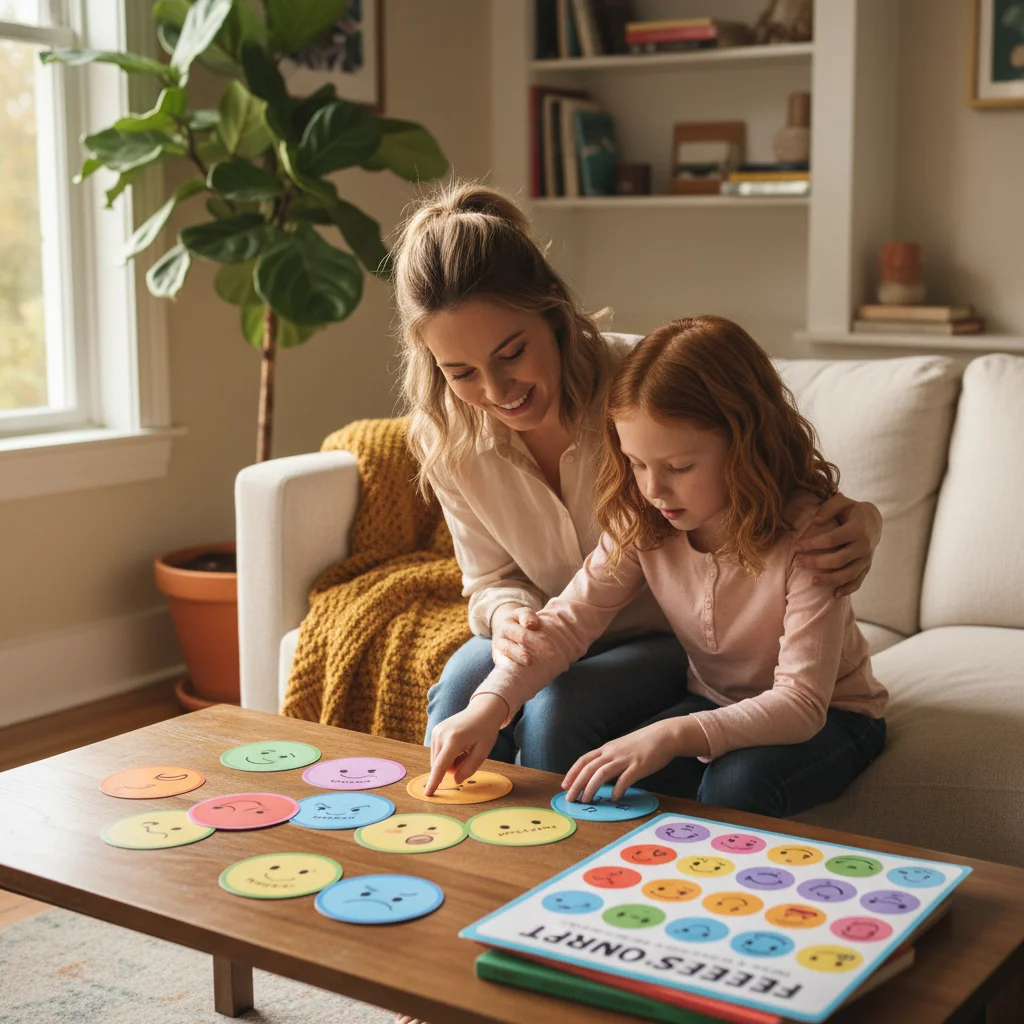
I was completely blindsided when my daughter Lily smiled sweetly at me, then launched her backpack across the room.
Her facial expression said "I'm fine, Mom." Her behavior screamed something entirely different. For months, I thought she was being manipulative—happy one second, explosive the next.
Then I learned about alexithymia, and everything clicked into place. This isn't about manipulation. It's about ADHD kids struggling to read their own internal emotional state—and their faces not matching what's happening inside.
The Day I Realized Her Happy Face Meant She Was Overwhelmed
It was a Tuesday afternoon pickup. Lily bounced out of school with her usual bright smile, chattering about her day. Twenty minutes later, she was sobbing uncontrollably because I suggested we stop for groceries.
The pattern was always the same: normal face, normal conversation, then complete emotional collapse over something minor. I kept wondering if she was just "holding it together" at school and falling apart at home.
Turns out, I was half right. She was holding it together—but not because she was being strong. She literally couldn't identify the stress building up inside her body until it exploded outward.
Her brain wasn't connecting her internal emotional state to conscious awareness—or to her facial expressions.
What Alexithymia Looks Like in ADHD Kids (And Why We Miss It)
Alexithymia means "no words for emotions"—but it's deeper than vocabulary. It's the brain's inability to recognize and process internal emotional signals before they become overwhelming.
Research suggests up to 60% of people with ADHD also have alexithymia. That means your child might experience intense emotions but struggle to identify them until they're already in crisis mode.
Here's what makes it so hard to spot: their face genuinely doesn't reflect their internal state. They're not faking it or hiding emotions—they truly don't recognize what's building up inside.
This connects directly to what I learned about ADHD not being bad behavior, but brain chemistry. When we understand the neurological basis, the seemingly confusing behavior patterns start making perfect sense.
The Brain Science Behind Emotion-Expression Disconnect in ADHD
The emotional disconnect happens because ADHD affects the brain's interoception system—your ability to sense internal body signals like heartbeat, muscle tension, and stress hormones.
Most neurotypical kids feel their heart racing and think "I'm getting upset." ADHD kids often miss those early warning signals entirely. By the time they realize something's wrong, they're already in full meltdown mode.
This involves multiple neurotransmitter pathways. The serotonin system helps regulate mood awareness and emotional processing. GABA helps the brain stay calm enough to recognize subtle internal changes. When these systems are imbalanced, emotional recognition becomes nearly impossible.
It's similar to the afternoon hyperactivity I wrote about in why ADHD kids turn into different people at night—the brain chemistry shifts throughout the day, making emotional regulation even more challenging.
How Serotonin Deficiency Affects Emotional Awareness
Serotonin doesn't just regulate mood—it helps the brain process and categorize emotional information. When serotonin levels are low (common in ADHD), kids struggle with emotional granularity.
Instead of recognizing "I feel frustrated because this homework is confusing," they might only register "something feels bad" right before they slam their pencil down and storm off.
The facial expression disconnect happens because the brain pathways that generate conscious emotional awareness are different from the ones that control facial muscle responses. They can literally feel fine on the outside while chaos builds internally.
5 Signs Your ADHD Child Struggles to Read Their Own Emotions
- Sudden emotional explosions that seem to come from nowhere, even during pleasant activities
- Difficulty answering "How are you feeling?" with anything beyond "good," "bad," or "I don't know"
- Physical symptoms before emotional awareness—stomachaches, headaches, or fatigue before they recognize they're upset
- Mismatched expressions—smiling while frustrated, looking calm while internally overwhelmed
- All-or-nothing emotional responses—either completely fine or completely dysregulated, with no middle ground
If these sound familiar, you're dealing with alexithymia on top of ADHD. The good news? Once you understand what's happening, you can start helping your child build emotional awareness skills.
Teaching Emotional Vocabulary When Words Feel Impossible
Traditional "feelings charts" don't work for alexithymic kids because they can't connect the internal sensation to the external word. Instead, we need to work backward from body sensations.
Start with body mapping: "Where in your body do you notice something changing?" Help them identify tight shoulders, clenched jaw, or butterfly stomach before trying to name the emotion.
Use intensity scales instead of emotion words initially. "On a scale of 1-10, how much energy is your body feeling right now?" This bypasses the need to identify specific emotions while building awareness.
Create regular check-in rituals—not just when they're upset. "Body scan time: What do you notice in your shoulders? Your stomach? Your breathing?" Make it routine, like brushing teeth.
This approach works particularly well alongside strategies for managing hyperactivity at dinner time, since both require building body awareness and self-regulation skills.
Supporting All Four Pathways for Emotional Clarity
Emotional regulation in ADHD involves four key neurotransmitter pathways: dopamine (motivation and reward processing), serotonin (mood and emotional awareness), GABA (calming and anxiety regulation), and norepinephrine (alertness and executive function).
Most single-ingredient approaches only target one pathway. As I discovered when researching why magnesium alone won't fix meltdowns, addressing only GABA or only serotonin leaves the other systems still struggling.
Research on saffron, particularly a 2019 clinical trial published in the Journal of Child and Adolescent Psychopharmacology, showed that this spice naturally supports all four pathways simultaneously. The study found saffron comparable in effectiveness to methylphenidate for ADHD symptoms, but with additional benefits for emotional regulation.
Supporting multiple pathways makes sense when you understand that emotional awareness requires the brain to be calm enough to notice subtle signals (GABA), motivated to pay attention to internal states (dopamine), able to process emotional information clearly (serotonin), and alert enough to act on that information (norepinephrine).
What Changed When We Started 'Feeling Checks' Instead of 'Behavior Checks'
Instead of asking "Why did you throw your backpack?" I started asking "What was your body telling you before you threw your backpack?"
The shift was remarkable. Lily began noticing patterns: tight chest before math homework, restless legs before meltdowns, warm face when overwhelmed by noise.
We created a simple system: morning body check, after-school body check, and bedtime body check. No judgment, just curious observation of internal sensations.
Within weeks, she started catching overwhelm earlier: "Mom, my chest feels tight. I think I need a break before homework." The explosive outbursts became much less frequent because she could identify emotional buildup before it reached crisis level.
This connects to what I learned about why punishment doesn't work for ADHD kids. When children can't recognize their emotional state building up, traditional consequences feel random and unfair. Teaching body awareness gives them the tools they actually need.
The goal isn't perfect emotional control—it's helping your child develop the internal awareness to advocate for their own needs before reaching overwhelm.
Your child's emotional outbursts aren't manipulation—they're communication. Once you understand the alexithymia piece of ADHD, you can start building the emotional awareness skills they need to thrive.
Parent Training — Limited Spots
Want a Step-by-Step Plan for Your ADHD Child?
The Unbreakable ADHD program gives parents a complete framework for managing meltdowns, building routines, and connecting with their ADHD child. 9 video modules by licensed therapist Anneliese.
87 of 100 spots taken · 9 video modules · $9.99 trial
START YOUR $9.99 TRIAL →Is your ADHD child struggling with emotional regulation that doesn't match their outward expression?
Take our free assessment to understand which brain pathways might need support and get personalized strategies for your family's specific situation.
TAKE THE FREE ASSESSMENT →

