
If your ADHD child is falling apart right now — bigger meltdowns, worse focus, more defiance, more tears — I want you to hear this first: you did not cause this. And you are not the only one white-knuckling through the final weeks of school.
Every May, I'd brace myself. Oliver would start April holding it together, and then somewhere around the third week of May, it was like someone pulled a plug. Homework refusals. Meltdowns over socks. Teacher emails I dreaded opening. I used to think I was doing something wrong. I wasn't. And neither are you.
What's actually happening has a name. I call it the end-of-year crash — and once you understand what's driving it neurologically, the whole thing starts to make sense.
Why the last two weeks are the hardest (and why nobody warns you)
Here's the thing about ADHD kids: they spend the entire school year doing something neurologically exhausting. Every single day, they are white-knuckling their way through demands that their brain isn't naturally wired to meet — sitting still, waiting their turn, filtering distractions, managing transitions, regulating emotions in a room full of other kids.
They don't show you how hard that is. They hold it together at school. And then they bring it all home to you.
By May, they have been doing this for nine months. Their coping reserves — which were never deep to begin with — are basically empty. And then, just as they're running on fumes, the school calendar throws everything at them at once: field trips, assemblies, awards ceremonies, disrupted routines, end-of-year parties, graduation rehearsals, schedule changes every single week.
It's not a behavioral problem. It's brain chemistry — and it's completely predictable once you know what to look for.
What the end-of-year crash actually looks like
Most parents expect meltdowns. What catches them off guard is everything else.
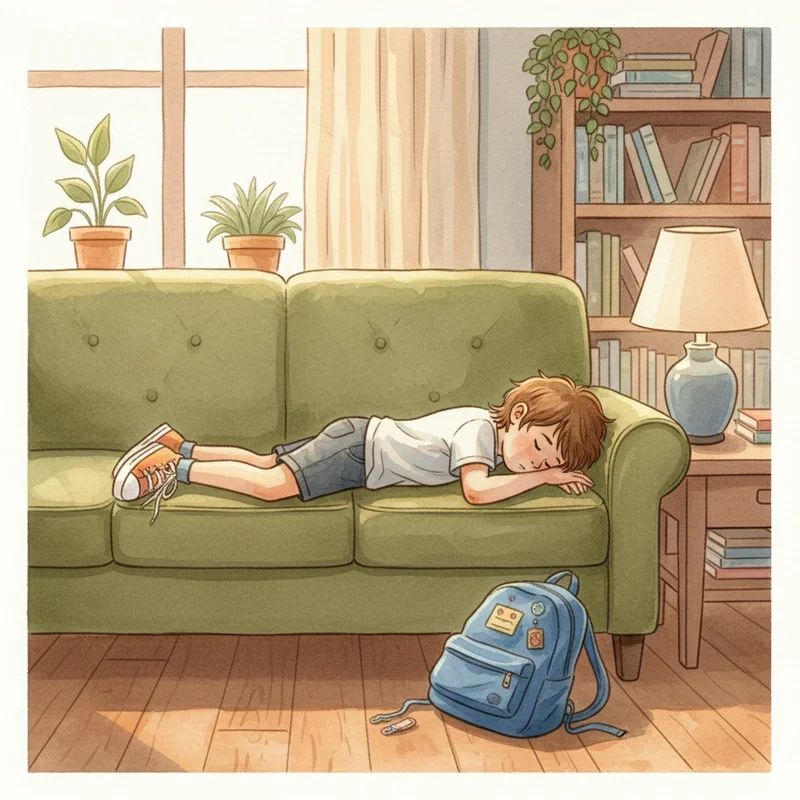
Oliver's crash didn't always look explosive. Sometimes it looked like him staring at his homework for 45 minutes without writing a single word. Sometimes it was crying over a shirt that was "too scratchy" — a shirt he'd worn a dozen times before. Sometimes it was a complete emotional shutdown where he just went silent and wouldn't look at me.
ADHD burnout in kids can wear a lot of disguises. Watch for:
- Sensory sensitivity spiking — sounds, textures, and smells that never bothered them before are suddenly unbearable
- Regression to younger behaviors — tantrums, clinginess, baby talk
- Increased lying or avoidance — their executive function is too depleted to handle confrontation
- Complete homework refusal after months of getting it done
- Sleep falling apart when it had been okay
- More physical aggression or property destruction than usual
What all of these have in common: they are signs of a dysregulated nervous system running on empty, not signs of a child choosing to be difficult.
The sensory and routine chaos of May and June
Even in the best years, ADHD kids depend on predictability. Routine isn't just helpful for them — it's neurologically stabilizing. Their brains use the familiar structure of a school day as a kind of external regulation scaffold.
May and June dismantle that scaffold piece by piece.
Field Day. Class parties. The week the specials schedule changes. The substitute teacher for two weeks because their real teacher is doing assessments. Early dismissal for teacher training. The assembly that replaced math. Every single disruption costs them regulation energy they do not have left.
I watched Oliver completely fall apart at his school's Field Day when he was 8. Not because he hated it — he loved Field Day. But it was 90 degrees, there were a hundred kids screaming, lunch was at a weird time, and his teacher wasn't running his usual station. He melted down at the school field day in front of his whole class and was devastated about it for a week.
The sensory load of these events is enormous. And when a child's coping reserves are already depleted, sensory overload hits faster and harder than it would in September.
What to say when the teacher calls (again)
One of the hardest parts of the end-of-year crash is that it often coincides with increased teacher communication — and not the good kind.
If you've been getting regular calls or emails about your child's behavior this spring, you're not alone. When teachers call every week, it can feel like an indictment of your parenting. It isn't. It's a teacher who is also exhausted, managing a classroom of kids who are all dysregulated in the home stretch, and who doesn't have the context you have about what's happening neurologically.
What I found helped: send a brief, proactive email first. Something like: "I wanted to flag that we typically see Oliver's symptoms intensify in the last few weeks of school as he reaches sensory and cognitive exhaustion — this is a pattern we've noticed over several years. We're working on it at home. Would it be helpful to put a few extra supports in place for the next two weeks?"
This does three things: it names the pattern (so it doesn't look like your child suddenly lost it), it positions you as a knowledgeable, engaged parent, and it opens the door to better communication rather than defensive phone calls.
If your child has a 504 or IEP, now is also a good time to request a brief check-in about any accommodations that might help in the final stretch — quieter testing environments, flexible seating, extra transition warnings before schedule changes. You have that right. Know it.
Five things that actually help right now
I'm not going to tell you to "reduce stress" or "keep consistent routines" as if you haven't been trying. Here's what actually moved the needle for us in the final weeks:
- Shrink the after-school ask to almost nothing. This is not the time to enforce homework battles or chore accountability. Their tank is empty. The single most important thing you can do after school is let them decompress completely — restraint collapse is real, and fighting it makes everything worse. Twenty minutes of unstructured quiet before you say a single word.
- Add heavy work before big events. Before field trips, assemblies, or any schedule change, front-load their sensory system with proprioceptive input: carrying a heavy backpack, doing wall push-ups, jumping on a trampoline, carrying groceries. This is one of the most underused regulation tools I know. It genuinely helps.
- Pre-announce every disruption 24 hours out. "Tomorrow is Field Day. Lunch will be at 11:30, not 12:15. You'll be outside all morning." ADHD brains struggle with unexpected change, but they can often handle change they've had time to process. The warning itself is the intervention.
- Lower the homework bar officially. Email the teacher. Tell them your child is hitting end-of-year cognitive exhaustion and ask if incomplete homework can be forgiven for the final two weeks. Most teachers, especially at this point in the year, will say yes. Advocating for your child is not making excuses — it is parenting.
- Protect mornings like they are sacred. The morning routine is the one predictable structure left when everything else is chaos. Guard it. Don't add anything new. Don't introduce a new reward system. Don't try to have important conversations before school. Just get them there.
Parent Training — Limited Spots
When You're Out of Strategies and Running on Empty Too
The end-of-year crash doesn't just hit your child — it hits you. This 9-module course walks you through exactly how to regulate your own nervous system while co-regulating your ADHD child's, with scripts and strategies built for the hardest seasons.
87 of 100 spots taken · 9 video modules · $9.99 trial
START YOUR $9.99 TRIAL →Bridging into summer without losing your mind
The last week of school is not the finish line. For ADHD families, it's actually a transition crisis in slow motion.
The sudden loss of structure that summer brings can be genuinely destabilizing for ADHD kids — even the ones who desperately wanted school to end. Their nervous system is calibrated to a school-day rhythm. When that disappears overnight, behavior often gets worse before it gets better.
The parents I've talked to who navigate this best start building summer structure before the last day of school — not the week after. Even rough anchors help: wake-up time, one morning activity, lunch, free time, one evening routine. A flexible summer schedule doesn't need to be rigid. It just needs to exist.
And for you: give yourself permission to let the final weeks be imperfect. The end-of-year crash is not a failure of your parenting or your child's character. It is the predictable result of a child who has been working incredibly hard all year and has finally run out of runway.
You both made it through another year. That counts for something — even when it doesn't feel like it.
The end-of-year crash is not a behavioral problem. It is a neurological one. And understanding that is the first step to surviving it with your relationship intact.
Is your child's behavior getting worse as summer approaches?
Take our free 2-minute assessment to understand what's happening in your child's brain — and what kind of support they actually need right now.
TAKE THE FREE ASSESSMENT →
