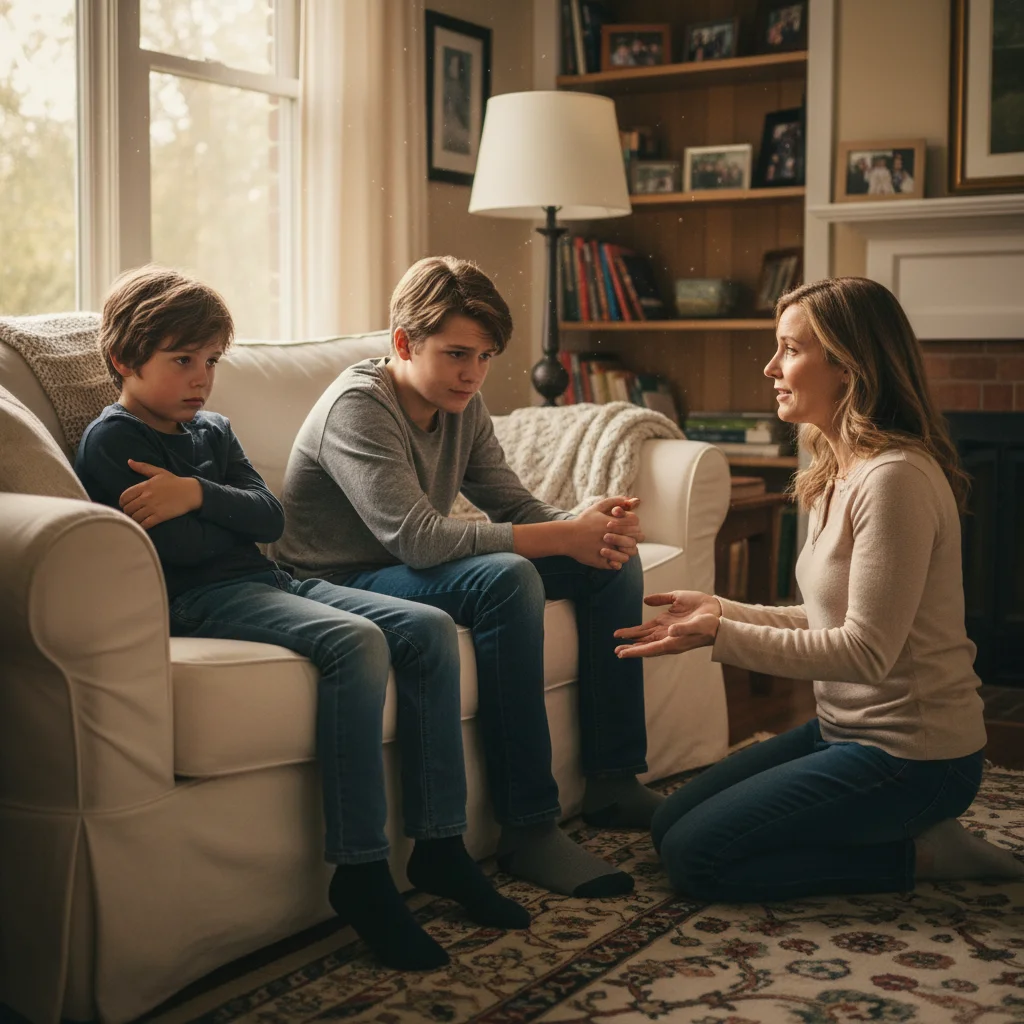
I used to say "Good job, Lily!" and brace for impact.
Before the words were even out of my mouth, Oliver — then 8 — would be across the room, furious. Shoving. Screaming that everything was unfair. That I loved her more. That he was stupid and she was the favorite. And I'd stand there, genuinely confused, heart sinking, wondering what I'd done wrong.
If you're living this, I want to say something clearly: this is not a parenting failure. It's not favoritism gone wrong, it's not that you're praising the wrong child, and it's not that your ADHD child is simply a bad sport. What's happening has a name — and once I understood it, everything changed.
This isn't normal sibling jealousy — it's rejection sensitive dysphoria
Normal sibling jealousy is annoying. Your younger kid sulks because their brother got a bigger piece of cake. They get over it in ten minutes.
What I was watching Oliver experience was something completely different. The intensity was off the charts. He wasn't sulking — he was in genuine pain. Full-body, screaming, sometimes physically aggressive pain. And it would happen even when the praise had nothing to do with him.
Rejection sensitive dysphoria (RSD) is an emotional response pattern common in ADHD brains where perceived criticism, failure, or being "less than" triggers a neurological flood — not a behavioral choice. The key word is perceived. Oliver didn't need to actually be criticized. Watching his sister get praised was enough for his brain to register: she is better, therefore I am not enough.
As I wrote about in why ADHD kids can't handle losing games, the dysphoria isn't manufactured drama — it's a real neurological event. The emotional pain is instant and overwhelming, far out of proportion to what triggered it.
And comparison is its sharpest trigger of all.
Why sibling praise feels like a personal attack on the ADHD brain
When I say "Great reading, Lily!" — Oliver's brain doesn't hear a compliment directed at his sister. It hears an implicit judgment about him.
This is because ADHD brains are already carrying an enormous weight of comparison. By age 8, Oliver had heard hundreds of variations of "why can't you be more like..." — from teachers, from other adults, sometimes accidentally from me. His brain had learned to scan every interaction for evidence of his own inadequacy.
Praise directed at a sibling doesn't land as neutral information. It lands as data: she did the thing I can't do. She got the approval I don't get. I am behind, again.
The explosion that follows isn't a tantrum about wanting attention. It's the aftermath of a shame flood. As I've explained in what actually happens during an ADHD shame spiral, the brain goes into a kind of emergency mode — and that mode looks a lot like rage from the outside.
This is also deeply connected to the rejection sensitivity that wrecks ADHD friendships. The same raw nerve. The same instant flood. Just a different trigger.
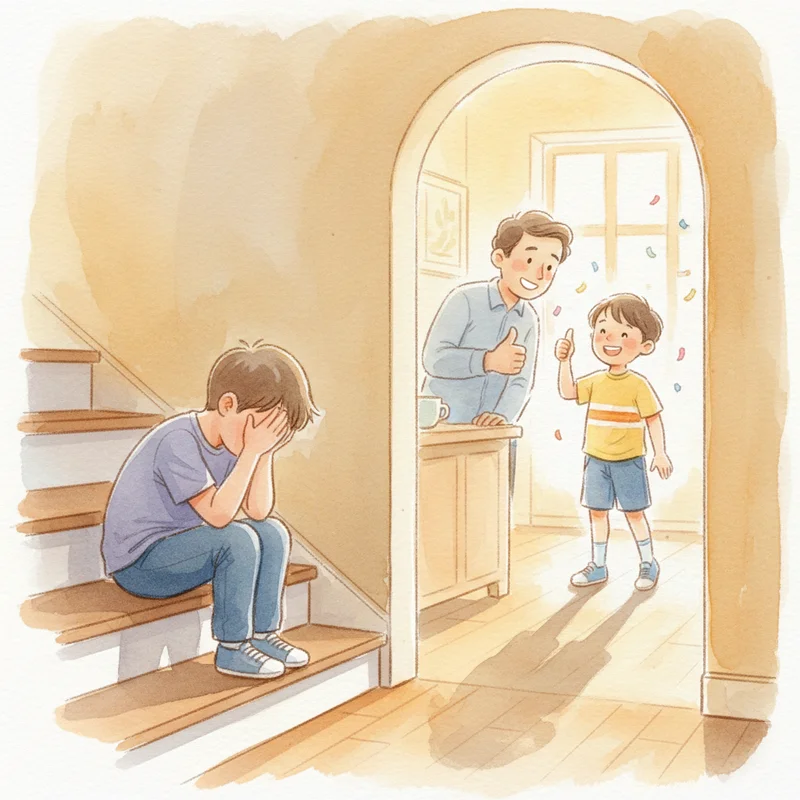
The shame spiral nobody sees — what your child feels after the explosion
Here's the part that broke my heart when I finally understood it.
After Oliver would explode, he'd disappear to his room. I'd assume he was still angry. He wasn't. He was drowning in shame about what he'd just done.
Kids with RSD often describe the aftermath as feeling like they're the worst person alive. They know the reaction was too big. They can't explain why it happened. They feel genuinely terrible about the hurt they caused — and that shame makes the next explosion more likely, not less, because their baseline stress level never fully resets.
Punishing the explosion without addressing the shame spiral underneath is one of the most common traps parents fall into. The behavior looks defiant. It's actually despair.
I started checking in with Oliver about 20 minutes after an episode — not to debrief or lecture, but just to sit with him. Quiet. No agenda. That small shift in how I showed up after the storm made him feel less alone in it.
What I stopped saying to my neurotypical child — and what I do instead
I had to completely rethink how I praised Lily when Oliver was in earshot.
I didn't stop praising her — that would be unfair to her, and honestly impossible. But I changed the structure of my praise in two specific ways.
First, I stopped comparative framing entirely. "You finished your homework so quickly" became just "you finished your homework." I removed any language that, even accidentally, implied a standard Oliver wasn't meeting.
Second, I started anchoring praise to effort and process, not outcome. "I noticed how hard you worked on that" doesn't trigger Oliver the way "you got a perfect score" does — because effort isn't something he perceives himself as losing at.
For Oliver, I learned to praise privately whenever possible. Same words, same warmth — just not in the moment when his sibling had just received something. Timing matters enormously for RSD brains.
I also started making a point of narrating Oliver's specific strengths in moments that had nothing to do with Lily. Not as a corrective to an explosion — just as ordinary, daily truth-telling. "You are really good at building things." Full stop. No comparison. No qualifier.
If your child's RSD is also driving sibling physical aggression, this piece on ADHD physical aggression toward siblings covers the de-escalation strategies that helped us most.
And for the broader sibling dynamic, this piece on the daily ADHD sibling fight cycle is the one I wish I'd read two years earlier.
When to bring in a therapist — and what actually helps
If the explosions are happening daily, if your neurotypical child is starting to withdraw or show signs of anxiety, or if you feel like you're managing a minefield at all times — that's the signal to bring in outside support.
What helped us most wasn't traditional talk therapy for Oliver alone. It was family therapy with a therapist who understood RSD specifically — someone who could work with all three of us on communication patterns, not just Oliver's behavior in isolation.
Look for a therapist who uses DBT (Dialectical Behavior Therapy) or works specifically with emotional dysregulation in ADHD. The goal isn't to eliminate Oliver's feelings. It's to give him a longer fuse between the feeling and the explosion — and to give our whole family a shared language for what's happening.
It's also worth reading about why ADHD kids can't handle being wrong, because the same emotional circuitry drives both patterns — and understanding the root makes the strategies click faster.
We're not done figuring this out. Oliver still struggles. Some weeks are harder than others. But we no longer live in a house where everyone holds their breath when I say "good job." That, for us, was everything.
Parent Training — Limited Spots
When Praise Becomes a Trigger: Understanding & Managing ADHD Emotional Dysregulation at Home
Learn the RSD communication strategies, sibling dynamics tools, and family de-escalation scripts that help ADHD families stop walking on eggshells — in 9 video modules you can watch at your own pace.
87 of 100 spots taken · 9 video modules · $9.99 trial
START YOUR $9.99 TRIAL →Is rejection sensitivity driving your child's meltdowns?
The free 2-minute assessment helps identify which emotional regulation patterns are most affecting your child — so you know where to focus first.
TAKE THE FREE ASSESSMENT →