
Oliver was eight years old, reading at a fourth-grade level, doing double-digit addition in his head — and completely unable to tie his own shoes.
Every morning was the same ritual. He'd sit on the hallway floor, loop the laces once, and then freeze. His hands would start shaking slightly. His face would go red. And within sixty seconds we'd be late, he'd be screaming, and I'd be kneeling down to do it for him — again — wondering what I was doing wrong as his mother.
This is not a parenting failure. I want you to hear that first. If your ADHD child is struggling with buttons, scissors, handwriting, or tying shoes while somehow passing every academic test — their brain is working exactly the way ADHD brains work. The problem isn't you. And it isn't laziness. There's a real neurological explanation, and once I understood it, everything changed.
Why ADHD and fine motor delays so often travel together
Here's what our developmental pediatrician explained to me at Oliver's evaluation — and what I wish someone had told me three years earlier.
ADHD affects the prefrontal cortex, the part of the brain responsible for sequencing, timing, and coordinating multi-step physical actions. Tying a shoe isn't just a physical skill. It's a six-step executive function task disguised as a motor task.
Loop, cross, tuck, pull, loop again, tighten. In sequence. With both hands doing different things simultaneously. While also remembering which step comes next. While also filtering out the sensation of the carpet under his knees and the sound of his sister's TV down the hall.
For a brain that already struggles with executive function and working memory, that's not a simple task. It's an enormous cognitive load.
Research shows that between 30–50% of children with ADHD have some degree of developmental coordination disorder — meaning their motor planning and fine motor execution genuinely lag behind their peers. This isn't about effort. It's about neural wiring.
And it shows up in ways most parents never connect to ADHD.
The daily tasks nobody told me were related
Once I started looking, I saw it everywhere.
Oliver couldn't button his school uniform shirt without help until he was almost nine. His handwriting was illegible even though he could dictate perfect paragraphs. He'd avoid any craft project involving scissors. He'd get frustrated and give up on Lego sets rated for kids three years younger than him.
His teachers described him as "careless" and "rushing." But he wasn't rushing. He was avoiding. When something requires a motor skill your brain hasn't wired yet, you find a hundred creative ways not to do it.
I also noticed the emotional component. The rejection sensitivity that makes ADHD so hard meant that every failed attempt at shoelaces wasn't just frustrating — it was proof, in Oliver's mind, that he was broken. He started saying "I'm stupid" when he couldn't do things his younger classmates could do. That broke my heart in a way the meltdowns never did.
What our OT evaluation actually showed us — and what moved the needle at home
I'd been a pediatric OT before Oliver was born, which meant I had just enough knowledge to be simultaneously more informed than most parents and more stubborn about asking for help. I kept thinking I could figure this out myself.
Finally, when Oliver was seven and a half, I called in a favor from a former colleague and got him a proper fine motor evaluation. The results were humbling.
He scored in the 12th percentile for in-hand manipulation — the ability to move small objects within your hand without using the other hand. This is what you use to button shirts, manage a pencil, and yes, tie shoes. His bilateral coordination (using both hands together) was similarly delayed.
The OT gave us a home program. Here's what actually worked:
- Theraputty and playdough daily. Ten minutes while watching TV. No pressure, no performance. Just squeezing, rolling, hiding small beads inside and digging them out. It felt like play. It was building the exact muscles he needed.
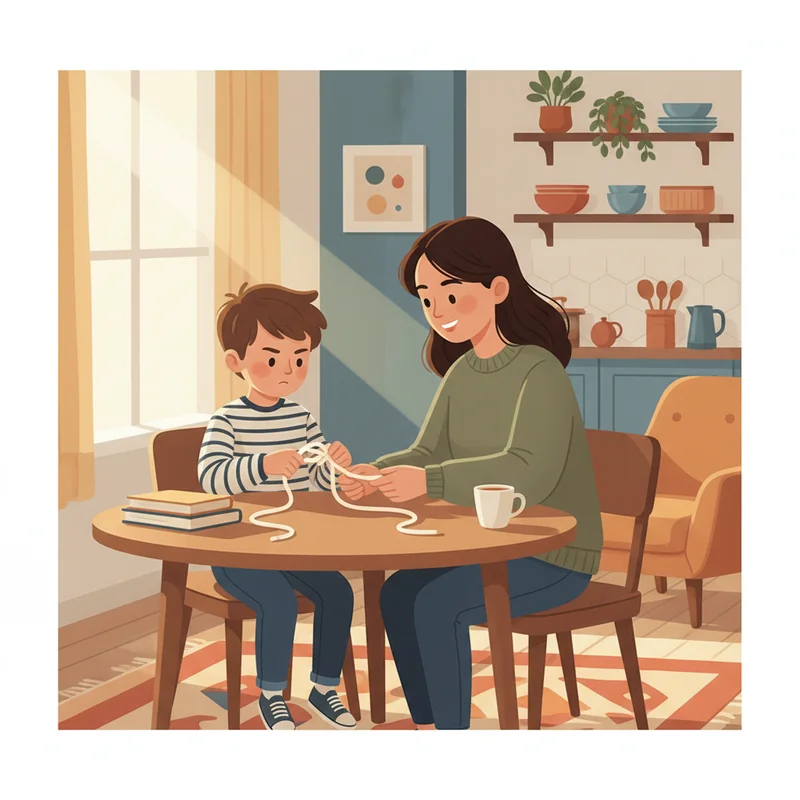
- The "bunny ears" method for shoelaces. Not the traditional loop-swoop-pull. Two loops first — one in each hand — then crossing them. It reduced the working memory load significantly because both hands do the same motion.
- Lacing cards before shoes. We practiced on a big wooden lacing card for two weeks before we ever touched a shoe. Slower hands, bigger movements, lower stakes.
- Handwriting — pencil grip first. We switched to a triangular grip pencil and did finger warm-ups (spider push-ups, finger taps) before any writing. His teacher noticed a difference within a month.
What didn't work: drilling the same skill repeatedly when he was already frustrated. The ADHD brain under stress shuts down rather than pushes through. Forcing more attempts when he was dysregulated made it worse every time.
How I stopped turning every skill into a battle
The biggest shift wasn't a technique. It was a mindset.
I stopped treating fine motor practice as remediation — as fixing something broken — and started treating it as just another way we played together. I stopped timing him. I stopped comparing him to his peers. I stopped making shoe-tying the hill we died on every single morning.
For three months, Oliver wore slip-on shoes to school. That's it. Problem solved. His self-esteem stopped taking a daily hit at 7:45 AM, which meant he arrived at school regulated instead of already in survival mode.
We practiced tying on weekends, when there was no time pressure, with a thick rope on a doorknob, like a game. Not every day. Not with a timer. Just when he was in a good mood and willing.
He tied his own shoes for the first time three weeks before his ninth birthday. He ran into the living room and made me watch him do it four times in a row.
"Mom. Did you see that? I did it."
I cried in the kitchen afterward. Not because it took so long. Because of how proud he was. That look on his face was worth every frustrated morning that came before it.
When to ask for an OT referral and what to say
If your child is school-age and struggling with two or more of the following, it's worth requesting an OT evaluation — either through the school (free, via a 504 plan or IEP process) or privately:
- Can't button or zip independently by age 6
- Handwriting significantly below grade level despite effort
- Avoids drawing, crafts, or building activities
- Can't use scissors with control by age 6
- Unable to tie shoes by age 7-8
- Drops small objects frequently, struggles with utensils
When you call the pediatrician, say this: "My child has ADHD and I'm concerned about possible developmental coordination issues affecting their daily self-care and school performance. I'd like a referral for a fine motor OT evaluation." That framing gets taken seriously. "My kid can't tie his shoes" sometimes doesn't.
If the school pushes back on providing services, know your child's legal rights. Fine motor delays that affect academic performance — including handwriting — qualify for school-based OT support in most districts.
And if you're already navigating this alongside sensory issues or a possible dual diagnosis, this piece on the ADHD/autism overlap might also be worth reading. Fine motor delays are even more common when both are present.
The fine motor gap is real. It's neurological. And it is absolutely something you can support — without turning every morning into a war zone, and without waiting until your child has spent years feeling broken over something that was never their fault.
Parent Training — Limited Spots
Stop Fighting the Same Battles Every Morning
If fine motor struggles are just one piece of a bigger daily chaos puzzle, this 9-module course walks you through the exact strategies that help ADHD kids build independence — without the meltdowns.
87 of 100 spots taken · 9 video modules · $9.99 trial
START YOUR $9.99 TRIAL →Is your child's ADHD affecting more than just behavior?
Fine motor delays, emotional regulation, focus, and daily meltdowns often share the same root. Take the free 2-minute assessment to understand what's driving your child's specific struggles.
TAKE THE FREE ASSESSMENT →

