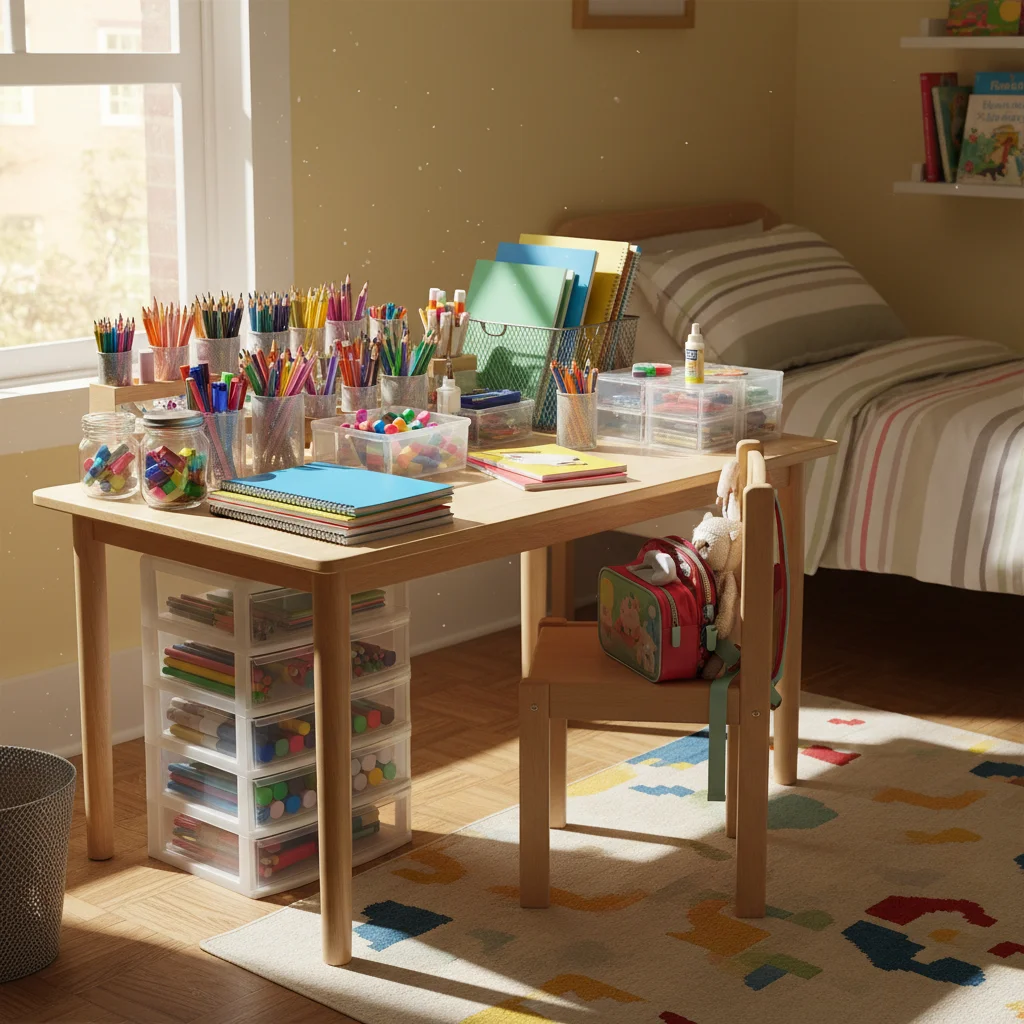
I found 47 pencils under my daughter's bed. Not broken ones. Not chewed ones. Perfectly good, unsharpened pencils lined up like tiny soldiers in a shoebox.
The paper clips came next. Then erasers. Then rubber bands she'd "borrowed" from my office. I thought it was quirky collecting behavior — maybe even a sign she was getting organized for school.
I was wrong. What looked like harmless hoarding was actually my 8-year-old's brain desperately trying to manage something much deeper: a working memory crisis that was sabotaging her success at school and creating chaos we couldn't see.
The "Just In Case" Brain That Never Stops Worrying
Here's what I learned from our pediatric neuropsychologist: ADHD children who hoard school supplies aren't being greedy or disorganized. Their brains are stuck in constant "just in case" mode because their working memory — the mental workspace that helps us plan, prioritize, and remember what we need — isn't functioning properly.
Think about it this way: if you couldn't trust your brain to remember where you put your keys, you'd probably start leaving keys in every room. That's exactly what was happening with Emma's pencils.
The collecting served a neurological function. When your working memory fails you repeatedly — forgetting homework, losing supplies, showing up unprepared — hoarding becomes a survival strategy.
How Working Memory Failure Creates Hoarding Behavior
Working memory involves multiple brain pathways working together. In ADHD children, the dopamine and norepinephrine pathways that support executive function are often dysregulated. This creates a perfect storm:
- Dopamine dysregulation: Can't sustain attention long enough to organize or remember what's needed
- Norepinephrine imbalance: Executive planning falls apart, so the brain defaults to "collect everything"
- GABA pathway stress: Constant anxiety about being unprepared drives the collecting compulsion
The result? A child whose brain says "I can't trust myself to remember what I need, so I'll keep everything I might possibly need."
Emma wasn't being difficult. Her brain was trying to solve a problem I couldn't see. The hoarding was actually adaptive — a coping mechanism for the working memory crisis that looks like defiance.

The School Struggles I Finally Connected
Once I understood the mechanism, everything clicked. The pencil hoarding wasn't separate from her school struggles — it was directly connected:
She'd show up to math class with three pencils because she couldn't trust herself to remember to bring one. She'd stuff her backpack with extra erasers because she'd forgotten them before and felt the shame of being unprepared.
The teachers saw a disorganized, overpacked backpack. What they couldn't see was a working memory system in crisis, desperately trying to compensate.
The worst part? Every time she lost something despite all her "preparing," it reinforced the cycle. Her brain learned: "See? You need to collect even more next time."
The Dopamine Hit That Feeds the Cycle
Here's the part that surprised me most: the collecting itself was providing dopamine hits that her ADHD brain craved. Every time she found a new pencil or paper clip to add to her stash, she got a tiny reward signal.
But it came with a cost. The anxiety of potentially losing something — or not having what she needed — was creating chronic stress that was affecting her sleep, her mood, and her confidence at school.
She was trapped between the dopamine reward of collecting and the anxiety of scarcity. No wonder she couldn't handle changes in plans — her entire system was already maxed out managing this internal crisis.
When Hoarding Becomes the Coping Mechanism for ADHD Chaos
The more I researched, the more I realized Emma's hoarding was serving multiple functions:
- Memory backup system: Physical items she could see and touch replaced the working memory she couldn't trust
- Anxiety management: Having "enough" supplies reduced her fear of being caught unprepared
- Control mechanism: In a world where her brain felt chaotic, her collections felt manageable
- Dopamine source: Finding and organizing supplies provided the reward signals her brain needed
This wasn't about teaching her to be less messy. This was about supporting the underlying brain pathways that weren't functioning properly.
How We Redirected the Collecting Into Organization Systems
Instead of fighting the collecting urge, we worked with it. Here's what actually helped:
We created designated "supply stations" in three locations: her room, the kitchen homework spot, and a portable kit for her backpack. This satisfied her need to have supplies available while creating actual organization.
We turned collecting into a system. Every Sunday, we'd inventory her supplies together. She got the dopamine hit of organizing and counting, but within a structure that actually supported her school success.
We addressed the working memory directly. Instead of just managing the hoarding, we looked at natural support for the brain pathways that weren't functioning properly — the same pathways that research shows can be supported through specific nutritional approaches.
The change wasn't immediate, but within about six weeks, her anxiety around supplies decreased significantly. She still likes having backups, but she's not panicking about pencils anymore.
Warning Signs Other Parents Should Watch For
If your child is showing these signs, it might be working memory struggles disguised as collecting behavior:
- Hoarding school supplies "just in case"
- Extreme anxiety when they can't find a specific item
- Backpack stuffed beyond capacity with duplicates
- Collecting random office supplies, craft materials, or small objects
- Difficulty letting go of "useful" items even when they have plenty
- Meltdowns when you try to organize their collections
The key insight? This isn't bad behavior — it's brain chemistry trying to solve a problem. When we address the underlying working memory and executive function challenges, the hoarding behavior often resolves naturally.
Your child isn't being difficult or greedy. Their brain is doing exactly what it needs to do to cope with a system that isn't working properly. And once you understand that, you can actually help.
Parent Training — Limited Spots
Want a Step-by-Step Plan for Your ADHD Child?
The Unbreakable ADHD program gives parents a complete framework for managing meltdowns, building routines, and connecting with their ADHD child. 9 video modules by licensed therapist Anneliese.
87 of 100 spots taken · 9 video modules · $9.99 trial
START YOUR $9.99 TRIAL →Is your child's collecting behavior actually a sign of ADHD executive function struggles?
Take our free assessment to understand what's really happening in your child's brain — and discover natural approaches that support the pathways behind working memory and organization.
TAKE THE FREE ASSESSMENT →

