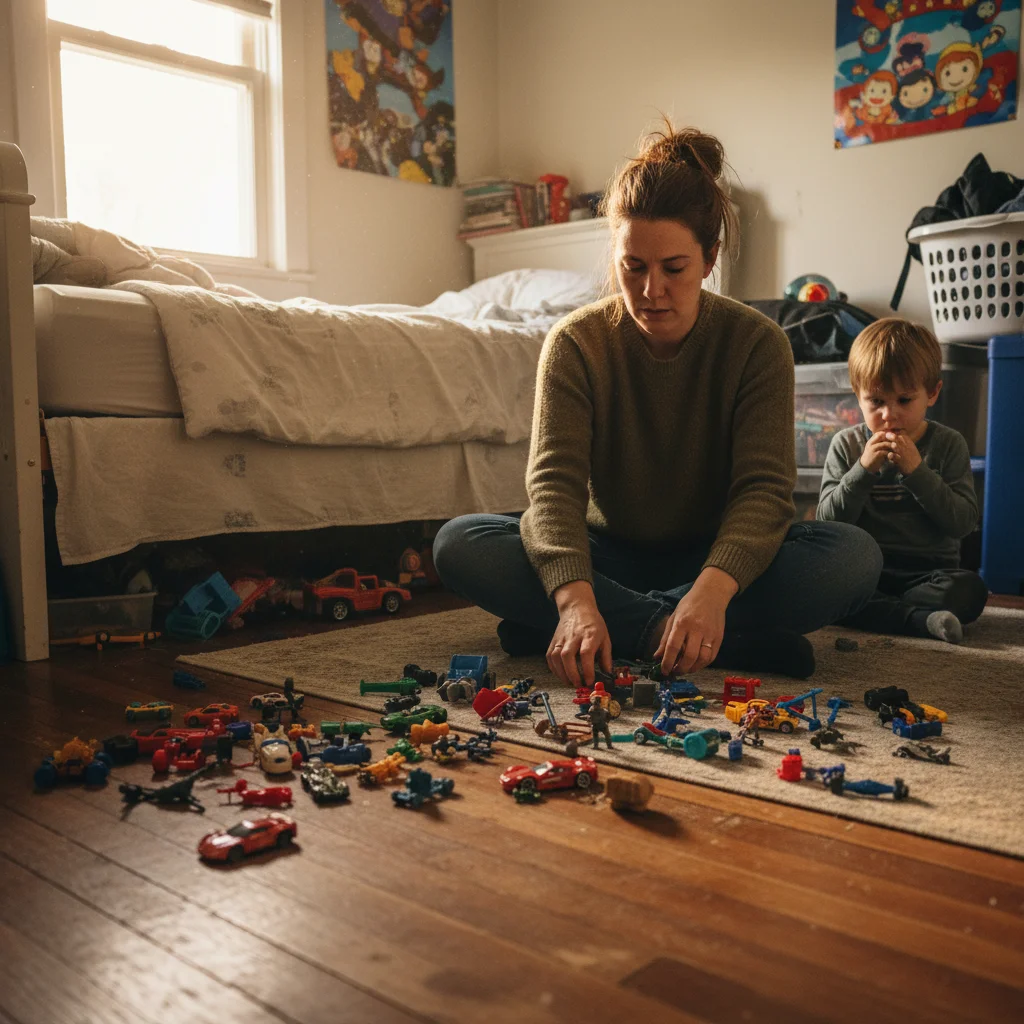
I found 47 toy cars under my son's bed. Not scattered mess — carefully arranged in precise lines, hidden from view, accumulating for months.
At first, I thought it was just typical 8-year-old messiness. But this wasn't disorganization. This was systematic collecting with emotional attachment that I'd never seen before.
What I didn't realize was that I was looking at one of the clearest warning signs of executive function breakdown in ADHD kids. And I almost missed it completely.
When 'Messiness' Becomes Something More
For weeks, I'd been finding random toys in weird places — Legos in his backpack, action figures stuffed in coat pockets, small cars rolled under the couch. I kept telling him to put things back where they belonged.
Then I decided to help him "organize" his room.
Under his bed, I found an entire civilization. Not just the 47 cars, but also 23 Pokemon cards, 15 bouncy balls, 8 fidget toys, and a collection of "special rocks" from our driveway. All arranged with careful intention.
When I asked him about it, he got defensive in a way that surprised me. These weren't just toys — they were his security system.
"I need them close to me at night. They make me feel safe."
The Brain Science Behind ADHD Hoarding Behaviors
This behavior clicked into place when I learned about working memory deficits in ADHD kids. His brain wasn't just being "messy" — it was trying to solve a neurological problem.
ADHD brains struggle with what researchers call "object permanence for emotional regulation." When something important leaves their immediate environment, the anxiety spike can be intense. The collecting behavior is actually their nervous system trying to create predictability and control.
The dopamine pathway that should help with organization and letting go gets overwhelmed. Instead of "I can put this away and find it later," their brain says "I need this close to me or I'll lose it forever."
It's not about the toys themselves. It's about the emotional regulation those objects provide when everything else feels chaotic.

How This Shows Up Differently Than Regular Kid Messiness
I started paying closer attention to the pattern. Regular kid messiness is random — toys left wherever they played last. This was different:
- Systematic collection — Same types of objects gathered intentionally
- Hidden locations — Under beds, in closets, behind furniture
- Emotional attachment — Distress when asked to move or organize the items
- Expansion over time — Collections growing larger, spreading to new hiding spots
- Secretive behavior — Not wanting others to see or touch the collections
This isn't the same as hyperfocus on video games or food hoarding behaviors. It's specifically about using physical objects as external emotional regulation tools.
What Actually Helped (Without Shame or Punishment)
The breakthrough came when I stopped trying to fix the "messiness" and started supporting the underlying need for security and control.
First, I gave him designated spaces for his collections. We got clear containers for under his bed so he could still see everything, but it was contained. This honored his need while creating some organization.
Second, I helped him understand what his brain was doing. We talked about how ADHD brains sometimes need extra security, and that wasn't wrong or bad — it was just how his nervous system worked.
But the biggest shift came when we started supporting his brain chemistry directly. Research-backed nutritional support helped strengthen the same pathways that medication targets — particularly the dopamine and serotonin systems that affect both organization and emotional regulation.
Within about 6 weeks, I noticed him starting to let go of items on his own. Not because I asked him to, but because his brain felt secure enough to release the tight control.
Parent Training — Limited Spots
Want a Step-by-Step Plan for Your ADHD Child?
The Unbreakable ADHD program gives parents a complete framework for managing meltdowns, building routines, and connecting with their ADHD child. 9 video modules by licensed therapist Anneliese.
87 of 100 spots taken · 9 video modules · $9.99 trial
START YOUR $9.99 TRIAL →Is your child showing signs of executive function struggles?
Hoarding behaviors, organization problems, and emotional meltdowns often stem from the same brain chemistry imbalances. Take our free assessment to understand what's happening in your child's brain.
TAKE THE FREE ASSESSMENT →