
The third call this week. "Oliver left his math worksheet on his desk again. And we can't find his reading folder anywhere." My stomach drops because I know what's coming: the assumption that he just doesn't care about his work.
But here's what I've learned after years of watching my son lose everything from homework to lunch money to his own shoes: Your ADHD child isn't losing things because they're careless or irresponsible. They're losing things because their working memory is overwhelmed, and traditional organization systems are designed for brains that work completely differently than theirs.
This isn't your fault as a parent, and it's not your child's fault either. It's a neurological difference that requires neurological solutions.
Why Working Memory Is Like a Leaky Bucket for ADHD Kids
When Oliver was 8, his teacher suggested we try a color-coded folder system. "Green for go-home work, red for turn-in work," she explained. It sounded brilliant.
It lasted exactly three days.
Here's why: ADHD brains have what researchers call working memory deficits. Think of working memory as your brain's sticky notes — it's what holds onto information you need right now. For neurotypical kids, working memory can juggle multiple pieces of information simultaneously.
But for ADHD kids, it's like trying to hold water in a leaky bucket. The moment new information comes in (a friend says hi, a noise in the hallway, remembering they forgot their lunch), the previous information (where does this paper go?) simply vanishes.
This is why your child can remember every detail about their favorite video game but can't remember to put their completed homework in their backpack. One requires long-term memory storage (which works fine in ADHD brains), while the other requires active working memory management (which doesn't).
How Traditional Organization Systems Fail ADHD Brains
Most school organization systems assume kids can hold multiple steps in their head simultaneously:
- Remember which subject this paper is for
- Recall which color folder corresponds to that subject
- Remember where that folder is located
- Execute the physical action of filing it correctly
That's four separate working memory demands for one simple task. No wonder our kids are overwhelmed.
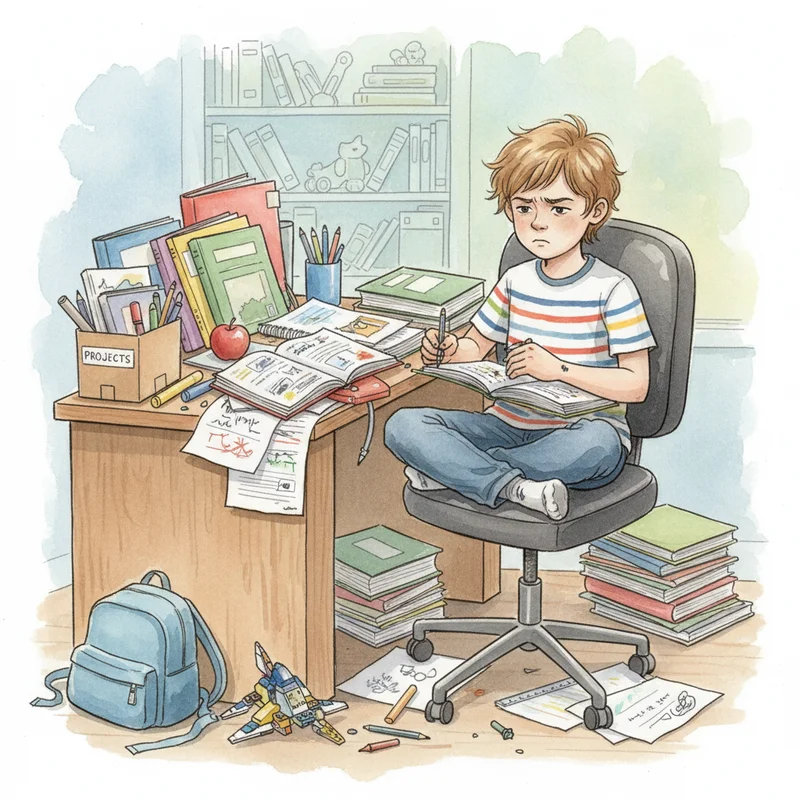
The systems that work for neurotypical kids actually make ADHD kids feel more chaotic and defeated. I watched Oliver try so hard to use his planner, his color-coded folders, his designated homework spot. Each failure reinforced his belief that he was "bad at school stuff."
The Difference Between Forgetting and Not Caring
This distinction changed everything for our family. When Oliver "forgot" his science project at home for the third time, I used to think he didn't care about the consequences. I'd lecture him about responsibility and preparation.
But forgetting due to working memory issues feels completely different from not caring. Oliver would be genuinely upset when he realized what happened. He'd say things like, "I remembered it this morning! I don't know what happened."
What happened was that his brain couldn't maintain that memory thread while processing all the other demands of getting ready for school. It's not a character flaw — it's a neurological reality.
Kids who don't care will make excuses or show indifference. Kids with working memory issues show genuine distress and confusion about their own forgetfulness. My ADHD child remembers everything except what I just asked — this pattern is actually a clear sign of working memory challenges, not defiance.
Building External Memory Systems That Work
The breakthrough came when I stopped trying to fix Oliver's memory and started building external memory systems that worked with his ADHD brain, not against it.
Single-Step Systems: Instead of "put homework in the green folder, then put the green folder in your backpack," we created "dump everything in the backpack pocket." One step. One decision.
Visual Cues at Decision Points: We put a laminated checklist on his backpack: "Homework? Folder? Water bottle?" He sees it every time he packs up.
Immediate Capture: No more "I'll put this away later." Everything goes in its place immediately, or it gets lost. We made this easier by having fewer "places" — one folder for all take-home work, not five different colored ones.
Physical Barriers: We velcroed a mesh pocket to the inside of his backpack. Papers can't fall out, and he can see everything at once.
School Accommodations That Actually Help with Organization
Your child needs accommodations that address working memory overload, not just behavior modification. Here's what I've requested that made a real difference:
Teacher Check-ins: Not "did you put your homework away?" but "let me see you put your homework in your backpack." The teacher witnesses the system working.
Duplicate Materials: One set at home, one at school. This eliminates the "remember to bring it back and forth" working memory demand entirely.
Photo Documentation: Teacher takes a photo of the assignment written on the board. Oliver gets a copy. No more "I forgot to write it down" issues.
Assignment Notebooks: Teacher writes key assignments directly in a designated notebook that never leaves the backpack.
These accommodations acknowledge that your ADHD child has legal rights at school to support their executive functioning differences.
Teaching Your Child to Advocate for Memory Support
I taught Oliver to say: "My brain has trouble holding onto information when there's a lot going on. Can you help me write that down?" This isn't making excuses — it's self-advocacy based on neurological reality.
Kids need to understand that asking for memory support is like asking for glasses when you can't see clearly. It's a tool that helps their brain work better, not a sign of failure.
We practiced phrases he could use: "Can you repeat that?" "Can I write that down?" "Where should this go again?" These became his working memory lifelines.
When to Intervene vs. Let Natural Consequences Teach
This is the hardest balance for parents. Traditional advice says to let natural consequences teach responsibility. But natural consequences don't teach working memory skills — they just reinforce shame.
I intervene when the issue is clearly neurological: forgetting, losing things, not following multi-step directions. These aren't teaching moments about responsibility; they're accommodation moments about brain differences.
I let natural consequences happen when the issue is motivational: choosing not to do homework when reminded, deliberately ignoring systems that work, being careless with other people's belongings.
The difference? Neurological issues come with genuine distress and confusion. Motivational issues come with defensiveness or indifference.
Your ADHD child isn't losing everything because they don't care. They're losing everything because their working memory is constantly overloaded, and traditional organization systems assume a type of brain function they simply don't have.
Once I understood that Oliver's constant losing of papers and folders wasn't a character issue but a working memory issue, everything changed. We stopped fighting about responsibility and started building systems that actually worked with his ADHD brain.
The result? His teacher asked what changed. His desk stayed cleaner. His backpack became functional instead of a black hole. And most importantly, he stopped believing he was "bad at school stuff."
Parent Training — Limited Spots
Stop the Daily Organization Battles
Get the exact systems and scripts I use to help Oliver stay organized without constant reminders and battles. Real solutions for ADHD executive function challenges.
87 of 100 spots taken · 9 video modules · $9.99 trial
START YOUR $9.99 TRIAL →Is your child's forgetfulness actually ADHD working memory issues?
Take our free assessment to understand your child's specific ADHD challenges and get personalized strategies that work with their brain, not against it.
TAKE THE FREE ASSESSMENT →

