
By the third week of 6th grade, Oliver was a different kid.
Not a little different. Unrecognizable. The confident, funny boy who'd thrived in 5th grade — who'd had a good teacher, a solid routine, friends he'd known since kindergarten — was now coming home every afternoon in full meltdown mode, missing assignments he swore he'd turned in, and telling me he hated school for the first time in his life.
I want to say this clearly before anything else: if your ADHD child is falling apart right now in middle school, this is not your fault, and it is not theirs. What's happening has a very specific explanation — and once I understood it, everything changed.
Why middle school is a perfect storm for ADHD brains
Elementary school, for all its imperfections, has one massive structural advantage for kids with ADHD: one teacher who knows your child, watches your child all day, and catches problems before they spiral.
Middle school eliminates that entirely.
Suddenly Oliver had seven teachers. Seven different expectations, seven different systems for turning in work, seven different classroom cultures. He had a locker he had to open between every class — with a combination he kept forgetting — while navigating hallway crowds that would have overwhelmed any sensory-sensitive kid. And the schedule rotated. Different classes on different days. No consistent rhythm to grab onto.
For a brain that struggles with transitions and unpredictability, this is genuinely catastrophic — not dramatic, not an excuse. Catastrophic.
The executive function cliff that hits overnight
In 5th grade, Oliver's teacher sent home a single weekly folder. Assignments were written on the board. Reminders were constant. The structure was built into the classroom.
In 6th grade, he was expected to:
- Track assignments across seven classes in one planner
- Prioritize which homework was due when
- Remember to check his locker between specific classes
- Self-advocate with teachers he'd known for three weeks
- Manage his own time during unstructured passing periods
Every one of those tasks is an executive function demand. And executive function is precisely where ADHD hits hardest.
It wasn't that Oliver suddenly got worse. It was that the environment suddenly demanded skills he'd never been required to use independently before.
"He didn't need more discipline. He needed more scaffolding in a building that had just removed all the scaffolding at once."
The warning signs I missed in September
I thought the first few rough weeks were adjustment. Normal new-school jitters.
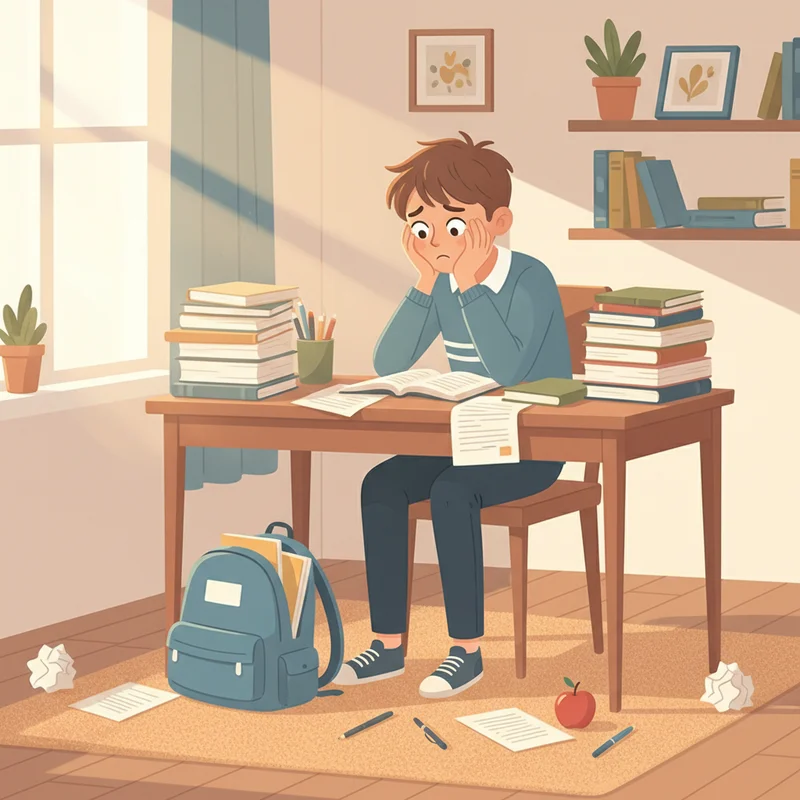
What I didn't recognize: the after-school explosions that were getting worse, not better. The fact that he'd stopped talking about his day entirely. The backpack that was becoming a black hole of crumpled papers. The Sunday night crying that I chalked up to general anxiety.
By October, we had three missing assignments in two classes and a teacher email I was not prepared for.
That was our crisis point. And honestly? I'm glad it happened when it did, because it forced us to act.
The five things we changed that stopped the spiral
1. The class-by-class binder system. We ditched the single planner entirely. Oliver got one binder section per class, color-coded by subject. Every paper went into its section the moment a teacher handed it out — not later, not at home. His OT helped us practice this until it was automatic.
2. A designated check-in teacher. We asked his homeroom teacher if she'd do a 60-second check-in every morning — just a quick "do you know what's due today?" This single adult touchpoint was the closest we could get to replicating what elementary school had provided naturally. She said yes immediately.
3. The 10-minute debrief after school. Not homework. Not "how was your day?" Just ten minutes where Oliver could decompress before I asked him anything. After-school restraint collapse is real — he'd been holding it together all day and needed to fall apart safely before he could function again.
4. We updated his 504 plan. His elementary accommodations hadn't been reviewed in two years and were completely inadequate for middle school demands. If you haven't looked at your child's 504 plan accommodations since the transition, do it now. Ours needed significant revision for the new environment.
5. We eliminated the locker. This sounds small. It was not. Oliver kept a second set of core materials in his homeroom classroom. The locker became for gym and lunch only. Three minutes of stress removed from every single transition.
The email I sent before things got bad — and what I wish I'd sent sooner
After October's crisis, I wrote to his team before the next semester started. Here's the core of what I sent:
"Oliver has ADHD with significant executive function challenges. The shift to multiple teachers and self-managed organization has been harder than anticipated. I'd like to request a brief team meeting to discuss proactive supports — specifically a daily check-in system, updated accommodation language for assignment tracking, and a clear communication channel between home and school. I'm not looking for extra credit or special treatment. I'm looking for the scaffolding that will let him succeed independently."
That framing — "scaffolding for independence" — landed differently than "my son is struggling." It positioned me as a collaborator, not a complaint. Know your child's legal rights at school before you walk into that meeting.
What I tell parents whose kids are about to make this leap
Don't wait for the crisis. Schedule a proactive meeting with the middle school counselor the summer before 6th grade. Ask specifically: who will be Oliver's go-to adult? How does the school communicate with parents about missing work? What does a typical week look like for students managing their own schedules?
And prepare your child for the time blindness challenges that middle school will expose. Passing periods are not forgiving. Practice the locker combination before school starts. Walk the schedule with them before day one.
Also: watch for ADHD burnout. The effort it takes for an ADHD brain to white-knuckle through a chaotic school day is enormous. What looks like defiance at home in October is often a child who has nothing left.
The mindset shift that saved our relationship
The hardest part of Oliver's 6th grade wasn't the missing homework or the teacher emails. It was the moment I realized I'd been treating his failures as choices.
He wasn't choosing to forget his binder. He wasn't choosing to melt down. ADHD isn't bad behavior — it's brain chemistry. And the middle school environment had just tripled the neurological load without adding a single support.
When I shifted from "why won't he just try harder" to "what does he need that he doesn't have," everything changed. Not overnight. But it changed.
Oliver is in 8th grade now. He still uses the binder system. He still has a check-in teacher. He advocates for himself in ways that genuinely surprise me.
The transition crisis didn't break him. It broke our assumptions about what he needed — and that turned out to be the most useful thing that could have happened.
Parent Training — Limited Spots
Is middle school exposing every gap your ADHD child has?
This 9-module course teaches you exactly how to build the external scaffolding your ADHD child's brain needs — at school and at home — so the demands of middle school stop being a crisis.
87 of 100 spots taken · 9 video modules · $9.99 trial
START YOUR $9.99 TRIAL →Is your ADHD child's brain getting the support it needs for this level of demand?
Middle school doesn't just expose organization gaps — it exposes neurological ones. Take the free 2-minute assessment to understand what's actually happening in your child's brain right now.
TAKE THE FREE ASSESSMENT →

