
The moment I understood what I'd done, I was standing in the hallway outside Nora's room, holding a basket of laundry, listening to her call my name for the eleventh time in four minutes.
She wasn't stuck on a hard problem. She just needed to know I was there.
And I had taught her she needed that. Very thoroughly. Over about two years.
If your ADHD child can't do homework without you physically present — and falls apart the second you try to step away — I want you to hear this first: you were trying to help your kid succeed. That's not a failure. That's a parent doing what parents do. What happened next is just a neurological mismatch nobody warned you about.
How I Accidentally Became Her External Brain
When Nora was eight and newly diagnosed, homework was a full-contact sport. She'd stare at the page, her leg bouncing under the table, and within sixty seconds she'd be somewhere else entirely — mentally, sometimes physically.
So I sat with her. Every night. I'd redirect her, repeat the instructions, break tasks into smaller chunks, remind her what came next. It worked. Homework got done. I felt like a good mom.
What I didn't realize was that I wasn't teaching her to focus. I was focusing for her.
Her brain had learned that starting a task, sustaining attention, and knowing what to do next were all my jobs. Every time I sat down beside her, I confirmed that belief. By the time she was nine, she couldn't begin a single worksheet without me in the chair next to her — and if I tried to move even to the adjacent room, she'd panic.
This is what's sometimes called a scaffolding trap: the support that was supposed to be temporary becomes load-bearing. ADHD kids genuinely struggle with executive function — task initiation, working memory, sustained attention — and those are real neurological gaps. But when we fill those gaps ourselves, completely, every single time, we prevent the brain from building any capacity of its own.
Why ADHD Kids Genuinely Need a Co-Regulator — And Why That's a Problem
Here's the part that made me feel better about how we got here, and I want you to sit with it for a second.
ADHD brains have real difficulty self-regulating without an external anchor. That's not a parenting opinion — it's neurophysiology. Research on ADHD consistently shows that many kids regulate better when they're near a calm, present adult. The presence of a co-regulator genuinely changes what their nervous system can do.
So your child isn't being manipulative when they say they can't work without you. They probably really can't — yet. ADHD isn't bad behavior. It's brain chemistry. And for a lot of kids, that brain chemistry makes independent sustained attention genuinely hard without support nearby.
The problem isn't needing support. The problem is when the support never changes form.
Necessary scaffolding looks like: providing structure while the child also participates in their own regulation. Accidental dependency looks like: the adult doing all the regulatory work while the child's nervous system stays in passenger mode.
I was in passenger-mode facilitation for two solid years. And I say that without any self-flagellation, because understanding it was the first step to changing it.
If you've noticed similar patterns around the "extra help" your child gets at school creating learned helplessness, you're seeing the same dynamic from a different angle.
The Fading Technique — What Actually Worked
I want to be honest about the timeline here: this was not a two-week fix. It took us about four months to reach what I'd call genuine independence, and we had setbacks during a week when Nora had a cold, and again after spring break. That's normal. That's what this looks like in real life.
The principle is called scaffolding fading — you reduce support in increments so small that the nervous system barely notices each step. Here's what it looked like in our house:
Phase 1 (Weeks 1–3): Same chair, no talking. I sat next to her but stopped prompting, redirecting, or answering questions unless she'd been stuck for more than three minutes. Just my presence. She hated this at first. I held the line anyway.
Phase 2 (Weeks 4–6): Same room, different seat. I moved to the couch across the room and worked on my own laptop. I could still see her. She could still see me. The anchor held — just at a longer distance.
Phase 3 (Weeks 7–10): Adjacent room, visible through doorway. I worked in the kitchen with the door open. She could hear me. She could walk over if she needed to. I checked in every ten minutes, verbally, without entering the room.
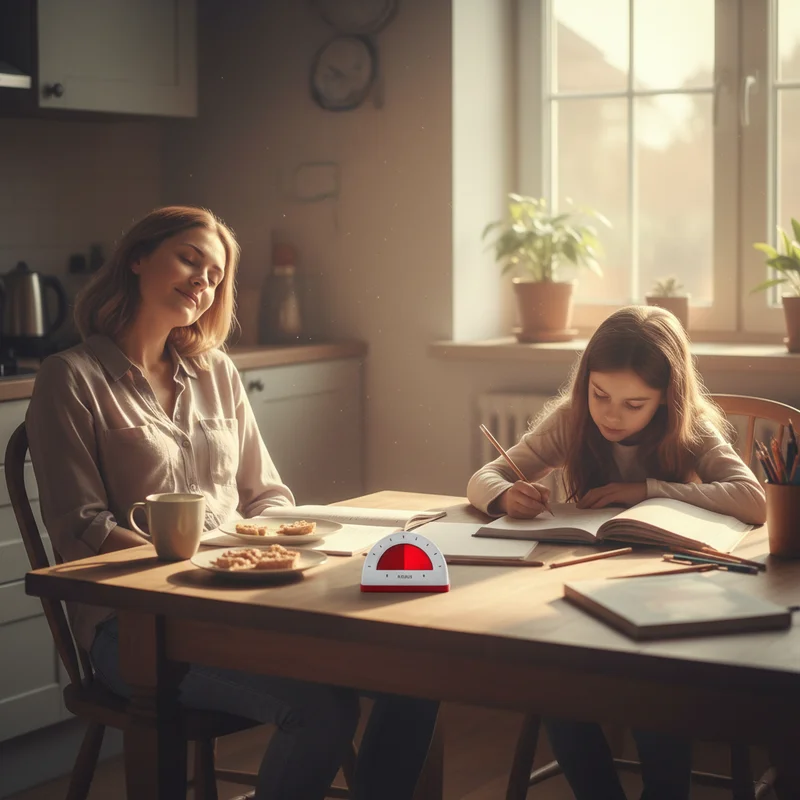
Phase 4 (Weeks 11–16): Different room, timer-based check-ins. I set a visual timer on her desk — the kind that shows remaining time as a red arc. Every fifteen minutes I came to check. She knew I was coming. That predictability mattered enormously.
The key insight: her brain needed to know exactly when contact was coming next. Open-ended separation was terrifying. Scheduled separation was manageable.
This pairs naturally with what to do when your ADHD child shuts down when homework starts — because sometimes what looks like task avoidance is actually dysregulation from anticipating that you'll leave.
What Replaced My Physical Presence
A few tools did real work during this transition:
- A visual timer. Non-negotiable. The red-arc timers cost about $12 and removed the "how much longer?" spiral completely. Visual schedules work for the same reason — ADHD brains need to see time, not just hear it.
- A laminated task strip. Each homework session had a printed checklist of exactly what needed to happen, in order. When I wasn't there to say "next," the strip said it instead.
- A "stuck box." A small notepad where she could write down what she was stuck on instead of calling me. I'd review it at check-in. This stopped the eleven-times-in-four-minutes cycle almost immediately.
- Brown noise through headphones. Steady background sound that helped her nervous system stay regulated without needing a human presence for the same purpose. We tested this one almost by accident and it made a noticeable difference.
I also want to mention that for Nora, a couple of the ADHD apps I'd reviewed actually helped with task initiation — the starting problem — once I wasn't there to manually launch her into each assignment.
The other thing that changed things significantly: her medication adjustment that year. If you're navigating the gap between what medication covers and what it doesn't, this piece on why parents add natural support alongside medication is worth reading.
How to Tell If Your Child Needs More Scaffolding or Less
Not every ADHD child is ready to fade support at the same point, and I want to be clear that some kids need adult presence for longer than others. This isn't a moral judgment. It's a developmental question.
Signs your child may be ready for less scaffolding:
- They complete tasks independently when they're highly motivated (proves the capacity exists)
- They can articulate what they're stuck on, rather than just panicking
- The anxiety about your absence is greater than the actual difficulty of the work
- They've started self-correcting during tasks without prompting
Signs they still need significant support:
- Even with you present, they can't sustain attention for more than 2–3 minutes
- They're unable to identify what step comes next in any task
- They become dysregulated (not just frustrated) when you step back even slightly
- Working memory issues are severe enough that they forget the task mid-sentence
If you're in the second category, fading might need to wait until you've addressed the underlying regulation first. The 3-step meltdown reset is a better starting point than fading for kids who are still fully dysregulated during homework.
And if homework dependency is combined with broader after-school dysregulation, read about why ADHD kids save their worst behavior for home — because sometimes what looks like homework refusal is actually a regulation crisis that starts at school pickup and hasn't resolved yet.
The goal was never to make Nora not need support. The goal was to help her internalize enough regulation that the support could come from a timer and a task strip instead of from me sitting three inches away.
We're not fully there yet. She still does better with check-ins than complete independence. But she can now sit down, start her work, and manage a full fifteen-minute stretch without me in the room — and that, after two years of sitting next to her every single night, felt like something worth writing about.
Parent Training — Limited Spots
Ready to Stop Being Your Child's External Brain?
The Unbreakable ADHD course walks you through fading, co-regulation, and building real independence — step by step, with video guidance for each phase.
87 of 100 spots taken · 9 video modules · $9.99 trial
START YOUR $9.99 TRIAL →Is homework dependency only part of what you're managing?
Take the free 2-minute assessment to get a clearer picture of what your child's brain needs most right now — and what's actually driving the dependency.
TAKE THE FREE ASSESSMENT →
