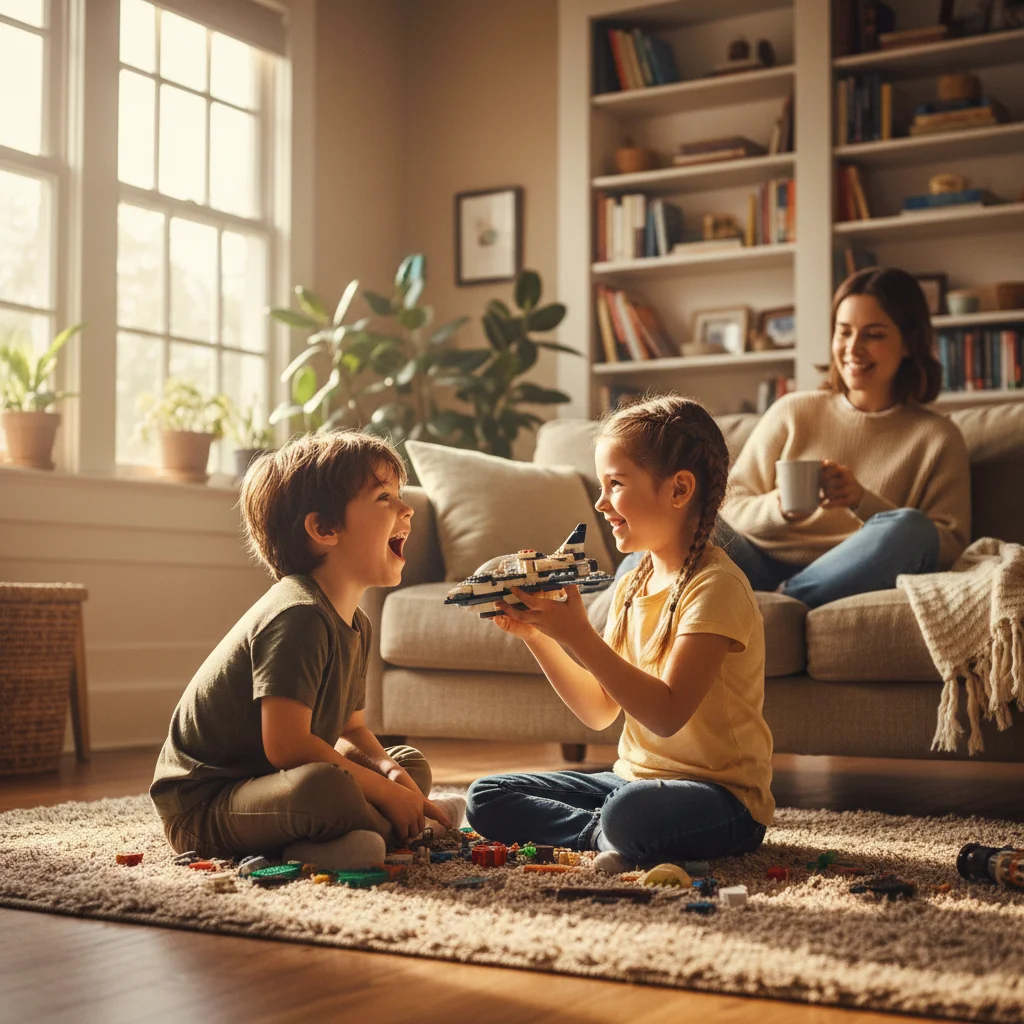
Oliver came home from Jake's house buzzing. Best afternoon ever, he said. Jake was his new best friend. They were going to hang out every single weekend.
We never heard from Jake's mom again.
It happened with Caleb. Then with Ethan. Then with a boy from swim class whose name I've honestly blocked out because the pattern was so painful to watch repeat. Oliver would come home glowing. And then silence.
If this is happening in your house, I need you to hear this first: your child is not broken, and you are not failing them. The ADHD brain processes social situations differently — not worse, just differently — and once I understood what was actually happening at those playdates, I could finally start helping Oliver instead of just hoping for the best.
What's Actually Happening During Playdates That ADHD Parents Don't See
I used to drop Oliver off and assume he was fine. He was excited. He was friendly. He genuinely wanted to connect with these kids.
What I didn't see was everything happening in between.
ADHD kids often struggle to read the subtle signals other children send out — the slight lean-away, the glance toward the door, the slowing-down that means "I need a break." Oliver couldn't catch those cues. So he'd keep going. More ideas, more energy, more suggestions, more touching the other kid's toys. He wasn't being rude. He was being enthusiastic. But to an 8-year-old neurotypical kid, enthusiastic for three straight hours feels exhausting.
This is related to something I write about more in my piece on why ADHD kids struggle to read facial expressions — it's not a character flaw, it's a neurological gap in real-time social processing.
The other child would end the playdate feeling drained. Oliver would end it feeling amazing. Those two experiences don't produce a second invitation.
The Intensity Loop — Why ADHD Kids Overwhelm Peers Without Knowing It
Here's the specific thing that kept tripping Oliver up, and I wish someone had named it for me sooner.
When an ADHD child gets excited — which happens fast and often — their arousal system spikes. They get louder. They get closer. They move faster. They talk more. This sends a social signal of intensity that most neurotypical kids find uncomfortable, even if they can't articulate why.
The neurotypical child starts to withdraw slightly. The ADHD child, sensing the withdrawal (even without consciously recognizing it), often escalates to try to re-engage. More intensity. The other child withdraws more. It's a loop that ends with one kid exhausted and one kid confused about why the vibe changed.
This connects directly to rejection sensitive dysphoria — Oliver didn't just miss the social cues, he also felt any cooling-off acutely, even when he couldn't name it. That made the loop worse.
Understanding this changed everything about how I prepared him.

The Three Mistakes I Was Making That Made Things Worse
Looking back, I was doing three things that consistently set Oliver up to struggle.
Mistake 1: Three-hour open-ended playdates. No structure, no end time agreed in advance, no natural breaks. Three hours of unstructured time with another kid is genuinely hard for an ADHD brain to navigate. The longer it goes, the more dysregulated Oliver got — and the more dysregulated he got, the more intense his behavior became.
Mistake 2: No pre-playdate coaching. I'd just drop him off. I never talked to him beforehand about what to watch for, what to do when he felt excited, or how to read the room. I assumed he'd figure it out. He couldn't. Social skills for ADHD kids don't develop by osmosis — they need explicit coaching, the same way reading does. I go deeper on this in my article about what I learned about ADHD and social skills.
Mistake 3: Hosting with too many kids at once. When we had two or three kids over, Oliver was already overwhelmed before they even took their shoes off. Multiple kids means multiple competing stimuli, multiple bids for attention, multiple opportunities to misread a social cue. It was too much.
How I Started Coaching Oliver Before, During, and After Every Playdate
This is the piece that made the biggest actual difference.
Before every playdate now, Oliver and I do a five-minute check-in. We talk about one thing to watch for ("If Jake seems quiet, give him some space") and one thing to try ("Ask him what he wants to do before suggesting your idea"). Small, concrete, specific. Not a lecture. Just a quick preview.
During longer playdates, I started building in a natural midpoint break. A snack. A bathroom pause. Something that gives both kids a moment to reset without it feeling like an intervention. For Oliver, that break is a regulated moment that prevents the arousal spiral from getting out of hand.
Afterward, we debrief. Not "how did it go?" — that gets a one-word answer. Instead: "What's one thing you noticed about how Jake was feeling?" It teaches him to reflect on the other kid's experience, not just his own. Over time, that reflection starts to happen in real time.
This kind of explicit coaching is something I also recommend for school situations — the same principles that help with social scripts for kids with no friends translate directly to playdate prep.
The Format Changes That Made the Biggest Difference
We made three structural changes that I now consider non-negotiable.
One kid at a time. Full stop. Group playdates are a later milestone. Right now, we focus on building one friendship at a time, deeply. The cognitive load of managing one social relationship is manageable. Three is not.
90 minutes maximum. We end while both kids still want more. This sounds counterintuitive, but it's everything. Ending on a high note is what produces a second invitation. I'd rather Oliver leave Jake's house with Jake saying "already?" than stay until Jake is covertly checking the clock.
Activity-based, not free-play. Legos. A specific video game with turns. Building something together. A defined activity gives the playdate structure and gives Oliver's brain something to anchor to besides the social dynamic itself. It dramatically reduces intensity spirals because both kids are focused on the task, not just each other.
I also started thinking about how we handle birthday parties differently — the same principles apply. Too long, too unstructured, too many kids is always the formula for a bad experience.
What to Say to the Other Parent — and When
This part scared me for a long time. I didn't want to over-explain Oliver or make it weird before the kids even played together.
What I've landed on is simple and it works. When I set up the playdate, I say: "Oliver does best with a shorter visit — we've found 90 minutes is the sweet spot. And he gets along really well when there's something to do together, so if they could start with [activity], that would be great."
I don't mention ADHD unless I know the parent well. I frame it as knowing my kid, which every parent can relate to. Most parents appreciate the specificity — it takes the guesswork out for them too.
If Oliver has already had a rough playdate with a particular kid, I address it directly rather than letting it fade: "I think last time was a bit much — Oliver was really ramped up. Would you be open to trying again with a shorter visit?" Most parents say yes. They weren't writing Oliver off. They just didn't know what to do with what happened.
The Slow Rebuild: From Zero Callbacks to a Real Friendship
We started with Marcus from Oliver's class. One playdate. 90 minutes. Legos. Oliver prepped beforehand. I texted Marcus's mom the next morning to say Oliver had a great time.
She texted back within an hour. Could Oliver come over next Saturday?
That was eight months ago. Marcus and Oliver are genuinely close now. They've had probably fifteen playdates. Marcus has started texting Oliver directly. Oliver talks about him the way kids talk about real friends — inside jokes, shared references, the whole thing.
It didn't happen because Oliver's ADHD went away. It happened because I stopped hoping he'd figure out social navigation on his own and started actually teaching it to him — the same way I'd teach him anything else his brain needs extra scaffolding for.
If your child is also dealing with the social isolation that often comes alongside the social skills gap in ADHD, or you're noticing withdrawal that looks like disinterest but isn't, please know: this is one of the most fixable parts of the ADHD picture. It just requires intentional, explicit support. And none of this is about bad behavior — it's brain chemistry, and it responds to the right scaffolding.
You're not watching your child fail at friendship. You're watching them need a different on-ramp. That's something you can give them.
Parent Training — Limited Spots
Learn the Exact Social Coaching Scripts That Helped Oliver Build His First Real Friendship
The Unbreakable ADHD course includes step-by-step playdate prep scripts, social skills coaching frameworks, and strategies for rebuilding peer connections — designed specifically for ADHD kids who need explicit social scaffolding.
87 of 100 spots taken · 9 video modules · $9.99 trial
START YOUR $9.99 TRIAL →Is your child's ADHD affecting more than just playdates?
Take the free 2-minute assessment to better understand your child's specific ADHD profile — and what kind of support fits their brain best.
TAKE THE FREE ASSESSMENT →
