
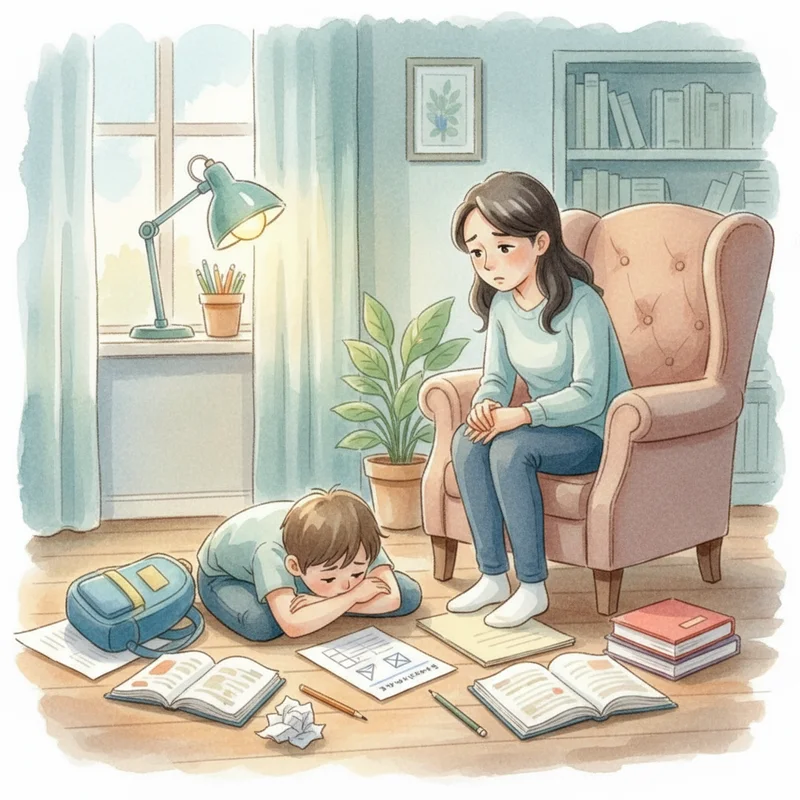
Your child sits at the homework table, staring at the worksheet like it's written in hieroglyphics. When you ask them to start, they slump further into their chair. "I can't," they say. "It's too boring."
Here's what I need you to know: your ADHD child isn't lazy. They're not defiant or unmotivated. Their brain is literally understimulated — and that changes everything about how we help them.
After years of watching my son get labeled as "lazy" by teachers who didn't understand, I dove deep into the neuroscience. What I found changed how I parent completely.
The Dopamine Deficit Behind "Lazy" Behavior
ADHD brains have a fundamental dopamine problem. Dopamine is your brain's reward chemical — it's what makes you feel motivated to start and stick with tasks.
Neurotypical kids get enough dopamine from regular activities. Math worksheet? Their brain says "okay, let's do this." ADHD kids? Their brain says "this doesn't produce enough dopamine to be worth our attention."
This isn't a character flaw. ADHD isn't bad behavior — it's brain chemistry. When dopamine levels are too low, the brain literally cannot generate motivation for low-stimulation activities.
Think of it like this: if neurotypical brains need a dopamine level of "3" to engage with homework, ADHD brains need a level of "7" — but they're only getting a "2."
Understanding Understimulation vs. Overstimulation
Here's where it gets tricky. We've all heard about ADHD kids getting overstimulated — the meltdowns, the sensory overwhelm. But understimulation is just as problematic and way more misunderstood.
Overstimulation looks like: hyperactivity, emotional outbursts, inability to focus because there's too much input.
Understimulation looks like: appearing lazy, zoning out, seeking intense stimulation through "problematic" behaviors, refusing to start tasks.
When my son would sprawl on the floor claiming he "couldn't" do his math, I used to think he was being difficult. Now I understand his brain was desperately seeking the stimulation level it needed to function.
Signs Your Child Is Understimulated (Not Unmotivated)
ADHD understimulation has specific patterns. Your child might:
- Procrastinate on "boring" tasks but hyperfocus on high-interest activities
- Seem to "shut down" when asked to do low-stimulation work
- Constantly seek more intense experiences (louder music, riskier play, bigger reactions)
- Appear tired or "lazy" during routine tasks but energized by novel experiences
- Have trouble with transitions from high-stimulation to low-stimulation activities
The key difference: truly lazy behavior is consistent across all activities. Understimulated ADHD behavior is inconsistent — high energy for some things, zero energy for others.
Why Punishment Makes Understimulation Worse
When we see our kid "refusing" to do homework, our instinct is consequences. Take away screen time. Add extra chores. Make them sit at the table until it's done.
This backfires spectacularly with understimulated ADHD brains.
Punishment lowers dopamine even further. You're asking a brain that's already running on empty to function with even less fuel. Punishment doesn't work for ADHD kids because it attacks the wrong problem.
Instead of motivation, you get shutdown. Instead of compliance, you get meltdowns. Instead of learning, you get shame.
Finding Your Child's Stimulation Sweet Spot
Every ADHD brain has an optimal stimulation level — not too high, not too low. Think Goldilocks zone for dopamine.
For homework, this might mean:
- Background music or white noise
- Fidget toys in their non-dominant hand
- Standing desk or exercise ball chair
- Timer games ("beat the clock")
- Frequent breaks with movement
For my son, we discovered that lying on the floor with music playing was actually his optimal learning position. It looked like he wasn't paying attention, but his test scores improved dramatically.
Natural Ways to Support Dopamine and Motivation
The ADHD brain needs support across multiple neurotransmitter pathways — not just dopamine, but also serotonin for mood regulation, GABA for calming, and norepinephrine for sustained attention.
This is why magnesium alone won't fix your child's meltdowns. Single-ingredient supplements typically only target one pathway, leaving the others imbalanced.
Research suggests that saffron may support all four pathways naturally. A 2019 clinical study found saffron comparable to methylphenidate for ADHD symptoms, but without the appetite suppression or personality changes.
Beyond supplements, you can support dopamine through:
- Protein-rich breakfasts
- Regular exercise (especially before challenging tasks)
- Novel experiences and environments
- Clear, achievable goals with immediate rewards
Creating Challenge Without Overwhelm
The goal isn't to eliminate all challenge — ADHD brains actually need challenge to generate enough dopamine. The goal is right-sized challenge.
Too easy: brain disengages, looks "lazy" Too hard: brain overwhelms, leads to meltdown Just right: brain activates, motivation appears
This is why your child can spend six hours building an elaborate Minecraft world but "can't" write a three-sentence paragraph. The Minecraft provides optimal challenge and immediate dopamine rewards. The paragraph doesn't.
Instead of fighting this, work with it. Can the paragraph be about Minecraft? Can they dictate while walking around? Can you gamify it with a timer and point system?
Remember: you're not enabling laziness. You're accommodating a neurological difference so your child can show their actual capabilities.
Is your child struggling with motivation and focus?
Take our free 2-minute assessment to discover what might be affecting your child's brain chemistry and get personalized recommendations.
TAKE THE FREE ASSESSMENT →

