
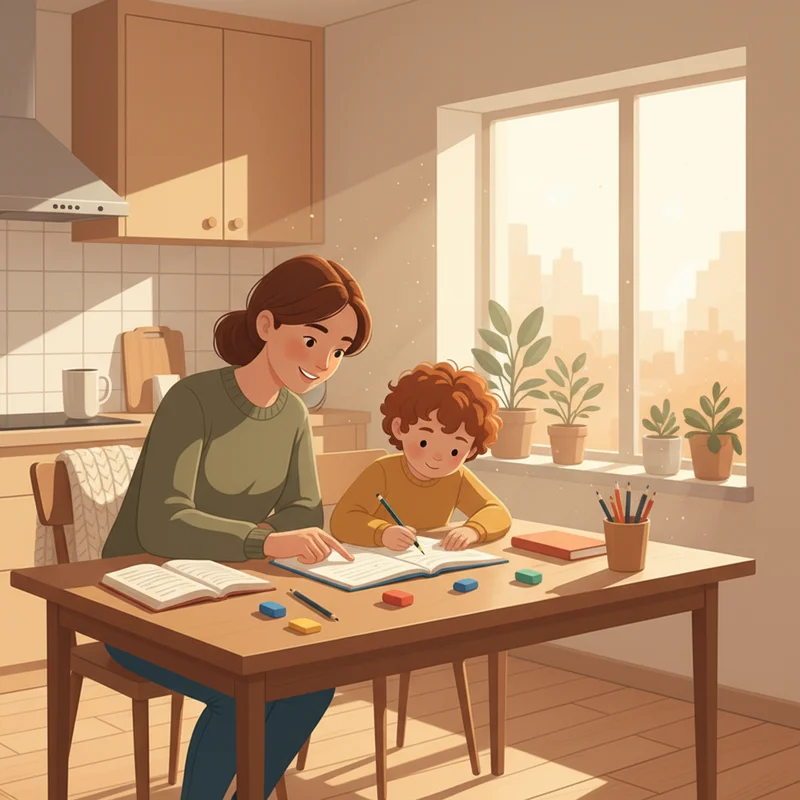
I was trapped at the kitchen table for two hours every night, watching my son Jake stare at a math worksheet he could finish in fifteen minutes. The moment I got up to start dinner? Complete shutdown.
If you're reading this while mentally calculating how many hours you've spent as your child's homework supervisor, you're not alone. ADHD isn't bad behavior — it's brain chemistry, and what looks like defiance is actually a neurological dependency your child's brain has learned to rely on.
Here's what I wish someone had told me earlier: your presence isn't just moral support. You've accidentally become your child's external dopamine system.
The Homework Hostage Situation I Didn't See Coming
It started innocently enough. Jake struggled with focus in second grade, so I sat with him during homework to "help." Within weeks, he couldn't start a single assignment without me there.
I thought I was being a supportive parent. Instead, I was feeding a neurological pattern that was making him less independent, not more.
The ADHD brain craves dopamine — the neurotransmitter that drives motivation and focus. When that system is underdeveloped, children seek external sources of stimulation and reward. Your presence, attention, and encouragement become the dopamine hit their brain needs to engage with boring tasks.
The problem? Their internal motivation system never learns to kick in.
Why ADHD Brains Crave External Dopamine Sources for Mundane Tasks
Think of homework as asking your child's brain to run a marathon without proper fuel. The ADHD brain produces less dopamine naturally, especially for tasks that aren't immediately rewarding or interesting.
When you sit beside them, several things happen:
- Your presence creates social accountability (mild stress = alertness)
- Your encouragement provides immediate positive feedback
- Your attention makes them feel special and important
- The shared experience transforms boring work into social time
All of this floods their system with the dopamine their brain desperately needs. It works — in the short term.
But you're not teaching their brain how to generate that focus independently. You're teaching it to wait for external fuel.
The Difference Between Executive Function Support and Dopamine Dependency
There's a crucial difference between helping your ADHD child with genuine executive function challenges and becoming their external dopamine source. Here's how to tell which one you're dealing with:
Executive function support looks like:
- Helping them break large assignments into smaller chunks
- Setting up organizational systems they can use independently
- Teaching them to use timers and break schedules
- Problem-solving when they get stuck on specific questions
Dopamine dependency looks like:
- They can't start work unless you're physically present
- They stop working the moment you leave the room
- They ask for your help on things they clearly know how to do
- They seem to "forget" how to do tasks they've mastered when alone
Jake hit every single dopamine dependency marker. He'd literally sit staring at a worksheet for twenty minutes until I sat down, then suddenly "remember" how to do multiplication.
How I Accidentally Became My Child's External Brain
The transition happened so gradually I didn't notice. First, I was helping with actual problems. Then I was encouraging him through frustration. Eventually, I was just... there. A human focus pill.
I realized how deep the dependency went when Jake had a substitute teacher who gave the class independent work time. He sat frozen for the entire forty minutes rather than start a worksheet identical to ones he'd done at home.
His brain had learned that homework required my presence to function. Without me, the dopamine system simply didn't engage.
The scary part? This pattern can extend beyond homework into every area where your child needs to self-motivate.
The Gradual Independence Protocol That Actually Worked
Breaking dopamine dependency isn't about cold turkey withdrawal — that just triggers meltdowns that have nothing to do with your parenting. It's about gradually teaching your child's brain to generate its own motivation.
Here's the protocol that worked for us:
Week 1-2: Physical proximity fading
I stayed in the same room but moved progressively further from the table. Kitchen counter, then living room chair, then folding laundry nearby.
Week 3-4: Attention fading
I stayed nearby but started doing my own tasks instead of watching him work. Reading, laptop work, meal prep.
Week 5-6: Check-in system
I'd leave the room but return every 10-15 minutes to check progress and offer specific praise.
Week 7+: Independence building
Jake worked alone but could call me for genuine help (not just dopamine). We celebrated completion together afterward.
The key was maintaining some level of reward and accountability while gradually shifting it from constant to intermittent.
Natural Supplements That Support Internal Motivation Systems
While I was working on the behavioral changes, I also researched ways to support Jake's internal dopamine production naturally. The research on saffron was particularly compelling — studies suggest it may help balance multiple neurotransmitter pathways, including dopamine and serotonin.
A 2019 clinical trial published in the Journal of Child and Adolescent Psychopharmacology found that saffron showed comparable efficacy to methylphenidate in supporting focus and attention in children with ADHD.
What made saffron different from other supplements I'd tried was its multi-pathway approach. Magnesium alone won't fix your child's meltdowns because it primarily affects GABA. Saffron appears to work on dopamine, serotonin, GABA, and norepinephrine — the same four neurotransmitter systems that ADHD medications target.
I noticed Jake seemed less dependent on my presence for motivation about three weeks after adding a high-quality saffron supplement to his routine. Whether that was the behavioral protocol, the supplement, or both working together, I can't say for certain. But the timing coincided with a noticeable shift in his internal drive.
Red Flags That You're Enabling vs. Truly Supporting
It took me months to recognize the difference between helping Jake and handicapping him. Here are the warning signs I wish I'd caught earlier:
You're enabling if:
- Your child's homework time equals your homework time (you're both captive)
- They "forget" skills they've demonstrated multiple times
- They can't attempt anything without you present first
- Other adults (teachers, babysitters) report they seem "lost" without you
- You feel resentful about the time commitment but guilty about pulling back
You're truly supporting if:
- You're teaching skills they can use independently later
- Your help decreases over time as they internalize strategies
- They can attempt tasks alone, even if they need help to finish
- Other caregivers can successfully support them using your strategies
- You feel like you're building their confidence, not their dependency
The hardest part was accepting that my good intentions had created a problem. But once I understood the neurological mechanism, I could address it systematically instead of blaming myself or Jake.
What Homework Independence Looks Like for ADHD Kids
Independence for an ADHD child doesn't look like neurotypical independence. Jake still needs more structure, more frequent breaks, and different organizational systems than his sister.
But now he can:
- Start assignments without me in the room
- Work through frustration for 5-10 minutes before asking for help
- Complete familiar types of problems independently
- Use his timer and break system without prompting
- Ask for specific help ("I don't understand this word problem") rather than general presence
Most importantly, those dreaded teacher calls stopped coming. Jake's classroom independence improved dramatically once his brain learned to self-regulate without an external dopamine source.
The transformation took about eight weeks of consistent protocol following. There were setbacks — especially when he was tired or stressed. But gradually, his internal motivation system strengthened.
If your evenings are consumed by homework supervision and you're wondering how you became your child's external brain, you're not failing. You're dealing with a neurological pattern that can be changed with the right approach and patience.
Parent Training — Limited Spots
Homework Doesn't Have to End in Tears
Get a proven homework and routine framework from licensed therapist Anneliese — 9 video modules covering the daily battles ADHD families face, with strategies that work with the ADHD brain.
87 of 100 spots taken · 9 video modules · $9.99 trial
START YOUR $9.99 TRIAL →Is Your Child's Brain Chemistry Making Independence Harder?
Take our free assessment to discover which neurotransmitter pathways might need support in your child's developing brain.
TAKE THE FREE ASSESSMENT →

