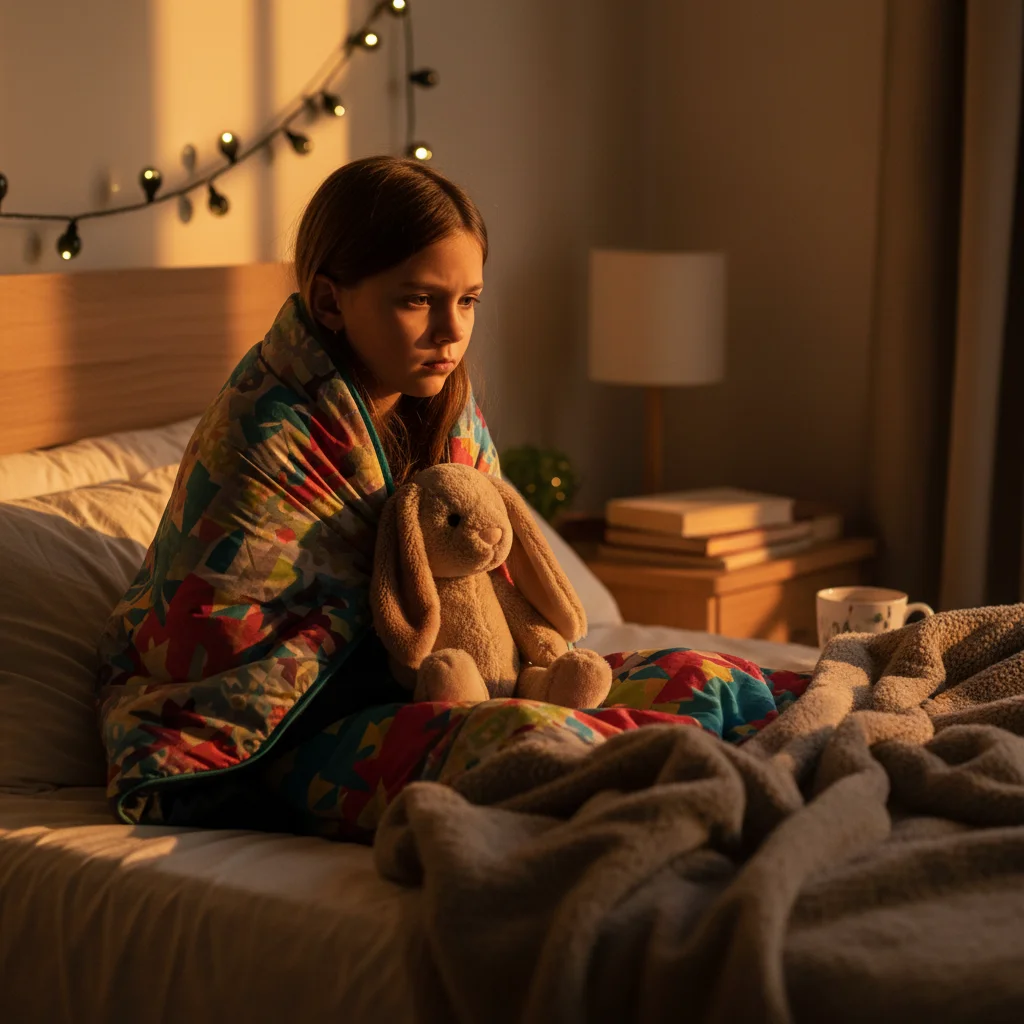
I found it crumpled at the very bottom of her backpack, wedged under a broken crayon and three week-old permission slips. A birthday sleepover invitation — pink and glittery and clearly important — that my daughter Marigold had hidden from me on purpose.
She was nine. And she'd been doing this for two years.
If you're reading this, I want you to hear something first: your child hiding that invitation is not a sign that you've failed her. It's a sign that she's protecting herself — and that she trusts you enough to know you'd push her toward something that feels genuinely terrifying to her nervous system. That's not failure. That's an ADHD brain doing exactly what ADHD brains do.
Why Sleepovers Are Uniquely Terrifying for ADHD Brains
Think about everything a sleepover actually requires. An unfamiliar sensory environment. No established routine. No escape valve. Sleeping in a strange place with sounds and smells and textures that aren't home. Then add the fear — and it is a genuine fear, not shyness — of losing control at night.
For Marigold, nighttime is already the hardest part of her day. Her brain doesn't slow down on command. ADHD brains often turn on hardest right when they should be winding down, and without her weighted blanket, her white noise machine, and the exact sequence of steps we've built over years, she unravels. She knows this about herself. That crumpled invitation was self-protection.
This is also different from general shyness. Marigold wanted to go. She talked about that birthday party for weeks beforehand. The problem wasn't social fear — it was the specific, sensory, regulatory nightmare of nighttime in an unfamiliar place with no exit plan. The line between ADHD and anxiety in kids can be razor thin, and sleepover avoidance often lives right on it.
Once I understood that distinction — "doesn't want to go" versus "can't regulate well enough to go yet" — everything changed.

What We Actually Did: The Three-Stage Exposure Plan
I'm a former OT. I knew exposure therapy worked. I also knew you don't throw a dysregulated kid into the deep end and call it brave. So we built three stages.
Stage one: the half-sleepover. Marigold went to her friend Priya's house for the evening — dinner, movie, all the fun — and I picked her up at 10 PM before anyone fell asleep. She got the experience without the terror of waking up somewhere unfamiliar. We did this twice.
Stage two: the practice run at Grandma's. Grandma's house is familiar-but-not-home. Safe but different. Marigold brought her own pillow, her white noise app, and a small stuffed animal she'd retired but quietly still needed. She stayed the full night. It was bumpy — she called me at midnight — but she did it. That phone call mattered more than the staying.
Stage three: the real sleepover, with an exit plan. Before Marigold went, I called Priya's mom. Not to overshare her diagnosis — I'll get to that — but to establish one simple thing: "If Marigold needs to come home at 2 AM, that's completely okay and I'll come get her no questions asked." Just having that option made Marigold willing to try. She also had a secret signal: if she texted me "rainbow," I'd call with a fake emergency to give her a graceful out.
She never sent the rainbow text.
Scripts That Actually Help — Including the Secret Signal
The scripts I gave Marigold weren't elaborate. Simple sentences she could use when she felt overwhelmed:
- "I need a few minutes to myself — I'll be right back." (Bathroom break as a reset.)
- "Can we turn the lights down a little? Bright lights bother my eyes." (Sensory need, neutrally stated.)
- "I'm going to read for a bit before I sleep — that's just how I fall asleep." (Normalizes her routine needs.)
The text signal — "rainbow" for "come get me, no questions" — gave her a sense of control she didn't have before. ADHD kids who feel out of control escalate fast. Giving her that exit valve is the only reason she was willing to walk in the door.
As for talking to Priya's mom: I kept it simple and honest without disclosing anything Marigold hadn't okayed. "Marigold sometimes has a hard time in new environments at night — nothing dramatic, but she might need a quiet moment. Can I give you my number to text if anything comes up?" Most parents are warmer about this than we expect. Priya's mom texted me at 11 PM to say they were all still up giggling. That text made me cry.
This kind of ADHD social skills work is slow and it's not linear. Marigold has since had two more successful sleepovers and one that ended at midnight with a tearful pickup. That midnight pickup was not a failure. It was data. We adjusted and tried again.
If your child's anxiety is showing up as physical symptoms — stomachaches before events, headaches the morning of — that's worth paying attention to separately. Sometimes the sleepover fear is the visible tip of a bigger regulation iceberg.
And if the social isolation is broader than just sleepovers — if your child genuinely has no friends and you're watching them fall further behind socially — please know that is a documented, neurologically-driven gap, not a character flaw and not your fault.
The Night She Finally Stayed
Marigold came home from Priya's birthday sleepover at 10 AM on a Saturday, smelling like someone else's shampoo and talking so fast I couldn't follow the story.
She'd stayed. She'd regulated herself. She'd used her bathroom-break reset twice and hadn't needed the rainbow text at all.
What that night did for her confidence going into summer was something no amount of coaching from me could have manufactured. She proved to herself that she could do it. That her brain, with the right scaffolding, could handle something that had felt impossible for two years.
The invitation she hid from me last spring? She found it in her drawer a few months later and said, "I wish I'd told you about that one."
Me too, baby. Me too. But we got there.
If you're in the thick of this right now — watching your child miss out, finding crumpled invitations, fielding the "why won't she just come?" questions from other parents — hold on. This is not a parenting problem. It is a brain wiring challenge that can be scaffolded, slowly and with a lot of patience, into something your child can handle.
Start small. Build the exposure in stages. Give her an exit plan she controls. And trust that she wants to get there just as much as you want it for her.
Parent Training — Limited Spots
Learn to Build the Scaffolding Your ADHD Child Actually Needs
If sleepover anxiety is just one piece of a bigger regulation puzzle, this course walks you through the exact frameworks for building your child's confidence and self-regulation — one stage at a time.
87 of 100 spots taken · 9 video modules · $9.99 trial
START YOUR $9.99 TRIAL →Is nighttime anxiety part of a bigger picture for your child?
If your ADHD child struggles with regulation after hours — sleepovers, bedtime meltdowns, overnight anxiety — this free 2-minute assessment can help identify what's driving it.
TAKE THE FREE ASSESSMENT →

