
It started with a spilled drink.
Oliver was eight. He knocked over his cup of apple juice at dinner — the kind of accident that happens in every house, every single week. Before I could even grab a paper towel, he'd slid off his chair, crawled under the table, and curled into a ball.
For two hours, he wouldn't come out.
That wasn't a tantrum. That was something else — something deeper and more painful to watch. And first, I want to be clear: it had nothing to do with your parenting. The shame spiral ADHD kids fall into after mistakes isn't a discipline failure. It's a neurological one.
Why ADHD kids carry shame about mistakes differently
Neurotypical kids make a mistake, feel bad briefly, and move on. Their brains process the emotion, file it, and reset.
ADHD brains don't do that. The emotional centers and the prefrontal cortex — the part that says "this is just a small thing, you're fine" — aren't communicating efficiently. So a spilled drink doesn't register as "minor accident." It registers as confirmation of something they already secretly believe about themselves: I always mess up. I can't do anything right.
This is especially true if your child has been struggling with ADHD perfectionism and fear of mistakes — a pattern I see far more often than people expect.
And there's another piece most parents miss entirely.
The shame spiral starts at school, not at home
By the time Oliver walked through our front door every afternoon, he'd already spent seven hours absorbing corrections. Sit down. Stop fidgeting. You weren't listening. You forgot your folder again.
Most ADHD kids receive somewhere between 20 and 60 corrective interactions per school day. Twenty. To sixty. Every single day.
So when he spilled that juice at 6 PM, it wasn't the first time he'd felt like he failed that day. It was the last straw on top of a mountain that had been building since 8 AM. That's why the worst behavior often happens at home — home is where the dam finally breaks.
If your child's meltdowns seem disproportionate to what actually happened, this is almost always why. The mistake at home just triggered the shame they'd been holding since morning. You can read more about this pattern in my piece on after-school restraint collapse.
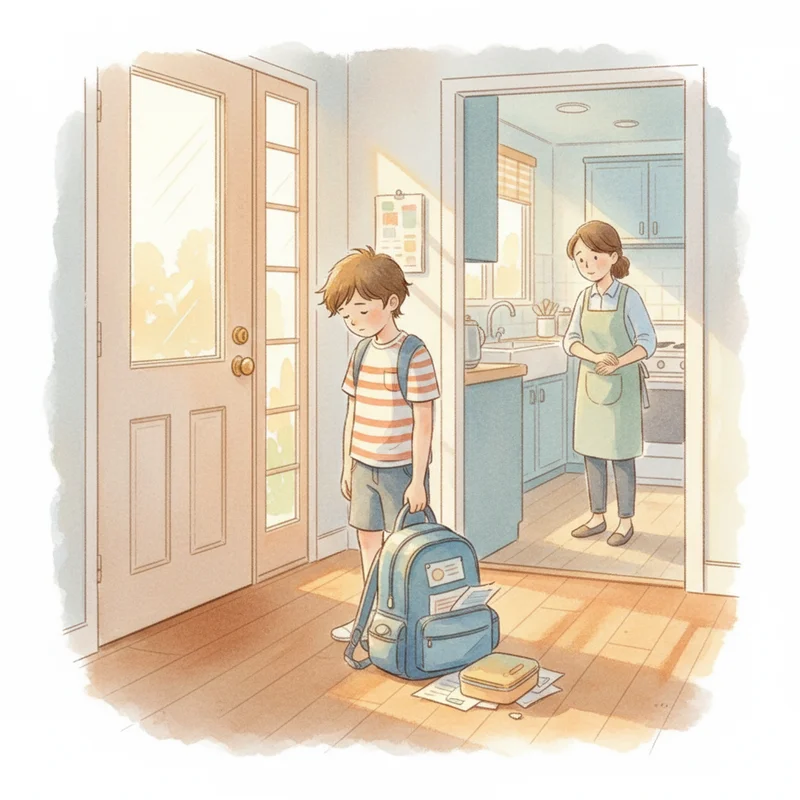
A shame spiral versus a tantrum — and why it matters
I spent months trying to handle Oliver's shutdowns the same way I handled his meltdowns. It made everything worse.
A tantrum is an outward explosion — yelling, throwing, demanding. The child is trying to get something or avoid something. They're activated and loud.
A shame spiral looks like the opposite. Withdrawal. Silence. "I'm stupid." Hiding. Refusing comfort. Sometimes it looks like defiance — he wouldn't come out from under the table — but it's actually collapse.
The critical difference: during a shame spiral, your child is not trying to manipulate you. They genuinely believe something terrible about themselves in that moment. Consequences, lectures, and "you need to calm down" statements don't work here because they confirm what the shame is already telling them. This is closely connected to the self-esteem crisis that builds quietly over time in ADHD kids.
There are also four phrases parents use that accidentally deepen the spiral — and I was guilty of all of them.
- "It's not a big deal." (It feels huge to them. Minimizing it confirms you don't understand.)
- "Why are you acting like this over nothing?" (Now they feel shame about their shame.)
- "You need to apologize." (Impossible to access social skills while emotionally flooded.)
- "Come on, just get up." (Rushing the reset makes it longer, not shorter.)
The co-regulation approach that actually helped
What finally worked for Oliver wasn't a script. It was a posture.
I stopped trying to talk him out of the spiral and started just being near him without demands. I'd sit on the floor close to where he was. Not touching. Not talking. Just present.
After a few minutes I'd say something like: "Everybody spills stuff. Even me. You're not in trouble." Then I'd go back to quiet.
That's it. No processing the feelings. No teaching moment. Just co-regulation — using my calm nervous system to help his dysregulated one settle. This is the same principle behind why I stopped talking during meltdowns and why it changed everything.
The shutdown that used to last two hours started coming down to 20 minutes. Then 10. The spiral didn't disappear, but it got shorter — and that matters enormously for the whole family.
For the longer-term work of rebuilding his sense of safety around mistakes, I also found the framework in this piece on ADHD kids who can't handle being wrong genuinely useful.
Building a "mistakes are data" culture at home
The co-regulation gets you through the crisis. This is what prevents the next one from being as deep.
We started narrating our own mistakes out loud — casually, without drama. "Oops, I burned the toast. Oh well, I'll turn it down next time." "I forgot to reply to that email. I'll do it now." Small, constant modeling that mistakes are just information, not indictments.
We also started a family ritual: at dinner, everyone shares one thing they "messed up and learned from" that day. The rule is it has to be real — parents included. Oliver's face the first time I shared mine was something I won't forget.
For practical, step-by-step accountability strategies that don't shame ADHD kids, this no-punishment responsibility system is the best place to start.
When the shame spiral signals something bigger
If your child's shutdowns are happening daily, lasting over an hour, or including statements like "I wish I wasn't here" or "I want to disappear" — that's beyond a coping strategy fix. That's a sign to loop in their pediatrician or a therapist who specializes in ADHD.
Chronic shame spirals can also be a signal of ADHD burnout — especially in kids who are masking heavily at school. The warning signs are worth knowing.
And if you're getting regular calls from teachers about your child's behavior, that external pressure makes the shame load even heavier. This communication system helped us get on the same team as Oliver's school instead of feeling like we were being reported on.
You're not failing your kid by struggling with this. You're paying attention — and that's the hardest, most important part.
Parent Training — Limited Spots
Turn shutdown moments into connection — before the next one happens
The Unbreakable ADHD course walks you through co-regulation techniques and shame-cycle interruption strategies you can start using this week.
87 of 100 spots taken · 9 video modules · $9.99 trial
START YOUR $9.99 TRIAL →Is daily shame and shutdown a sign of something in your child's brain chemistry?
The free 2-minute assessment helps identify which specific support areas matter most for your child's emotional regulation right now.
TAKE THE FREE ASSESSMENT →

