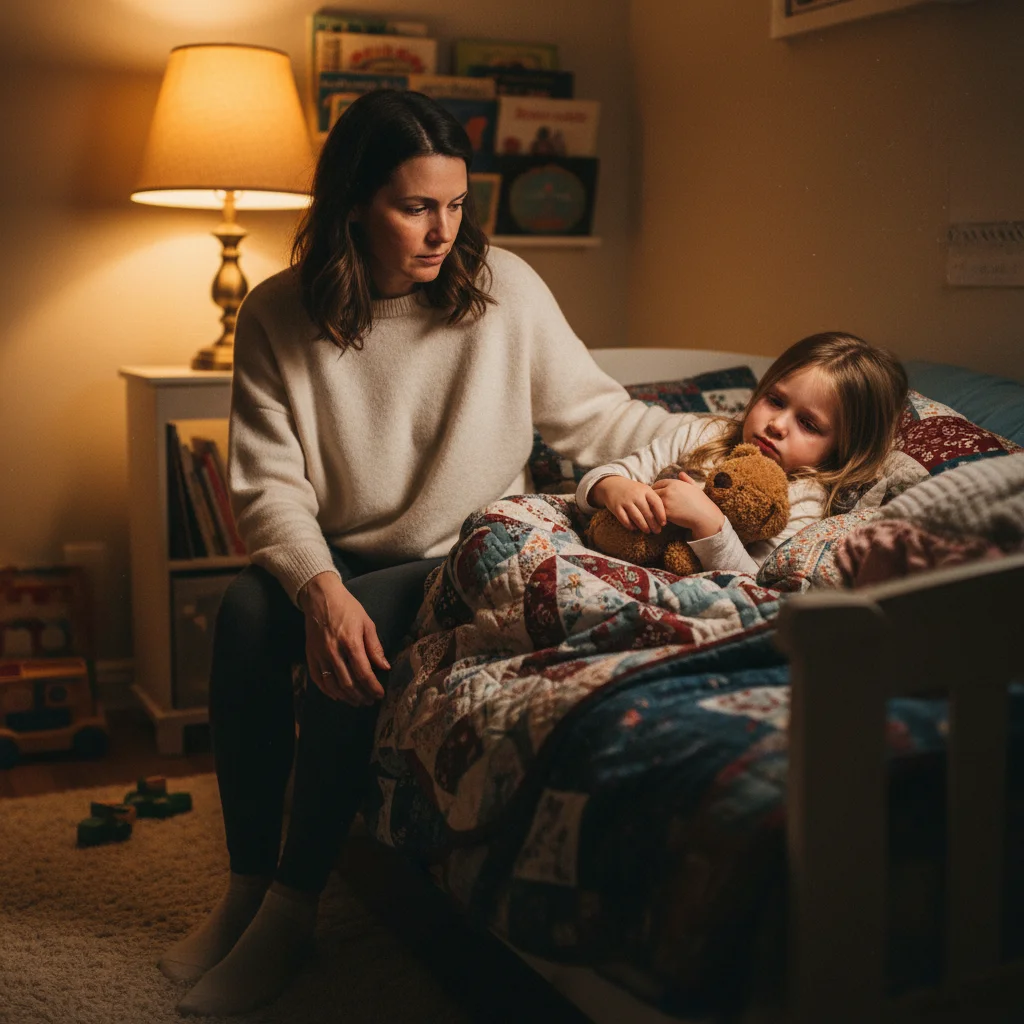
Every Sunday at around 6 PM, my daughter Macie would start to fall apart.
Not meltdown-level falling apart — something quieter and sadder than that. She'd get still. Go to her room. And when I went to check on her, she'd be curled on her bed, crying in a way that broke something in me every single time.
She was eight years old. And she was dreading Monday with her whole body.
I want to say something clearly before anything else: if your child does this, it is not a reflection of your parenting, and it is not your child being dramatic. ADHD anticipatory anxiety is one of the most real, most overlooked symptoms in kids — and it tends to hit hardest on Sunday nights, when the week looms ahead like a wall.
Why ADHD brains experience Sunday dread so much harder
Neurotypical kids feel some version of "Sunday blues." But for an ADHD brain, it's different in scale and in kind.
The ADHD nervous system struggles with what's coming. It can't hold a calm, abstract sense of "Monday will be fine." Instead it replays the hard parts — the transitions, the noise, the moments of embarrassment, the teacher's face when an assignment was late. It feels all of that, right now, at 6 PM Sunday.
This is anticipatory anxiety, and it's closely tangled with ADHD in ways that often get missed. A lot of parents — and a lot of teachers — see the Sunday crying and assume the child is being manipulative or avoidant. They're not. They're genuinely overwhelmed by what their brain is projecting.
Macie couldn't have told me that at eight. But that's exactly what was happening.
What Macie was actually trying to tell me
For the first few months, I handled Sunday nights the wrong way.
I reassured her. Constantly. "It'll be fine, sweetheart. You're going to have a great week." I problem-solved out loud. I asked questions. I tried to logic her out of the feeling.
None of it helped. If anything, the reassurance made the loop worse — she'd ask again, I'd reassure again, and we'd end up forty-five minutes in with both of us exhausted and nothing resolved.
What I eventually learned (partly through my OT background, partly through a lot of trial and error) is that reassurance feeds anxiety. It signals to the brain that there is something to be afraid of — otherwise why would Mom keep saying it's okay?
What Macie needed wasn't reassurance. She needed acknowledgment, and then a pattern that made Monday feel survivable rather than safe. There's a difference.

The specific school triggers we uncovered
Once I stopped flooding her with reassurance and started asking differently, Macie started talking.
Not right away. It took weeks of low-pressure check-ins — not at bedtime (too activated), but on car rides and during snack time — before the real stuff came out.
What she told me, piece by piece:
- She didn't know where to sit at lunch on days when her usual friend was absent.
- Transitions between subjects felt "like everyone else knew what was happening and she didn't."
- Her teacher called on her when her hand wasn't raised, and the fear of that happening again was constant.
- The hallway between second period and PE was loud in a way that "felt like it was inside her head."
None of these were things I could have guessed. None of them showed up in her teacher's weekly notes. To the school, Macie was "doing fine." To Macie, school was a series of unpredictable threats she had to navigate every single day.
This is why the triggers that drive ADHD school distress are so often invisible to adults. They're not the big things. They're the small sensory and social landmines that ADHD kids can't predict and can't explain.
Once I knew what they were, I could actually do something. I emailed her teacher about the cold-calling issue. We talked to the school counselor about the lunch seating. I created a small "landing script" for Macie — a few sentences she could say to herself during loud hallway transitions. Small things. But they were real.
If your child has a 504 or IEP, some of these triggers can become documented accommodations. Our 504 guide walks through exactly how to request those kinds of changes.
What we stopped doing — and what we started instead
Stopping reassurance was the hardest thing. It felt like I was abandoning her.
What we replaced it with was a Sunday reset ritual — about thirty minutes, starting after dinner. Not a "let's prep for the week" boot camp. More like a soft landing pad.
Here's what it looked like for us:
- The bag check. We packed her backpack together on Sunday evening instead of Monday morning. This one thing alone reduced her morning anxiety noticeably — one fewer unknown.
- The week preview. One sentence per day, nothing more. "Monday you have art. Tuesday is the library." Just enough structure for her brain to stop projecting chaos.
- The "one good thing" anchor. She picked one thing she was actually looking forward to each week — even something tiny. We wrote it on a Post-it and put it on her nightstand.
- Movement first. Before any of the above, we'd do fifteen minutes of something physical — a walk, jumping on the trampoline, anything that burned off the physical tension that anxiety creates. There's solid research behind exercise as an anxiety reset for ADHD kids, and we felt it every Sunday.
The crying didn't stop immediately. But within three weeks, it was less frequent. Within six weeks, Sunday nights were just Sunday nights.
When Sunday dread is a signal something bigger is wrong
I want to be clear: the strategies above work when Sunday anxiety is about the normal overwhelm of school life for an ADHD brain.
But sometimes Sunday dread is a signal that something more serious is happening — bullying, a classroom environment that's genuinely harmful, a teacher relationship that's causing real damage, or early signs of ADHD burnout that need more than a routine adjustment.
The red flags I'd watch for:
- Physical symptoms — stomach aches, headaches, nausea — that appear predictably on Sunday evenings or Monday mornings
- Escalating intensity over time rather than staying stable
- Refusal to attend school that becomes a pattern, not an occasional hard morning
- A child who was previously okay at school and suddenly isn't
If you're seeing those signs, the ritual won't be enough. This article on ADHD school refusal walks through how to figure out when to push through and when something in the environment needs to change.
What I wish I'd said to her teacher sooner
This is the thing I think about most.
I waited four months before I told Macie's teacher about the Sunday crying. I was embarrassed. I thought the teacher would see it as my problem to handle at home. I didn't want to seem like "that mom."
When I finally had the conversation — not a complaint, just a "here's what's happening at home and here's what I've learned about her specific triggers" — her teacher was genuinely surprised and genuinely helpful. She stopped cold-calling Macie. She gave her a heads-up before transitions. She started the year knowing to check in on Monday mornings.
None of that would have happened if I'd stayed quiet.
ADHD kids often save their hardest moments for home, which means teachers frequently don't see the full picture. You are not oversharing when you tell a teacher that your child is suffering on Sunday nights. You are giving them information they need to actually help her.
If you don't know how to start that conversation, our weekly teacher communication template gives you a framework that keeps things collaborative instead of confrontational.
Macie is ten now. Sunday nights are mostly fine. Not perfect — she still has weeks where the anxiety creeps back in. But she has language for it now. She knows what to do with it. And so do I.
That didn't come from fixing the ADHD. It came from understanding what she was actually trying to tell me — and finally listening.
Parent Training — Limited Spots
Learn How to Decode What Your ADHD Child Is Really Telling You
If Sunday nights feel like a crisis you don't know how to fix, this course gives you the practical framework to understand your child's anxiety triggers — and the scripts to actually help.
87 of 100 spots taken · 9 video modules · $9.99 trial
START YOUR $9.99 TRIAL →Is school anxiety making your child's ADHD symptoms worse?
Take the free 2-minute assessment to understand what's driving your child's struggles — and what kind of support might actually help.
TAKE THE FREE ASSESSMENT →

