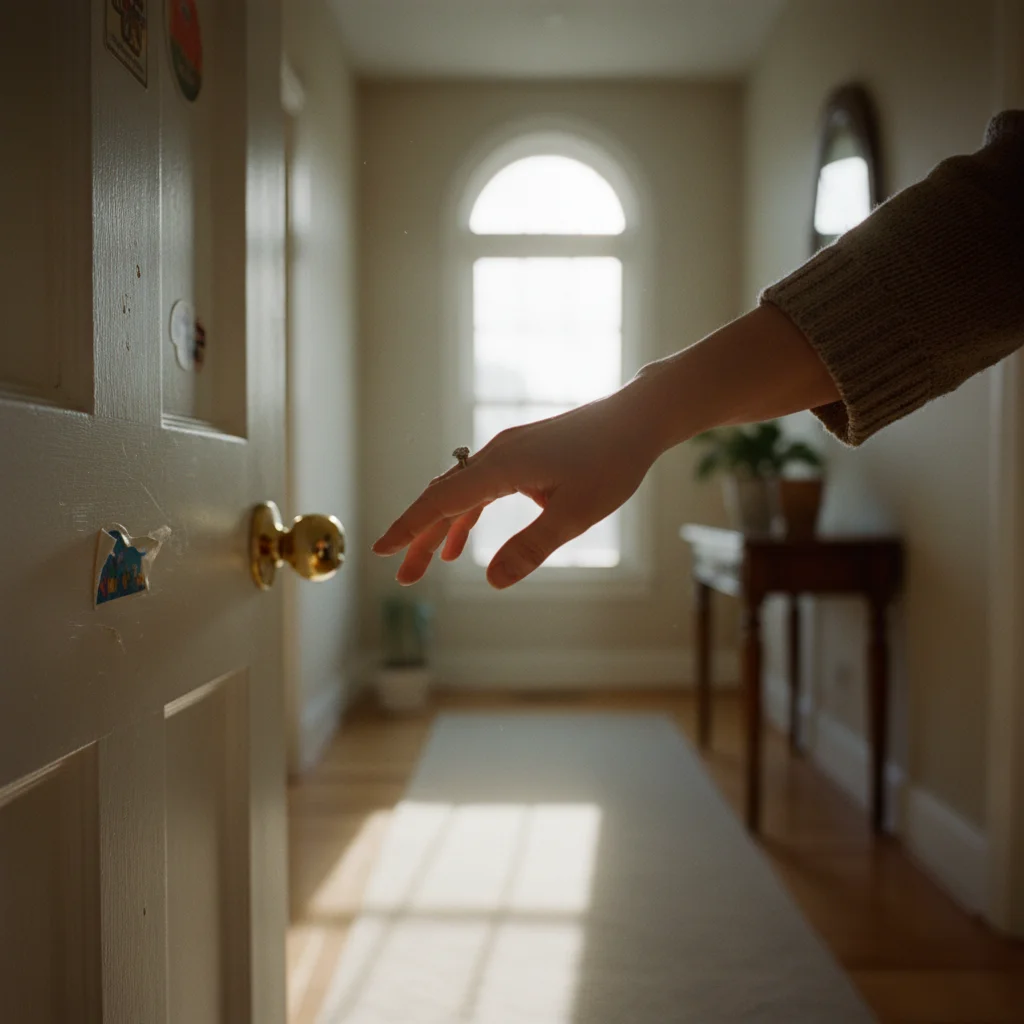
"I need to go check the laundry," I said, heading toward the basement door. Behind me, my 7-year-old son's voice turned razor-sharp: "DON'T LEAVE ME." When I kept walking, he threw his juice box at the wall, then his toy truck, then himself — literally throwing his body on the floor, kicking and screaming like a toddler having a nuclear meltdown.
But here's what I wish I'd understood sooner: this wasn't defiance or manipulation. This was separation anxiety triggering a legitimate neurological crisis in his ADHD brain.
The Violent Outburst That Changed Everything
The breaking point came on a Tuesday afternoon. I told my son I was going upstairs to fold clothes — a five-minute task. He immediately started the familiar escalation: pleading, then demanding, then screaming. When I explained I'd be right back, he picked up a wooden block and hurled it at my face.
It missed by inches. We both froze.
"I hate you!" he sobbed, collapsing into a heap. "Don't leave me alone! My brain gets scared!"
That last sentence — "my brain gets scared" — cracked everything open. This wasn't a behavioral problem. ADHD isn't bad behavior — it's brain chemistry. His brain was genuinely perceiving my absence as a threat to his survival.
Why ADHD Brains Experience Separation as a Threat
ADHD brains have dysregulated neurotransmitter pathways, particularly dopamine and norepinephrine — the same systems that control your fight-or-flight response. When you leave the room, your child's brain doesn't just miss you. It panics.
Here's what happens neurologically:
Dopamine crashes. Your presence provides dopamine regulation for your ADHD child. When you leave, their brain loses that external regulation source, creating an immediate chemical imbalance.
Norepinephrine spikes. This is your stress hormone. In ADHD kids, separation triggers the same norepinephrine flood as actual danger — their brain can't tell the difference between "mom's in the basement" and "mom's in actual peril."
GABA fails to activate. This is your calming neurotransmitter. ADHD brains already struggle with GABA function, so when stress hormones spike, they have no internal brakes to stop the panic spiral.
The Difference Between Separation Anxiety and Manipulation
I spent months thinking my son was being manipulative. "He's fine when I'm here," I'd tell myself. "This is just attention-seeking."
But attention-seeking behavior in ADHD kids is actually an emotional regulation crisis. The key difference:
Manipulation is calculated. Your child would be able to stop the behavior when they get what they want, or escalate strategically to get maximum attention.
Separation anxiety is involuntary. Your child can't "turn off" the panic response. They're not choosing to feel terrified — their nervous system is hijacked.
The proof? When I started treating my son's separation responses as anxiety instead of defiance, everything changed. Instead of consequences and lectures, I offered comfort and understanding. The violence stopped almost immediately.
How Dopamine Crashes Trigger Fight-or-Flight Responses
Research shows that ADHD children have baseline dopamine deficiency. Your presence acts like an external dopamine pump — your attention, your voice, your physical nearness all help regulate their brain chemistry.
When you leave, their dopamine crashes. And here's the crucial part: low dopamine doesn't just cause focus problems. It triggers survival responses.
A dopamine-crashed brain interprets everything as a threat. Your child isn't choosing to be violent — their nervous system is screaming "DANGER" and violence is how scared mammals protect themselves.
This explains why ADHD kids get violent when told "no" — it's the same dopamine crisis, just triggered by different stimuli.
The Gradual Desensitization Approach That Worked
Once I understood the neurological reality, I developed a system that honored my son's brain chemistry while gradually building his tolerance for separation.
Week 1: Announce and validate. "I'm going to the kitchen. Your brain might feel scared, and that's okay. I'll be back in two minutes."
Week 2: Leave the door open. Visual connection helped his brain stay regulated. He could see me moving around, hear my voice.
Week 3: Gradual door closing. Started with the door cracked, then quarter-closed, then fully closed but with constant verbal check-ins.
Week 4: Independent activities. Gave him specific tasks to do while I was gone — puzzles, drawing, building blocks. His brain needed something to focus on besides my absence.
The key was going slow enough that his nervous system never fully activated. We were retraining his brain to recognize that separation doesn't equal abandonment.
Natural Supplements That Support Emotional Regulation During Separations
While working on desensitization, I also researched natural support for the underlying neurotransmitter imbalances driving his separation anxiety.
Magnesium alone won't fix meltdowns because it only addresses GABA, not the dopamine and norepinephrine dysregulation that creates separation panic.
What I learned from the research: ADHD separation anxiety happens because four different neurotransmitter pathways are imbalanced simultaneously. You need comprehensive support, not single-ingredient supplements.
The 2019 clinical study by Baziar and colleagues in the Journal of Child and Adolescent Psychopharmacology found that saffron extract worked on all four pathways — dopamine, serotonin, GABA, and norepinephrine — showing comparable efficacy to methylphenidate for ADHD symptoms.
For separation anxiety specifically, this multi-pathway approach makes sense. You're not just calming the child (GABA) — you're stabilizing their dopamine, regulating their stress response (norepinephrine), and supporting mood stability (serotonin) all at once.
Building Independence Without Triggering Violence
The goal isn't to eliminate your child's need for connection — it's to help their brain learn that temporary separation is safe.
Start with co-regulation. Before you can expect self-regulation, your child needs to experience regulation with you present. This means staying calm during their panic responses, not escalating with your own frustration.
Build predictable patterns. ADHD brains struggle with unexpected changes, so separation anxiety is worse when departures are sudden or unpredictable.
Celebrate small wins. When my son managed even 30 seconds alone without panic, we celebrated like he'd won an Olympic medal. His dopamine-deficient brain needed that positive reinforcement to rewire the separation = threat association.
When to Worry vs. When It's Developmental
Some separation anxiety is normal, especially in ADHD kids whose emotional development often lags behind their chronological age. But here are the red flags that indicate you need professional support:
Violence is escalating or becoming dangerous. Throwing objects at people, self-harm, or threats of harm need immediate intervention.
Separation anxiety is expanding to new situations. If your child starts panicking about you leaving for work, going to the bathroom, or even moving to another chair, the anxiety is generalizing and needs treatment.
Your child can't be alone for age-appropriate periods. A 7-year-old should be able to handle 5-10 minutes alone in a safe, familiar space. If they can't manage even brief separations, this isn't just ADHD — it's likely an anxiety disorder that needs addressing.
The good news? With the right understanding and support, separation anxiety in ADHD kids is very treatable. My son went from violent meltdowns when I left the room to playing independently for 20-30 minutes. It took patience, consistency, and addressing the underlying brain chemistry — but it absolutely worked.
Parent Training — Limited Spots
Tired of Walking on Eggshells Around Meltdowns?
Licensed therapist Anneliese teaches a step-by-step framework for managing ADHD meltdowns, building connection, and ending the daily battles. 9 video modules parents are calling life-changing.
87 of 100 spots taken · 9 video modules · $9.99 trial
START YOUR $9.99 TRIAL →Is your ADHD child's separation anxiety getting worse?
Take our free assessment to understand which brain pathways might need support and get personalized strategies for your family.
TAKE THE FREE ASSESSMENT →

