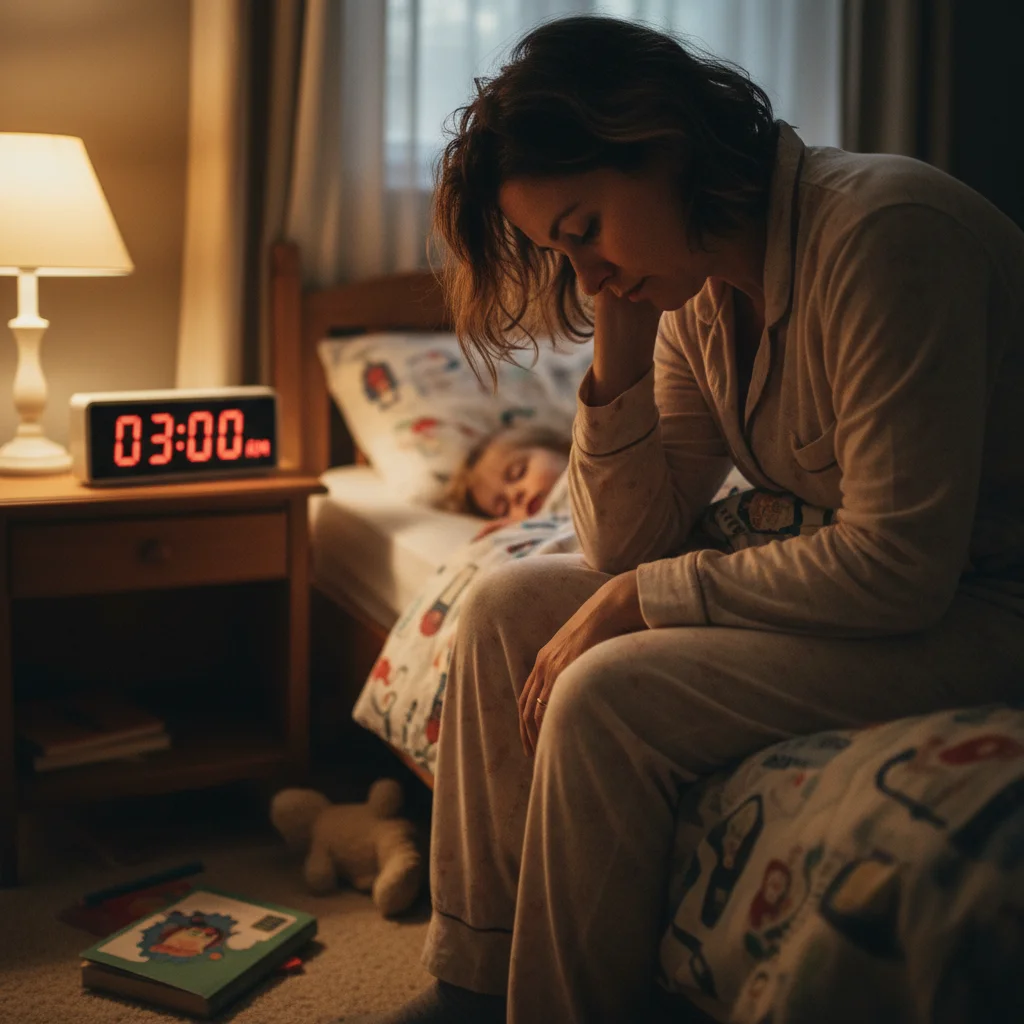
3:17 AM. The digital clock glowed like a taunt as I heard footsteps in the hallway again. My 8-year-old son Marcus had been waking up every night for three weeks straight, and I was beyond exhausted.
If your ADHD child is waking up in the middle of the night, you need to know this isn't your fault. This isn't about bedtime routines or screen time limits. ADHD brains have fundamentally different circadian rhythm patterns — and once you understand what's actually happening neurologically, everything starts to make sense.
The 3 AM Wake-Up Calls That Started Destroying Our Family
It started gradually. Marcus would wake up around midnight, then 1 AM, then it settled into this brutal 3 AM pattern. He wasn't having nightmares or needing the bathroom — he was just awake.
Wide awake. Ready to talk about Pokemon or ask if he could have pancakes for breakfast. His brain was fully online while mine was running on fumes.
The ripple effects were devastating. He'd fall back asleep around 5 AM, then be impossible to wake for school. His bedtime meltdowns got worse because he was overtired. My husband and I started snapping at each other because we were both sleep-deprived.
The pediatrician suggested "better sleep hygiene." The sleep consultant blamed too much stimulation. Everyone had an opinion, but nobody explained why this was happening.
Why ADHD Brains Have Broken Sleep-Wake Cycles
Here's what I learned after diving deep into the research: ADHD doesn't just affect attention and hyperactivity. It disrupts the brain's internal clock.
Your child's circadian rhythm is controlled by a complex dance between four neurotransmitters:
- Melatonin — signals when it's time to sleep
- GABA — calms the nervous system for rest
- Dopamine — regulates reward and motivation cycles
- Norepinephrine — controls alertness and energy
In neurotypical brains, these chemicals follow predictable patterns. Dopamine and norepinephrine drop at night while GABA and melatonin rise. But ADHD brains work differently — these neurotransmitter cycles are often completely out of sync.
Marcus wasn't choosing to be awake at 3 AM. His brain's chemistry was telling him it was time to be alert when it should have been telling him to sleep.

The Melatonin Trap That Made Everything Worse
Of course, the first thing we tried was melatonin. The pediatrician said it was "natural and safe," so we started with 1mg, then 2mg, then 3mg when that stopped working.
Here's what nobody told me: melatonin only addresses one piece of the puzzle. It can help with falling asleep, but it doesn't fix the underlying neurotransmitter imbalances that cause ADHD sleep disruption.
After six weeks on melatonin, Marcus was falling asleep easier but still waking up at 3 AM. We'd created a dependency on the supplement without fixing the real problem — his brain's circadian rhythm was still completely dysregulated.
Plus, I started noticing he was groggy and irritable in the mornings. The melatonin hangover was real, and it was making his morning routine battles even worse.
How Light Exposure Was Sabotaging Our Progress
The breakthrough came when I learned about light's role in circadian rhythm regulation. ADHD brains are hypersensitive to light cues — but in all the wrong ways.
I discovered we were doing everything backwards:
- Marcus wasn't getting enough bright light in the morning to signal "wake up"
- He was getting too much blue light in the evening from screens and overhead lights
- His bedroom wasn't dark enough to support proper melatonin production
The research shows that ADHD children need 30-60 minutes of bright morning light to properly reset their circadian clocks. But most kids rush through morning routines in dim indoor lighting, then get blasted with artificial light at night when their brains need darkness.
The Circadian Rhythm Reset Protocol That Finally Worked
Once I understood the neuroscience, I developed a three-phase approach that completely transformed Marcus's sleep:
Phase 1: Morning Light Therapy (Week 1-2)
Every morning, Marcus and I spent 20 minutes outside before school. Even on cloudy days. No screens, no rushing — just natural light exposure to signal his brain that it was time to be awake.
Phase 2: Evening Light Control (Week 2-3)
Two hours before bedtime, we dimmed all lights and switched to warm red bulbs. All screens went off, and we used blackout curtains to create true darkness in his room.
Phase 3: Neurotransmitter Support (Week 3-4)
Instead of just melatonin, I focused on supporting all four neurotransmitter pathways involved in sleep regulation. This meant looking at natural compounds that could help balance dopamine, GABA, and norepinephrine alongside melatonin production.
The results were dramatic. By week three, Marcus was sleeping through the night. By week four, he was waking up naturally without an alarm. His bedtime explosions disappeared because his brain finally knew when it was supposed to be tired.
When to Worry About Sleep Disorders vs ADHD
Not every sleep issue in ADHD kids is purely circadian rhythm related. Here are the red flags that suggest you need a sleep study:
- Loud snoring or breathing pauses during sleep
- Restless leg movements or periodic limb movements
- Multiple brief awakenings (different from the single 3 AM wake-ups)
- Excessive daytime sleepiness despite adequate sleep hours
But if your child is waking up once per night, staying awake for 1-3 hours, then falling back asleep, you're likely dealing with circadian rhythm disruption — not a sleep disorder.
The Supplement Stack That Supports Healthy Sleep Timing
After 18 months of research and trial and error, I learned that supporting ADHD sleep requires a multi-pathway approach. Single-ingredient supplements like melatonin or magnesium alone address only one piece of the complex neurochemical puzzle.
The most effective approach targets all four neurotransmitter pathways involved in circadian rhythm regulation. Recent research, including a 2019 clinical trial published in the Journal of Child and Adolescent Psychopharmacology, suggests that certain natural compounds can support healthy sleep-wake cycles by working on multiple brain pathways simultaneously.
The key is finding solutions that support your child's natural circadian rhythm rather than forcing artificial sleep with single-ingredient supplements that can create dependency.
"The difference is night and day — literally. Marcus sleeps through the night now, and our whole family is happier and healthier because of it."
If you're dealing with middle-of-the-night wake-ups, remember that this isn't a parenting problem. It's a neurological challenge that requires the right approach to solve.
Is your child's sleep disruption caused by ADHD brain chemistry?
Take our free assessment to discover whether your child's sleep issues are related to neurotransmitter imbalances and get personalized recommendations for supporting healthy sleep-wake cycles naturally.
TAKE THE FREE ASSESSMENT →
