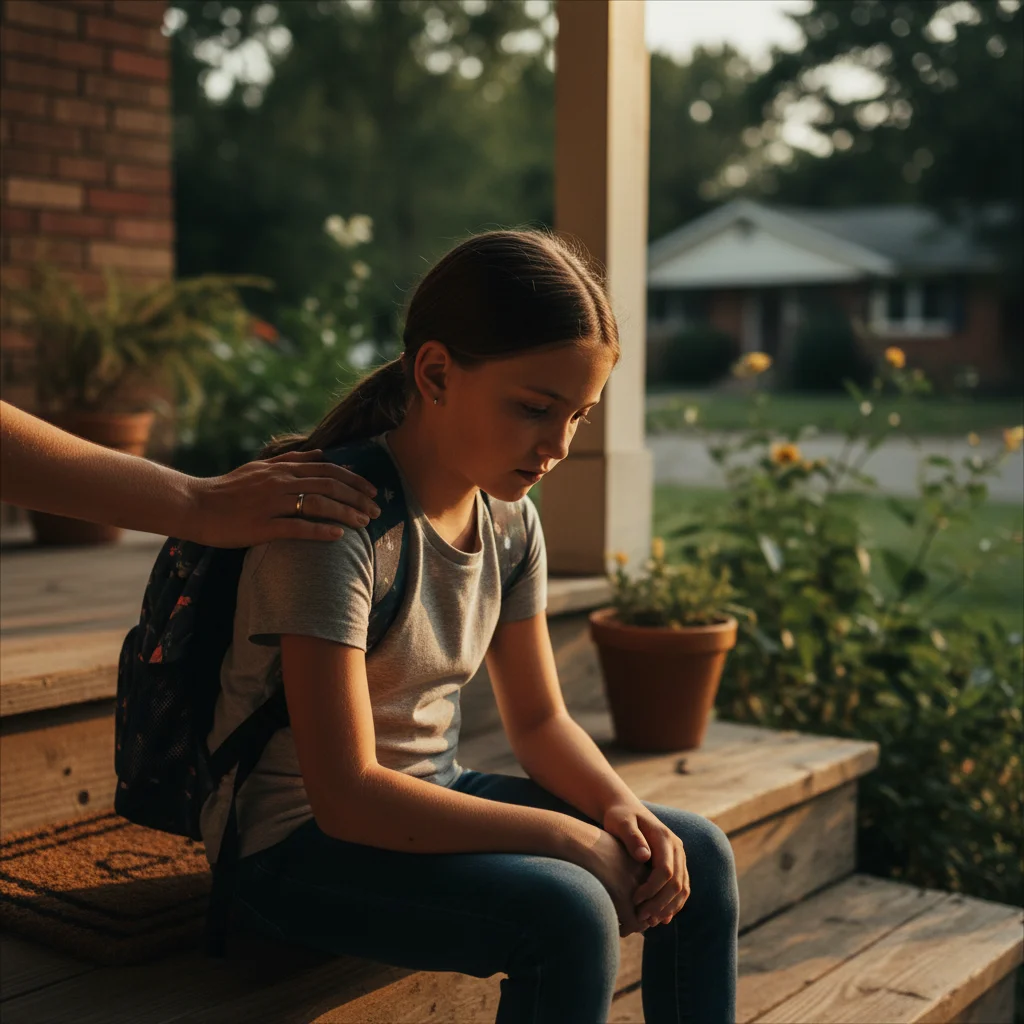
The call came on a Tuesday morning in October, when my daughter Mara was in second grade.
Her teacher, Ms. Brennan, was kind about it. But the words still landed like a stone: "Mara told me today that she hates school and she's not coming back tomorrow."
My first instinct was embarrassment. My second was panic. And underneath both of those — if I'm being honest — was a flash of shame directed squarely at myself.
But here's what I've learned since that Tuesday: what Mara said had nothing to do with attitude, and nothing to do with my parenting. It was a distress signal from a child who had been quietly drowning for months — and I had missed every sign.
What "I hate school" actually means when your child has ADHD
Mara wasn't being dramatic. She wasn't trying to manipulate her teacher or get out of class.
She was telling the truth as she experienced it — and for a kid with ADHD who had been struggling to keep up, struggling to sit still, and struggling to feel like she belonged, school had genuinely become a place that felt unsafe.
Kids with ADHD experience shame spirals at school more intensely than neurotypical kids. Every correction from a teacher, every paper handed back with red marks, every moment of being told to sit down or stop fidgeting — it accumulates.
It doesn't look like shame from the outside. It looks like attitude. It looks like refusal. It looks like a child saying "I hate school" to her teacher on a Tuesday in October.
And if you treat it like attitude, you make it worse.
The difference between school anxiety and school shame — and why it matters
I had read enough about ADHD and anxiety in kids to know they often travel together. So when Mara started resisting mornings, I assumed it was anxiety.
I was half right.
Anxiety says: something bad might happen.
Shame says: something is wrong with me.
Those require completely different responses. Anxiety needs reassurance and predictability. Shame needs repair — someone reflecting back that you are not broken, that the struggles you're having make sense, that you are loved exactly as you are.
When I kept trying to reassure Mara that school would be fine, I was speaking to anxiety. But Mara was living in shame. She didn't need me to tell her tomorrow would be better. She needed me to acknowledge that today had been really, really hard.
The "I'm stupid" spiral had been building for at least a year before that phone call. I just hadn't had the language to see it.

The conversation that changed everything — and what I asked the school to change
That night, instead of addressing what happened with Ms. Brennan, I just sat with Mara on her bed.
I didn't ask questions at first. I just said: "School sounds really hard right now."
She burst into tears.
What came out over the next twenty minutes was everything she had been carrying: that she was always the last one to finish her work. That she'd heard a classmate say she was "weird." That she had raised her hand three times one day and the teacher hadn't called on her. That she felt invisible and behind and like everyone else had a manual she hadn't been given.
None of that was attitude. All of it was pain.
The next week, I requested a meeting with Ms. Brennan and the school counselor. I had done enough reading about 504 plan accommodations to know Mara was entitled to support — and I came prepared to ask for specific changes.
We asked for three things:
- That Mara would never be called on unexpectedly — only when she raised her hand.
- That written assignments would be broken into smaller chunks with check-ins.
- That Ms. Brennan would find one genuine, specific thing to compliment Mara on each day.
The school agreed to all three. It took about ten minutes. I had spent months dreading that meeting, and it took ten minutes.
If you're hitting walls with your school, the article on your child's legal rights at school is worth reading before your next meeting.
The daily debrief that slowly rebuilt her confidence
The accommodations helped at school. But the shame Mara was carrying didn't live at school — it lived in her body, and she brought it home every afternoon.
I started what I now call the daily debrief. Every day after school — not in the car, not before snack, but after she'd had twenty minutes to decompress — I'd sit with her and ask the same three questions:
- "What was one moment today where you felt good?"
- "What was one hard moment?"
- "What's one thing you're proud of, even if it's tiny?"
The third question was the hardest for her at first. She'd say "nothing." I'd gently push: "Did you finish your lunch? Did you hold the door for someone? Did you try on the math even when it was hard?"
Gradually — over weeks, not days — she started finding answers faster.
This is connected to something I've read a lot about: the ADHD nervous system's sensitivity to failure. Kids with ADHD don't just feel bad about mistakes — they often become the mistake in their own minds. The daily debrief was my attempt to interrupt that pattern, one tiny reframe at a time.
For the after-school transition specifically — the meltdowns, the shutdown, the "I don't want to talk about it" — I found the strategies in this piece on after-school restraint collapse incredibly validating. What I thought was Mara being difficult was actually her nervous system in freefall.
Six months later: what's different, and what we're still working on
Mara is in third grade now. She does not love school. But she no longer says she hates it.
That might not sound like a win. But for us, it is enormous.
She has a teacher this year who, unprompted, told me at conferences that Mara is "one of the most creative thinkers in the class." I had to look away so Mara wouldn't see me cry.
What we're still working on: the perfectionism and fear of mistakes is deep-rooted and doesn't disappear with accommodations alone. Mara still shuts down when she gets something wrong. We're in the early stages of working with a therapist on that piece.
And mornings are still hard. They may always be hard. But we've built enough of a foundation — enough repair, enough daily proof that she is seen and capable — that the hard mornings don't undo everything anymore.
If your child is in the thick of this right now, please know: what they're expressing isn't attitude, and it's not a reflection of your parenting. ADHD isn't bad behavior — it's brain chemistry, and shame is one of its cruelest side effects.
You didn't miss the signs because you're a bad parent. You missed them because no one handed you the manual either.
Parent Training — Limited Spots
Learn how to stop the shame spiral before it starts
This 9-module course walks you through the exact strategies — daily debriefs, school advocacy scripts, emotional repair tools — that helped Mara and hundreds of other ADHD kids rebuild confidence.
87 of 100 spots taken · 9 video modules · $9.99 trial
START YOUR $9.99 TRIAL →Is your child's brain chemistry making school harder than it needs to be?
Take our free 2-minute assessment to understand what's driving your child's school struggles — and what kind of support actually addresses the root cause.
TAKE THE FREE ASSESSMENT →

