What's in This Guide
At 7:14 AM on a Wednesday last October, I was sitting on the bathroom floor at our house in South Austin, holding a sock in one hand and my cold coffee in the other, watching Oliver — who was nine at the time — cry into a towel because his shirt tag was "stabbing" him.
We had 16 minutes to leave for Barton Hills Elementary. He was wearing one sock. His backpack was still open on his bedroom floor with yesterday's crumpled homework inside. His cereal was getting soggy in the kitchen. And I could feel that familiar heat rising in my chest — that cocktail of frustration and guilt and desperation that every ADHD parent knows by name but never says out loud.
We do this every single morning. Why can't we just get out the door?
I had tried reward charts. I had tried yelling (I'm not proud of it). I had tried waking him up 45 minutes earlier, which just meant 45 more minutes of chaos. I had tried laying out his clothes the night before — but by morning he'd "changed his mind" and the outfit felt wrong and everything spiraled from there.
What I didn't understand then — and what took me two years of research, an OT background I should have leaned on sooner, and a lot of hard mornings to figure out — is that ADHD morning routines for kids fail for specific, predictable, neurological reasons. And once you understand those reasons, you can build a system that actually works.
This guide is everything I've learned. It's the resource I wish someone had handed me the morning I sat on that bathroom floor. I wrote the shorter version of our 15-minute morning framework a few months ago, and the response was overwhelming — hundreds of parents wrote in saying they needed more. So here it is. All of it.
Why ADHD Mornings Are Different (It's Not Laziness)
Before we get into the how, we need to talk about the why — because if you don't understand what's happening in your child's brain at 7 AM, you'll keep building routines that were designed for neurotypical kids. And they'll keep failing.
Three things happen in the ADHD brain every morning that make getting ready genuinely harder:
1. Executive function is at its lowest. Executive function — the brain's ability to plan, sequence, prioritize, and manage time — is already impaired in ADHD. But here's what most parents don't realize: executive function relies heavily on the prefrontal cortex, which is the last part of the brain to come online after sleep. For ADHD kids, whose prefrontal cortex may already be 3-5 years behind in development, mornings are like asking them to run a marathon before their legs wake up.
2. Dopamine is depleted. The ADHD brain produces less dopamine to begin with. After a full night of sleep (when dopamine isn't being replenished by stimulating activity), your child wakes up running on fumes. This is why everything feels harder, less interesting, and more overwhelming in the morning. Brushing teeth? Boring. Getting dressed? Zero motivation. Eating breakfast? Not engaging enough. Their brain is literally searching for something stimulating, which is why they'll happily play with a LEGO piece they found under the bed instead of putting on pants.
3. Time blindness makes urgency invisible. "We need to leave in 10 minutes" means absolutely nothing to most ADHD kids. Time blindness — the inability to sense the passage of time or estimate how long tasks take — is one of the most disabling and least understood symptoms of ADHD. I wrote a whole article about how we tackled Oliver's time blindness with visual schedules, and it remains one of the most important changes we made.
When you add these three factors together — impaired planning, low motivation, and no sense of urgency — you get a child who genuinely cannot do what you're asking them to do the way you're asking them to do it. Not won't. Can't.
And if your child also deals with sensory processing challenges around getting dressed, or wakes up dysregulated from disrupted sleep, the morning routine can feel impossible before it even begins.
So let's build one that accounts for all of this.
The 15-Minute Framework: A Step-by-Step ADHD Morning Routine
I call this the 15-Minute Framework not because the whole morning takes 15 minutes — I wish — but because the core routine is broken into three 15-minute blocks. Each block has exactly one focus. The simplicity is the point.
Here's what our mornings look like now, after nine months of refining this system:
Block 1: Body (6:45 - 7:00 AM)
Focus: Get dressed, brush teeth, use the bathroom.
The rule: No decisions. Oliver's outfit was chosen the night before (two acceptable options — not one, because he needs to feel some control, and not five, because too many choices = paralysis). His clothes are laid out in the order he puts them on. Underwear on top, then shirt, then pants, then socks.
Key strategy: We use a Time Timer visual clock so he can see the 15 minutes shrinking. This single tool was the biggest game-changer for his time blindness.
Block 2: Fuel (7:00 - 7:15 AM)
Focus: Eat breakfast, take any vitamins or supplements.
The rule: Only two breakfast options, decided the night before. We rotate between high-protein choices: scrambled eggs and toast, peanut butter banana oatmeal, or a yogurt parfait. Sugary cereal used to be our go-to because it was fast, but the crash by 9 AM was making school even harder.
Key strategy: Oliver eats at the kitchen counter, not the table. Sounds weird, but the change in location cues his brain that this is "morning fuel time," not "relax and play time." Environmental cues matter enormously for ADHD brains.
Block 3: Launch (7:15 - 7:30 AM)
Focus: Backpack check, shoes on, out the door.
The rule: The backpack was packed the night before. All Oliver has to do is grab it, put on his shoes (which are on a mat by the door, always the same spot), and walk out. I do a 3-item verbal checklist: "Backpack? Water bottle? Shoes?" He answers each one.
Key strategy: The last thing before we leave, Oliver gets to pick the song we listen to in the car. This isn't a reward — it's a dopamine bridge. It gives his brain something to look forward to that makes the transition from home to car less jarring.
That's it. Three blocks. Three focuses. No multitasking, no competing priorities, no "hurry up" (we banned that phrase — it spikes cortisol and makes everything slower, not faster).
For the full breakdown of how we built and tested this framework, including the scripts I use and the exact timeline, read The 15-Minute Morning Framework That Ended Our Battles.
The Visual Schedule That Changed Everything
Oliver was five when I first tried a visual schedule. It was a Pinterest-perfect chart with 14 steps, laminated, with little magnets he was supposed to move from "to do" to "done."
He used it for two days. Then he started playing with the magnets instead of following the steps, and it ended up behind the refrigerator.
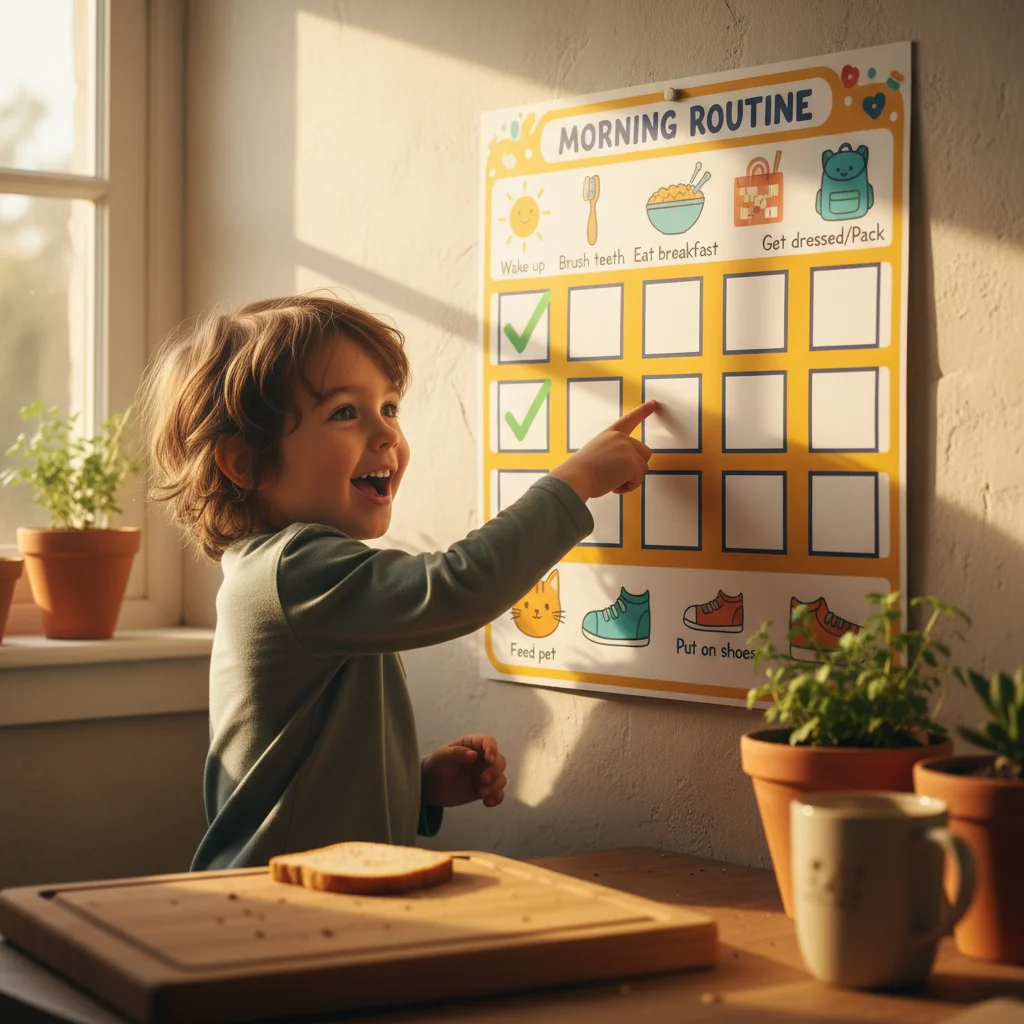
Here's what I learned: visual schedules for ADHD kids need to follow four rules or they won't work.
Rule 1: Maximum 6 steps. Any more than that and the ADHD brain sees a wall of tasks, not a path through the morning. Our current schedule has exactly 5 steps: Get Dressed, Brush Teeth, Eat Breakfast, Pack Check, Shoes On.
Rule 2: Pictures over words. Even for older kids who can read fluently, images are processed faster by the brain. Oliver's schedule uses simple icons — a shirt, a toothbrush, a bowl, a backpack, a shoe. His brain registers them in a glance.
Rule 3: Vertical, not horizontal. Top to bottom mimics the natural direction of progress. It feels like a countdown. Horizontal layouts feel like a menu of options, and ADHD brains will skip to whatever looks most interesting.
Rule 4: Physical interaction. Whether it's checking a box with a dry-erase marker, moving a clothespin, or flipping a card — the child needs to physically mark each step complete. This gives a tiny dopamine hit that fuels the next step.
Free Download: ADHD Morning Routine Visual Schedule
Print this visual checklist and stick it on the fridge. Oliver uses it every morning.
No spam. Unsubscribe anytime.
The downloadable PDF follows all four rules. It's a single-page, print-friendly visual schedule with large icons, checkboxes, and space at the top to write your child's name. I designed it based on exactly what we use in our kitchen — nothing fancy, just functional.
What to Do When the Routine Breaks Down
It will break down. I need you to know that upfront, because if you expect perfection, you'll abandon the routine the first bad morning and start over with something new. And that cycle — try, fail, scrap, try again — is exhausting for you and confusing for your child.
Our routine breaks down about once a week. Sometimes more. Here's what I've learned about recovery:
Bad mornings usually start the night before. If Oliver goes to bed late, has a screen-heavy evening, or skips his bedtime routine, the next morning is almost guaranteed to be rough. The single biggest predictor of a good ADHD morning is a solid evening routine the night before. If mornings are consistently falling apart, look at bedtime first.
Don't add more steps. Remove them. When things break down, parents instinctively add structure: more reminders, more checkpoints, more verbal cues. But an overwhelmed ADHD brain needs less, not more. On hard mornings, I strip our routine to three non-negotiables: dressed, fed, out the door. Everything else — teeth brushing, hair combing, bed making — gets dropped. We survive today and reset tomorrow.
Use the "two-word check-in" before correcting. When Oliver is stuck — standing in his room holding one sock, staring out the window — my instinct is to say "Oliver, come on, you need to get dressed." But what actually works is a two-word check-in: "What's next?" That's it. It re-engages his prefrontal cortex without flooding him with instructions or shame.
Repair after hard mornings. If the morning went badly and there was yelling (yours or theirs), do a brief repair after school. "This morning was hard for both of us. I'm sorry I raised my voice. Tomorrow we'll try again." This matters more than you think. As I've written about in why meltdowns aren't a parenting problem, the repair is where the real teaching happens.
Track the pattern. After three weeks of using the 15-Minute Framework, I started noticing patterns. Mondays were always hardest (transition from weekend). Wednesdays were usually smooth (midweek momentum). Fridays were hit-or-miss depending on how tired Oliver was. Knowing the pattern helped me front-load support on the days that needed it most.
Age-Specific Modifications
The 15-Minute Framework works across ages, but the level of support you provide — and the specific strategies you use — should shift as your child grows. Here's how I'd modify it based on developmental stage:
Ages 4-6: Full Support
- You do the routine with them, side by side
- Use hand-over-hand help (guiding their hands to button a shirt)
- Sing the same song during each block — music creates neural anchors
- Physical schedule with velcro picture cards they can remove
- Expect to repeat the same routine for 6-8 weeks before it sticks
- Allow 20 minutes per block instead of 15
Ages 7-9: Guided Independence
- They do the routine while you stay nearby and available
- Verbal check-ins between blocks: "Block 1 done?"
- Visual schedule with checkboxes they mark themselves
- Introduce the Time Timer so they build internal time sense
- Let them choose between two options at each step (builds autonomy)
- This is the age where the framework clicked for Oliver
Ages 10-13: Coached Autonomy
- They run the routine independently; you do a 2-minute debrief after
- Replace visual schedule with a phone alarm or checklist app
- Shift night-before prep to their responsibility (with reminders)
- Focus on self-monitoring: "How did your morning go? What would you change?"
- Build in a natural consequence: late = no car music that morning
- Respect their growing need for autonomy while maintaining structure
One note for parents of teenagers: if your child is 13+ and you're just starting to build a morning routine, don't expect them to jump to "coached autonomy" right away. Start at whatever level of support they actually need, even if that means side-by-side for a few weeks. Meeting them where they are isn't babying them — it's good neuroscience.
Supporting the Brain Behind the Morning
Every strategy in this guide — the framework, the visual schedule, the environmental cues — works better when the brain behind them is better supported. I learned this the hard way.
For the first year of using the 15-Minute Framework, we had good weeks and terrible weeks, and I couldn't figure out the pattern. Same routine, same prep, wildly different results. It wasn't until I started tracking Oliver's sleep, diet, and overall regulation that I saw the connection.
The ADHD brain runs on four neurotransmitter pathways: dopamine (motivation and focus), serotonin (mood and emotional stability), GABA (calm and impulse control), and norepinephrine (alertness and attention). When these are out of balance — which they frequently are in ADHD — even the best routine in the world can't compensate.
What helped us the most:
- Protecting sleep ruthlessly. Oliver's bedtime is 8:00 PM, no exceptions on school nights. I know that sounds strict, but the difference between 9 and 10 hours of sleep for him is the difference between a manageable morning and a catastrophe. If your ADHD child's mornings are consistently terrible, look at sleep before anything else.
- Protein-first breakfasts. We stopped doing sugary cereal and switched to eggs, nut butter, and yogurt. Amino acids are the building blocks of neurotransmitters. Starting the day with protein gives the ADHD brain better raw materials to work with.
- Targeted nutritional support. After researching what was available for supporting all four neurotransmitter pathways (not just one), we found that saffron showed promise in research for supporting attention and emotional regulation in children — with one study showing it comparable to methylphenidate. It's not a magic pill, but combined with structure and sleep, it was a noticeable piece of the puzzle for our family.
- Morning movement. Five minutes of jumping jacks, dancing, or bouncing on a mini trampoline before the routine starts. This floods the brain with dopamine and norepinephrine, essentially "turning on" the prefrontal cortex. Oliver does three minutes on a mini trampoline every morning before Block 1.
The behavior strategies and the brain support aren't competing approaches. They're the same approach. You build the external structure (the routine) while supporting the internal chemistry (sleep, nutrition, movement) — and they amplify each other.
Understanding that ADHD behavior is driven by brain chemistry, not bad character, was the shift that changed everything for me. Once I stopped seeing Oliver's rough mornings as defiance and started seeing them as a brain struggling to come online, I could actually help.
Frequently Asked Questions
How long does it take for an ADHD morning routine to stick?
Most families see meaningful improvement within 2-3 weeks of consistent use, but full habit formation typically takes 6-8 weeks for ADHD children. The key is consistency — doing the same routine in the same order at the same time every single day, including weekends if possible. Expect setbacks and don't abandon the routine when they happen. Persistence through the messy middle is what separates routines that work from routines that get pinned on Pinterest and never used.
Should I use rewards to motivate my ADHD child in the morning?
Small, immediate rewards can work well — but they need to be immediate (not "if you're good all week, you get..."). A sticker on the visual chart after each block, choosing the car music after the routine is complete, or a 5-minute activity of their choice if they finish early. Avoid food rewards and avoid making the reward so big that missing it becomes another source of shame. The goal is small dopamine boosts that keep momentum going, not high-stakes bribery.
What if my child refuses to follow the routine at all?
Total refusal usually signals that the routine is too demanding for where your child is right now. Drop to the absolute minimum — one step at a time, with you doing everything else. Sometimes the real issue is a sensory problem (the clothes feel wrong), a sleep issue (they're running on four hours), or an emotional issue (anxiety about school). Address the root cause. You might also want to read our article on sensory struggles with getting dressed, since that's one of the most common hidden triggers.
Does the routine work differently for ADHD-inattentive vs. ADHD-hyperactive kids?
The framework works for both, but the support strategies shift. Inattentive kids benefit more from external cues (timers, visual schedules, verbal check-ins) because their challenge is staying on track. Hyperactive kids benefit more from movement breaks built into the routine (jumping jacks between blocks, a "wiggle minute" before sitting for breakfast). For combined type — which Oliver is — you use both. The 15-Minute Framework accommodates all subtypes because it's built around ADHD-universal challenges: executive function, dopamine, and time blindness.
How do I handle mornings when my child wakes up already dysregulated?
Some ADHD kids wake up crying, angry, or deeply resistant every morning. If this is your child, the routine can't start yet — you need a "regulation buffer" first. For us, when Oliver wakes up already in distress, I add a 10-minute calm-down period before Block 1: dim lights, a weighted blanket, quiet music, and no demands. Only when his nervous system has settled do we begin. This means waking up 10 minutes earlier on those days, which is why a consistent early bedtime is so important.
Parent Training — Limited Spots
Ready for the Full ADHD Parenting Framework?
Morning routines are just the beginning. Licensed therapist Anneliese shares the complete, step-by-step system parents are using to transform daily battles into breakthroughs — from wake-up to bedtime.
87 of 100 spots taken · 9 video modules · $9.99 trial
START YOUR $9.99 TRIAL →Could Brain Support Make Your Child's Mornings Easier?
When the ADHD brain gets the nutritional support it needs, routines stick faster and meltdowns happen less. Take our quick assessment to see if targeted support across all four neurotransmitter pathways might help your family.
TAKE THE FREE ASSESSMENT →