
I remember the exact moment I realized I wasn't just tired anymore.
Oliver was eight. It was a Tuesday morning. He had melted down over the color of his cereal bowl, and instead of taking a breath and helping him through it, I just stood there in the kitchen — completely hollow. No frustration. No problem-solving. No warmth. Nothing.
I wasn't angry. I wasn't sad. I was empty.
That's the moment I finally understood that what I was experiencing wasn't ordinary parenting exhaustion. It was something qualitatively different — and it had a name.
First, let me say this clearly: the fact that you're depleted does not mean you're doing it wrong. Parenting a child with ADHD is genuinely harder in ways that other parents simply don't encounter at the same frequency. The research backs this up. You are not weak. You are not failing. You are running a marathon every single day with no finish line in sight.
Why parenting an ADHD child creates a specific kind of burnout
Regular parenting exhaustion comes from doing a lot. ADHD parent burnout comes from doing a lot — while also being the emotional regulator for a child whose brain genuinely cannot regulate itself yet.
There's a crucial difference.
When Oliver has a meltdown, it's not just disruptive — my nervous system responds to it as a threat. My cortisol spikes. My body goes into alert mode. And then, when it's over, I have to co-regulate him back down while I myself am still dysregulated.
Multiply that by several times a day, every day, for years. That's not normal parenting fatigue. That's chronic nervous system overload.
Add in the school calls, the teacher emails arriving before you've finished your first coffee, the homework that takes four hours, the after-school meltdowns that seem to come out of nowhere, the constant hypervigilance of walking on eggshells — and you have a recipe for a very specific, very severe form of caregiver burnout.
The seven warning signs of ADHD parent burnout
These are the signs I see most often — in myself and in the hundreds of parents I've connected with over the years. They go well beyond "I'm tired."
- Emotional numbness toward your child. Not frustration, not anger — just flatness. You go through the motions without feeling present. This was my kitchen-cereal-bowl moment.
- Resentment that shocks you. A flash of bitterness toward your child — or your partner, or parents with "easy" kids — that leaves you feeling like a terrible person. You're not terrible. Your tank is empty.
- Dreading your child coming home. The knot in your stomach at 3:15 PM. The wish that the school day could just go on a little longer. The guilt spiral that follows.
- Physical symptoms with no clear cause. Headaches, jaw tension, disrupted sleep even when you have the chance to sleep. Your body is carrying the chronic stress load your mind has stopped consciously registering.
- Loss of identity outside of ADHD management. You used to have interests. Friendships. A sense of who you were beyond "Oliver's mom." Now it feels like ADHD is your entire personality — and you resent that too.
- Hypervigilance that doesn't switch off. You're always waiting for the next eruption. Even in calm moments, you can't relax because you know it's coming. Your nervous system has stopped distinguishing between "threat" and "no threat."
- The feeling that you're the only one who sees how hard this is. Your partner doesn't fully get it. Your own parents think he just needs firmer discipline. Your friends have stopped asking how things are going because the answer is always the same. The isolation is profound.
If you recognized yourself in several of these, you're not imagining it. And you're not alone — the grief and guilt that comes with this journey is one of the least-discussed parts of parenting a child with ADHD.
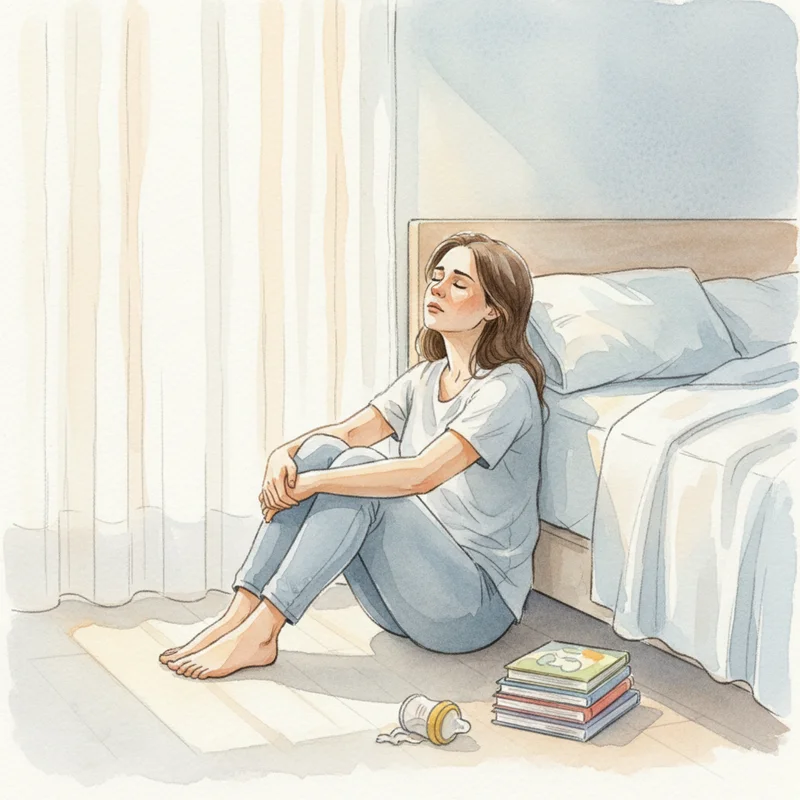
How ADHD parent burnout differs from depression — and why it matters
This distinction matters practically, not just semantically.
Depression tends to be pervasive — it colors everything, regardless of context. ADHD parent burnout is more situational. You might feel okay, even good, when you have a day away from the caregiving role. The heaviness lifts, at least partially, when the stressor is removed.
That's an important signal. It doesn't mean burnout is "less serious" than depression — it can absolutely trigger depression if it goes unaddressed long enough. But it does mean that the primary intervention is different.
With depression, the internal experience is the problem. With burnout, the load is the problem. You cannot think or meditate your way out of an objective overload.
"You cannot pour from an empty cup" is something people say to parents like us as if it's helpful. It isn't. What we actually need is someone to help us fill the cup — not another reminder that it's empty.
If you're unsure whether what you're experiencing is burnout or clinical depression, please talk to a doctor. The two can coexist, and both deserve real support.
The invisible load — what nobody sees you carrying
Here's what a typical Tuesday looks like from the outside: you got your kid to school, you went to work, you handled the afternoon, you made dinner, he's in bed.
Here's what that Tuesday actually looked like: you spent 45 minutes navigating a getting-dressed meltdown before 8 AM. You fielded a call from the teacher during your lunch break. You ran through your afternoon mentally calculating how to set up the transition from school to home to prevent the restraint collapse that happens 80% of days. You redirected a homework session for two hours while also making dinner. You managed the bedtime explosion. And then you lay awake wondering if you handled the morning wrong.
Nobody saw any of that. Your coworkers think you're managing fine. Your partner sees the end result but not the labor that produced it. Social media shows everyone else's highlight reels.
The invisible cognitive and emotional labor of ADHD parenting — the constant anticipating, preventing, problem-solving, regulating — is relentless in a way that ordinary parenting isn't. And because it's invisible, you rarely get credit for it. Even from yourself.
Why self-care advice makes ADHD parents feel worse
"Have you tried yoga?" "What about a bath?" "You just need a girls' night."
I want to be kind here, because people who say these things genuinely mean well. But surface-level self-care advice is functionally useless when the problem is structural overload — and worse, it can deepen the shame spiral when the bath doesn't fix you.
ADHD parent burnout isn't fixed by a candle. It's addressed by reducing the load, building real support structures, and changing the conditions that are depleting you — not by adding another item to your to-do list.
What actually helps — realistic recovery strategies
These aren't spa recommendations. These are things that have made a measurable difference for me and for parents I've spoken with.
- Name it to yourself, honestly. "I am burned out" is not failure. It's accurate. Naming it stops the exhausting cycle of pretending you're fine.
- Find one genuinely load-reducing change, not ten self-care additions. Can you stop doing one thing? Can your partner absorb one consistent task? Can school accommodations reduce the homework battle? Reducing input matters more than adding coping strategies.
- Connect with parents who actually get it. This is the thing that helped me most. Not advice — just people who understood, without explanation, why I was crying about a cereal bowl. Online communities for ADHD parents are imperfect but often genuinely helpful for this.
- Protect one non-ADHD part of your identity. One hour a week on something that has nothing to do with your child's diagnosis. Not because you deserve a treat, but because you are a whole person who existed before this role.
- Address the child's nervous system, not just your own. This is something I didn't understand for a long time. My burnout was partly driven by the constant dysregulation — the meltdowns, the volatility, the burnout cycles in Oliver himself. When his regulation improved, mine followed. Supporting his brain health wasn't just for him.
How to ask for help when everyone thinks you're handling it fine
This is the cruelest part of ADHD parent burnout: you're often very good at holding it together on the outside. Which means the people around you have no idea.
You have to be more direct than feels comfortable. "I'm exhausted but fine" is not asking for help. "I'm genuinely struggling and I need X specific thing" is asking for help.
Most people want to help and don't know how. Tell them exactly. "I need you to handle bedtime on Thursdays." "I need you to just listen without problem-solving." "I need you to believe me that this is as hard as I'm saying."
And if you're wondering whether supporting your child's neurological regulation might reduce some of the daily friction that's fueling your depletion — that's worth exploring too. Not because it's a magic fix, but because fewer daily crises means a nervous system that gets to recover.
You are not failing. You are carrying something genuinely heavy. And you deserve real support — not a bath bomb.
Parent Training — Limited Spots
Stop surviving. Start navigating ADHD with a real strategy.
The Unbreakable ADHD parent training gives you a concrete framework for reducing daily meltdowns, school conflicts, and the chronic overwhelm that's burning you out — taught by specialists who've been in your shoes.
87 of 100 spots taken · 9 video modules · $9.99 trial
START YOUR $9.99 TRIAL →Is your child's daily dysregulation driving your burnout?
Take the free 2-minute assessment to understand what's happening in your child's brain — and what kind of support might actually reduce the daily friction you're absorbing.
TAKE THE FREE ASSESSMENT →