
Last June, I sat on the laundry room floor at 11 in the morning and just cried. Not the weepy kind. The ugly, heaving, can't-catch-your-breath kind. Oliver had been home for nine days. Nine days.
I want to say that upfront — because if you're reading this, you might be heading into summer already dreading it, or you're deep inside it right now and feeling like something is wrong with you. There isn't. What you're experiencing has a name, and it's not weakness.
ADHD parent burnout summer is real, it's specific, and it hits differently than regular parenting exhaustion. Here's what I've learned about why — and what I actually changed to make it survivable.
Why summer specifically destroys ADHD parents
During the school year, you get six hours of regulated, predictable time. Six hours where someone else is managing the sensory input, the transitions, the social dynamics. Six hours where you can think in a straight line.
Summer strips all of that away in one morning.
It's not just that your child is home more. It's that all four of the systems that kept them regulated during the school year — schedule, structure, social stimulation, teacher support — disappear simultaneously. If your child can't handle summer break's structure collapse, their dysregulation spikes. And you absorb every bit of it.
By the end of week two, most ADHD moms I know aren't just tired. They're running on cortisol and resentment and guilt about the resentment. That's burnout, not tiredness.
The burnout signs I kept explaining away
I didn't recognize it for what it was, because each symptom had a "reasonable" explanation.
I was snapping at my husband because I was tired. I was crying in the car because it had been a hard week. I was fantasizing about being alone — truly alone, just for one afternoon — because that's normal, right? Every mom needs a break.
The sign I should have caught sooner: I stopped feeling anything when Oliver had a good moment. He'd come to me excited about something, and I'd smile and nod and feel... nothing. Just a flat, gray nothing. That's not tired. That's a specific kind of burnout that comes from sustained high-alert parenting with no recovery time built in.
Other signs that are easy to rationalize:
- Dreading the moment they wake up
- Counting down to bedtime before 9 AM
- Feeling irritated by their normal child sounds — laughing, running, asking questions
- Losing patience faster and faster, with less and less provocation
- The physical stuff: headaches, jaw tension, not sleeping even when you can
None of these mean you're a bad mother. They mean your nervous system has been in crisis mode for too long without a break.
And here's something worth saying clearly: your child's meltdowns are not a parenting failure. The behavior you're absorbing every day isn't because you're doing something wrong. It's neurological. That matters, because burnout is much harder to address when you're also carrying guilt about causing the problem in the first place.
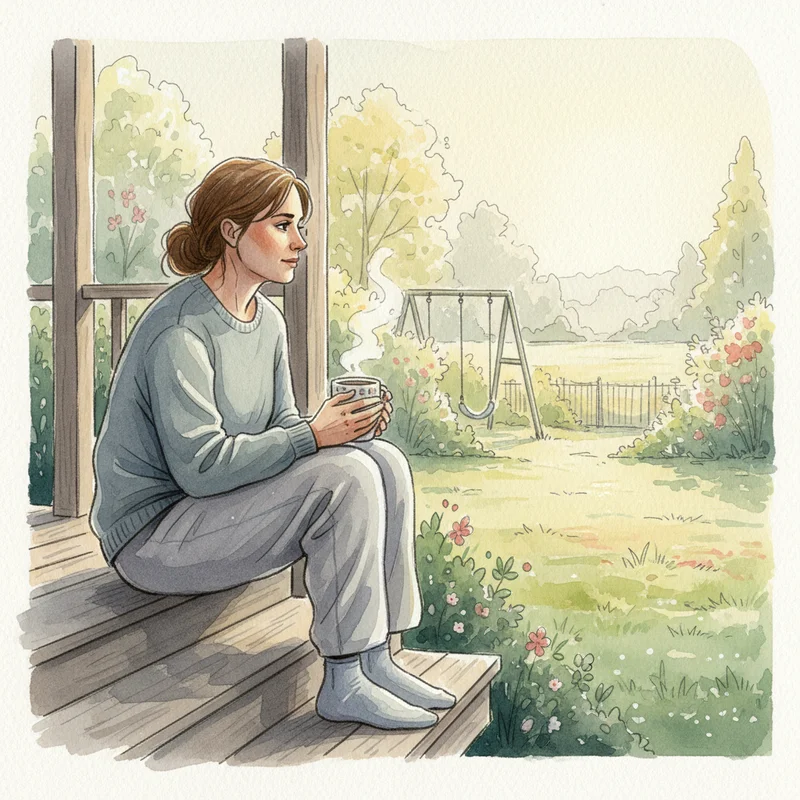
The 3 things that were quietly draining me every single day
When I finally got honest with myself, it wasn't the big meltdowns that were breaking me. It was three smaller things I'd never named.
1. Hypervigilance. I was constantly scanning. Is he okay? Is he about to escalate? Is that laugh going to turn into a scream? I was living three minutes ahead of every moment, braced for the next crisis. That state of constant anticipation is exhausting in a way that's hard to explain unless you've lived it. Walking on eggshells isn't a metaphor. It's a physical experience.
2. Invisible emotional labor. Every transition, every activity, every meal — I was the one engineering it so it didn't go sideways. Planning the backup plan for the backup plan. My brain never fully rested because the moment I stopped managing, something fell apart.
3. The isolation. Summer cuts you off. The school community disappears. The weekly rhythm disappears. And you can't exactly explain to friends why a pool day left you more depleted than a full workday. Unless they parent an ADHD child, they don't get it. That loneliness compounds everything.
What I actually changed — not the Pinterest version
I'm not going to tell you to do yoga or take bubble baths. Here's what actually moved the needle.
I built a non-negotiable window of regulatory support into the morning. Oliver gets 20 minutes of high-intensity outdoor movement before anything else — before screens, before breakfast battles, before requests. It doesn't fix everything, but it takes the edge off the hyperarousal that makes the first hour of every summer day feel like defusing a bomb. (The science on exercise and ADHD regulation is genuinely compelling for this.)
I stopped trying to make summer look like school. I'd been running myself ragged trying to replicate the school structure — scheduled activities, learning time, enrichment. Oliver's brain doesn't want school in summer. It wants novelty and movement and some degree of unstructured time to actually decompress. When I stopped fighting that, a layer of daily tension lifted.
I got ruthless about my own recovery windows. Not "me time" in some aspirational sense. I mean I identified two 30-minute windows each day where I was genuinely off-duty — not monitoring, not problem-solving, not available. My husband held one. The other happened during whatever independent activity Oliver could sustain. These windows were sacred. When I protected them, I was a measurably different person by 5 PM.
I stopped managing his emotional regulation alone. For years I'd been the one absorbing, redirecting, de-escalating every single episode. I started being much more honest with Oliver — age-appropriately — about what I needed too. Not as a guilt trip. Just as information. "I need ten minutes to reset. I'll be back." Modeling regulation is actually part of breaking the cycle for both of you.
What I wish someone had told me before the first week
Summer doesn't have to be survived. But it does have to be planned for, honestly, before it starts — not after you've already hit the wall.
The thing nobody says: your child's summer experience is directly downstream of yours. If you hit burnout in week two, the rest of the summer is harder for both of you. Protecting yourself isn't selfish. It's the actual intervention.
Build in transition support before school ends, not after. Prepare Oliver (or your child) for the structure change weeks in advance. If pre-summer transition anxiety is already showing up, that's data — not a preview of how the whole summer will go.
Know your three daily drains before they start draining. Name them. Make a plan for at least one of them before June hits.
And find one other parent who gets it — even just online. The isolation of ADHD parent burnout summer is its own compounding problem. You need someone who doesn't need you to explain why a birthday party required three days of recovery.
You're not failing. You're carrying something genuinely heavy. The goal isn't to carry it better — it's to put some of it down.
Parent Training — Limited Spots
Stop Surviving Summer. Start Actually Coping.
If burnout is already creeping in, the Unbreakable ADHD parent course gives you the specific tools to regulate yourself AND your child — before the wheels come off.
87 of 100 spots taken · 9 video modules · $9.99 trial
START YOUR $9.99 TRIAL →Is your child's summer dysregulation making burnout worse?
A calmer child makes for a calmer summer. Take the free 2-minute assessment to see what's driving your child's behavior — and what might help.
TAKE THE FREE ASSESSMENT →

