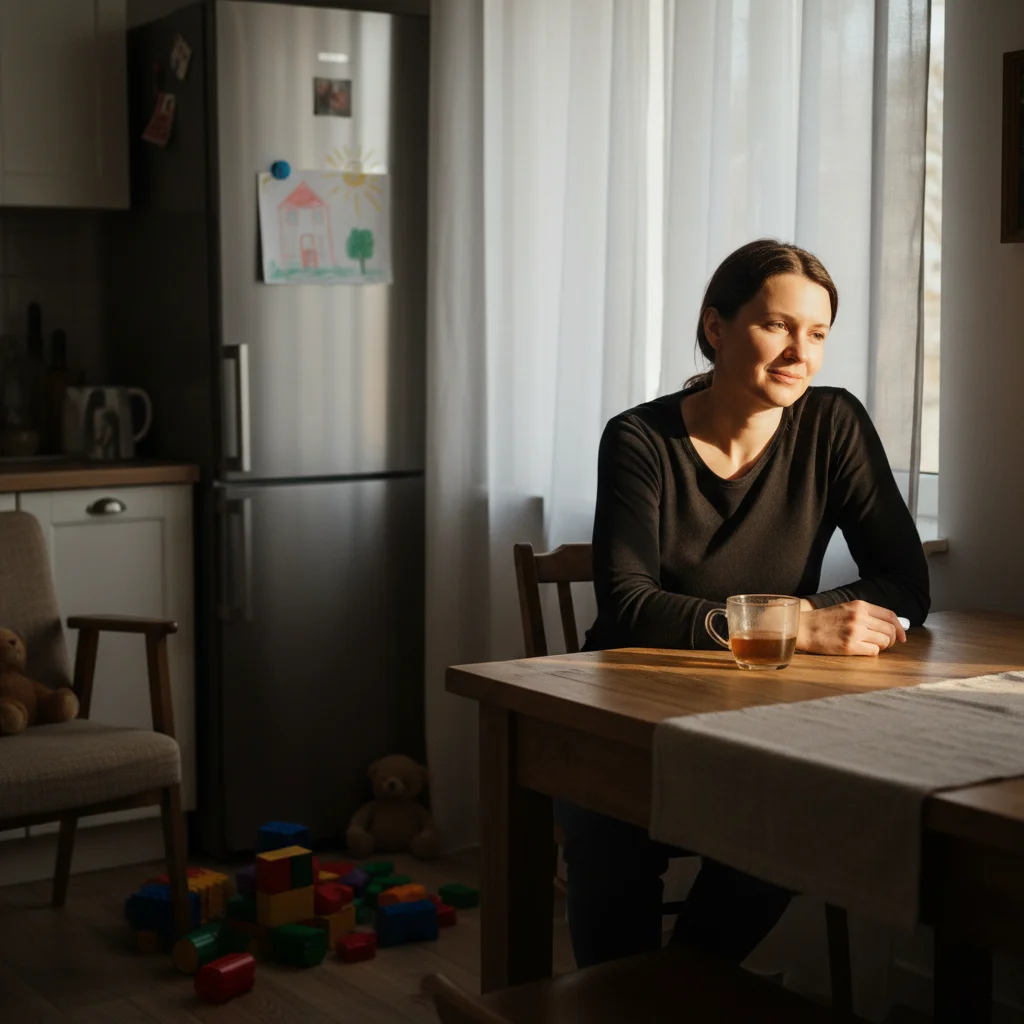
Oliver's seventh birthday party was supposed to be the one he'd remember forever. Dinosaur theme, twelve kids, the cake I'd spent two evenings decorating by hand.
He lasted forty minutes before the noise and the chaos pulled him under. He melted down in the backyard — screaming, throwing a paper plate, inconsolable. The other kids went quiet. One mom gathered her son and left early.
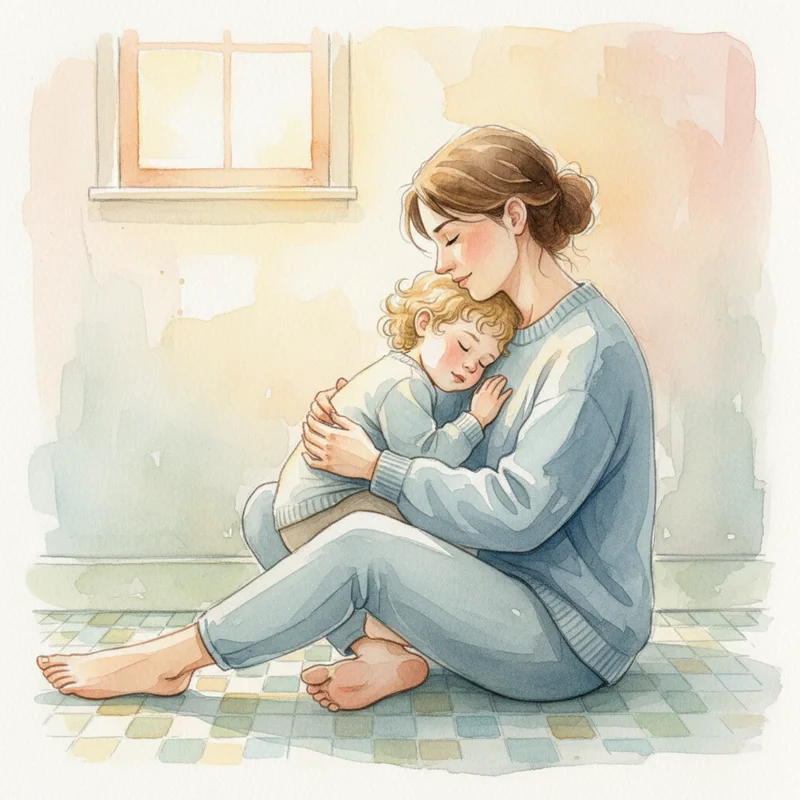
I held Oliver in the bathroom while he cried, and I cried too — but not for the reasons I admitted to anyone at the time.
I wasn't just sad about the party. I was grieving something I hadn't even named yet: the childhood I had imagined for him. The easy friendships, the carefree Saturday afternoons, the school years that weren't a constant battle. None of that was going to happen the way I'd pictured it. And nobody had warned me that realizing this would feel like a kind of loss.
If you've felt this, I want you to know something right away: it doesn't make you a bad mother. It makes you human.
Why ADHD parent guilt and grief feel so tangled up
When Oliver was diagnosed, people kept asking how he was doing. Almost nobody asked how I was doing.
That's because ADHD parent guilt is supposed to be invisible. You pour everything into your child — the therapies, the research, the late-night forum scrolling — and you don't get to publicly mourn the version of parenthood you thought you were signing up for. That feels selfish. Ungrateful, even.
But grief and guilt in this context are different things, even when they feel identical.
Guilt says: I caused this. I'm failing him. It looks backward and assigns blame.
Grief says: This is hard. I'm mourning something real. It looks at a genuine loss and asks to be acknowledged.
Most of the ADHD moms I know — in Facebook groups, at school pickup, through this blog — are carrying both. And they've been told, quietly or not so quietly, that neither is acceptable to feel.
Here's the thing I had to learn: your child's ADHD isn't a result of bad parenting — it's brain chemistry. Which means the guilt part, the part that says this is your fault? You can put that down. It was never yours to carry.
The grief part is different. That one's real. And it deserves space.
The specific losses that pile up — and why they hit so hard
Nobody tells you that parenting a child with ADHD involves a long, quiet accumulation of smaller griefs.
It's not one dramatic moment. It's the birthday party. It's the playdate that never got a return invite. It's the school picture where he looks disconnected from every other kid in the frame. It's the birthday parties that become a whole separate logistical challenge instead of a simple joy.
It's watching other kids sit through a school concert without incident while you're calculating your exit route.
It's the report card comments — "struggles to stay on task," "disrupts the class" — when you know, you know, how hard your son is actually trying.
It's the moment you realize that some of the friendships you hoped he'd have, the easy ones, the ones that just happen — those might not come easily for him. And that helping an ADHD child with friendships is its own long, painful education.
None of these individual moments are catastrophic. But they layer. And one day you're sitting in a bathroom at a birthday party, holding your crying seven-year-old, and the weight of all of them lands at once.
What I had to unlearn about "good childhoods"
I grew up with a very specific picture of what a happy childhood looked like. Bike rides with the neighborhood kids. Easy school years. A packed social calendar. Saturday morning cartoons and nothing hard.
Oliver's childhood doesn't look like that picture. His ADHD means that easy, frictionless experiences are rarer. His wins are harder-won. His friendships require more scaffolding. His days have more rough edges.
But I've had to sit with an uncomfortable truth: that picture I had? It was never the only version of a good childhood. It was just the one I'd inherited without questioning.
Oliver's life has something that frictionless childhood doesn't automatically produce: a mother who has learned to fight for him, to understand him at a neurological level, and to advocate for him in rooms where he isn't present. He has a mom who no longer confuses protection with hovering — because I had to learn the difference the hard way.
The grief about the childhood I'd imagined started to ease when I stopped measuring his life against that original picture. It didn't go away. But it got quieter.
How carrying this grief alone was hurting both of us
For about eighteen months after Oliver's diagnosis, I processed none of this out loud. I researched obsessively. I tried every supplement on the market. I read every book. I optimized his diet, his sleep schedule, his morning routine.
What I didn't do was grieve. Or talk to anyone about what I was actually feeling.
The result was that I was running on a level of internal pressure that had nowhere to go. And when Oliver had a hard day — a burnout episode, a meltdown, a call from school — I would absorb it with a level of distress that was completely out of proportion to what the moment actually needed from me.
He could feel it. Kids always can.
My unprocessed grief was leaking into our relationship as a kind of ambient tension. I was managing him instead of being with him. I was so focused on fixing the problems that I'd stopped just being his mom.
It took a therapist, a very direct one, to point this out. She said: "You're treating his ADHD like a crisis to be solved. What if you tried treating it like a reality to be lived?"
I cried for most of that session. And then I started actually grieving — out loud, to real people, without apologizing for it.
The permission slip I finally gave myself
I want to give you the thing nobody gave me early enough.
You are allowed to grieve the childhood you imagined. You are allowed to find this hard. You are allowed to feel the weight of the birthday parties that went sideways, the teacher meetings that left you drained, the mornings that felt like warfare before 8 AM.
Feeling that grief does not mean you love your child any less. It doesn't mean you've given up. It doesn't mean you're focusing on the wrong things.
It means you're human, and you're honest, and you're not pretending this is easy when it isn't.
What changed for me after I gave myself that permission: I stopped white-knuckling through hard moments. I stopped performing fine. I found other ADHD moms — online and in person — and I let them actually see me. Not my optimized supplement routine or my color-coded behavior charts. Me.
The meltdowns didn't stop being hard. The school calls didn't stop coming. But I stopped carrying the weight of them alone, and that changed everything about how I was able to show up for Oliver.
Resources and community for parents who are quietly falling apart
If this piece landed for you, you're probably not fine. And that's okay.
A few things that actually helped me:
- CHADD (chadd.org) — their parent-to-parent support groups are free and genuinely run by parents who get it
- ADDitude Magazine's parent forums — less polished than Reddit, more real
- A therapist who specializes in parenting stress — not your child's therapist. Yours.
- Facebook groups specifically for ADHD moms — search "ADHD moms support" and look for groups with active daily posts
I'd also encourage you to read about what's actually happening in your child's brain — not because knowledge fixes the grief, but because understanding often softens the guilt. When I truly understood that his meltdowns weren't behavioral choices but neurological events, something in me stopped blaming myself. And that mattered.
If you're also in the thick of trying to support your child's regulation, learning what actually helps ADHD kids' brains — and what doesn't — is worth your time. Not as a fix. As information that helps you stop second-guessing every decision you make.
You are not failing your child. You are raising one in conditions that are genuinely hard, with very little support, and a lot of judgment from people who don't understand.
That's not a parenting failure. That's a feat.
Parent Training — Limited Spots
Stop navigating ADHD parent guilt alone
The Unbreakable ADHD parent course gives you the tools, community, and framework to stop white-knuckling through every hard day — and actually feel steady again.
87 of 100 spots taken · 9 video modules · $9.99 trial
START YOUR $9.99 TRIAL →Is your child's brain getting the support it needs?
Take our free 2-minute assessment to understand what's driving your child's specific challenges — and what might actually help.
TAKE THE FREE ASSESSMENT →
