
I have never written about the Target parking lot incident. Not in three years of writing this blog. Not in any of the Facebook groups. Not even to my closest mom friends.
But I'm writing it today, because I think you need to hear it. And because the ADHD parent guilt after losing your temper in public — that particular kind of shame — deserves more than silence.
First: whatever happened, you are not a bad parent. You are a regulated adult who hit their limit. Those are not the same thing.
The Parking Lot Incident I've Never Written About
Oliver was seven. We were at Target on a Saturday — already a mistake, honestly — and he had been stimming loudly in every aisle, knocking things off shelves, running ahead, coming back, running ahead again.
I was doing everything right. Low voice. Redirection. Warnings. "Two more minutes, buddy."
Then, at the checkout line, he grabbed a candy bar off the rack and screamed — genuinely screamed — when I took it away. Every single person in that line turned around.
And I lost it.
Not my worst moment ever. But bad enough. I yanked his arm harder than I should have and said, through my teeth, "You are EMBARRASSING me." In a voice loud enough that the woman behind us stepped back.
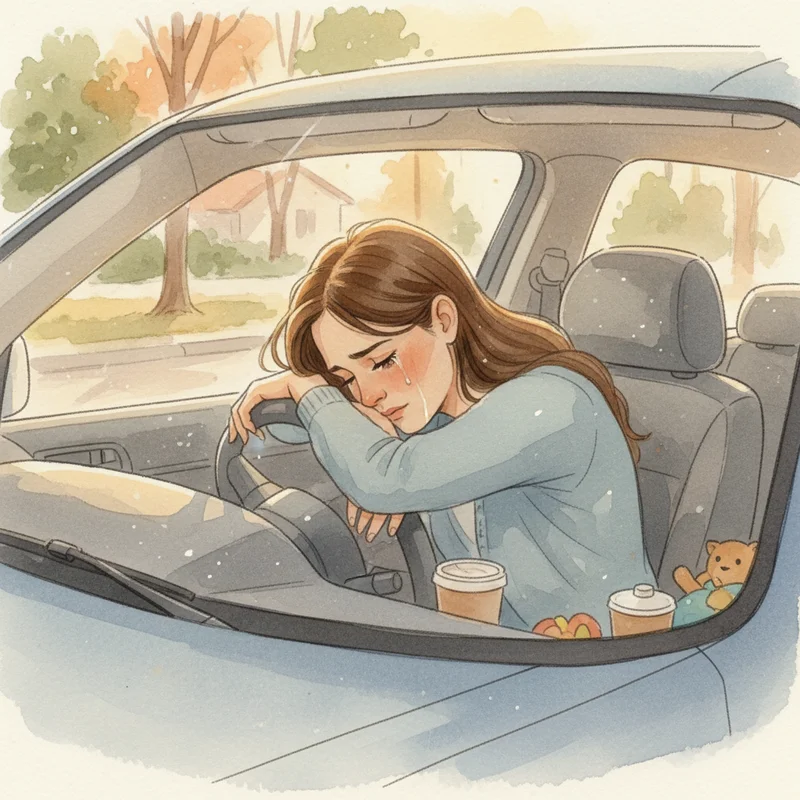
In the parking lot, I sat in the driver's seat and cried while he quietly buckled himself in. He didn't say anything. That silence was worse than any tantrum.
The ADHD parent guilt after losing your temper in public is a specific kind of awful. It's not just guilt — it's shame. And shame, unlike guilt, doesn't motivate repair. It just keeps you stuck.
Why Public Meltdowns Push ADHD Parents Past Their Limit Faster Than Anything Else
There's a reason public situations break us faster than home ones. It's not weakness. It's biology.
When you're being watched, your own threat-response system activates. Social judgment is processed by the same brain regions as physical danger. So you're simultaneously trying to co-regulate a dysregulated child and manage your own activated nervous system under the eyes of strangers who are almost certainly judging you.
That's not a parenting failure. That's an impossible neurological ask.
What makes ADHD meltdowns in public so destabilizing is the social layer on top of what's already hard at home. The sensory overload that triggers meltdowns at restaurants doesn't get easier with an audience — it gets harder, because now you're dysregulated too.
And if you've been walking on eggshells all week — bracing for the next explosion, running on empty from parent burnout — your window of tolerance going into that Target was already paper-thin. The meltdown didn't cause your reaction. It was the last straw on a very full load.
Understanding this isn't an excuse. It's the starting point for actually doing better next time.
The Shame Spiral — And Why It Keeps You Stuck
ADHD parent guilt after losing temper in public tends to follow a predictable loop: the incident, the spiral, the overcorrection, and then the next incident — often worse, because you're either hypervigilant or emotionally depleted going in.
The shame spiral sounds like this in your head: What is wrong with me. A good mother wouldn't have done that. He's going to remember this forever. I'm damaging him.
Here's what I know from both my OT background and from living it: shame doesn't produce repair. It produces avoidance, withdrawal, and the kind of overcorrecting that actually confuses kids more than the original incident did.
The guilt that says "I did something I'm not proud of and I want to do better" — that's useful. The shame that says "I am a bad mother" — that keeps you frozen.
If you've also been watching your child struggle with their own shame spirals after mistakes, you already know how hard it is to watch someone you love get stuck in that loop. We have to model our way out of ours, too.
What Repair Actually Looks Like With an ADHD Child
Here's what I got wrong for a long time: I thought repair meant a formal, serious apology conversation. The kind where you sit down, make eye contact, and carefully explain what you did wrong and why it won't happen again.
That approach tends to backfire with ADHD kids.
A formal apology can feel like another intense emotional event — one that reactivates the dysregulation instead of resolving it. Many ADHD kids have demand avoidance around "we need to talk" conversations. The more structured and serious you make the repair attempt, the more likely they are to shut down or escalate.
Real repair with an ADHD child is usually quieter. Simpler. More physical than verbal.
It happens in the doing, not the explaining.
That evening after the parking lot, I didn't sit Oliver down. I went and found him in his room, sat on the floor next to where he was playing, and just... was there. After a few minutes, I said: "Hey. I was really frustrated today and I grabbed your arm too hard and said something unkind. That wasn't okay. I'm sorry."
Eleven words. No lecture. No "and here's what you did that made it hard." Just the apology, clean and simple.
He looked up from his Legos, said "okay," and went back to building. And somehow that was enough. The door was open again.
Why Modeling Repair Is One of the Most Powerful Things You Can Do
ADHD kids struggle — profoundly — with the concept that you can make a mistake, apologize, and have the relationship survive intact. Their explosive reactions when they're wrong often come from a terror that mistakes are catastrophic and permanent.
When you model repair — when you show them that even adults lose it sometimes, and that the relationship holds anyway — you are teaching them something their ADHD brain desperately needs to learn.
You are not proving you're a bad parent. You are proving that repair is possible.
This connects directly to why the meltdown cycle can feel like it's destroying your relationship — not because of the meltdowns themselves, but because of what happens (or doesn't happen) afterward. Repair is what keeps the bond intact.
Building Your Own Regulation Toolkit Before the Next Public Trigger
Because there will be a next time. That's not pessimism — it's just the reality of parenting a child with ADHD. The goal isn't to never get triggered. It's to expand your window of tolerance so you have more runway before you hit your limit.
A few things that have genuinely helped in our house:
- The pre-public debrief. Before we go anywhere sensory-heavy, I do a quick internal check. Am I already running low? Have I eaten? Slept? If the answer is no on multiple fronts, I adjust expectations — mine, not his.
- The physical anchor. I press my feet into the floor. Hard. It sounds almost too simple, but proprioceptive input helps ground your own nervous system while you're trying to manage his. I learned this in OT school and I use it constantly.
- The exit plan, pre-decided. Before we go in anywhere, I identify where we'll go if things escalate. Having an exit already planned means I'm not making decisions under pressure, which is when I make bad ones.
- The time buffer. I stopped scheduling anything after an already-hard event. If we've had a difficult morning, we're not also going to Target. That's just math.
If you're also dealing with the sensory triggers behind your child's public meltdowns, addressing those is its own project — and an important one. But your regulation and your child's regulation are separate systems that both need attention.
You cannot pour from an empty cup. That phrase is exhausted from overuse, but it's true. The parent rage and screaming cycle almost always traces back to a depleted parent, not a bad one.
And if you find yourself losing it regularly — not occasionally, but as a pattern — that's important information. It might mean the day-to-day is genuinely too hard right now, and you need more support than a toolkit can provide. That's not failure. That's just an honest read of your situation.
You are allowed to be a work in progress. So is your child. That's actually the thing you have most in common.
The parking lot incident happened three years ago. Oliver is ten now. He doesn't remember it — or if he does, it hasn't become the defining story of our relationship. What he knows is that his mom gets frustrated sometimes, says sorry when she should, and shows up the next day.
That's enough. You can be enough too.
Parent Training — Limited Spots
Learn to Regulate Yourself So You Can Regulate Together
This 9-module training walks ADHD parents through the exact co-regulation tools that prevent public meltdowns from becoming breaking points — for you and your child.
87 of 100 spots taken · 9 video modules · $9.99 trial
START YOUR $9.99 TRIAL →Is your child's dysregulation making every outing feel like a gamble?
Take the free 2-minute assessment to understand what's driving the meltdowns — and what kind of support fits your child's specific brain.
TAKE THE FREE ASSESSMENT →
