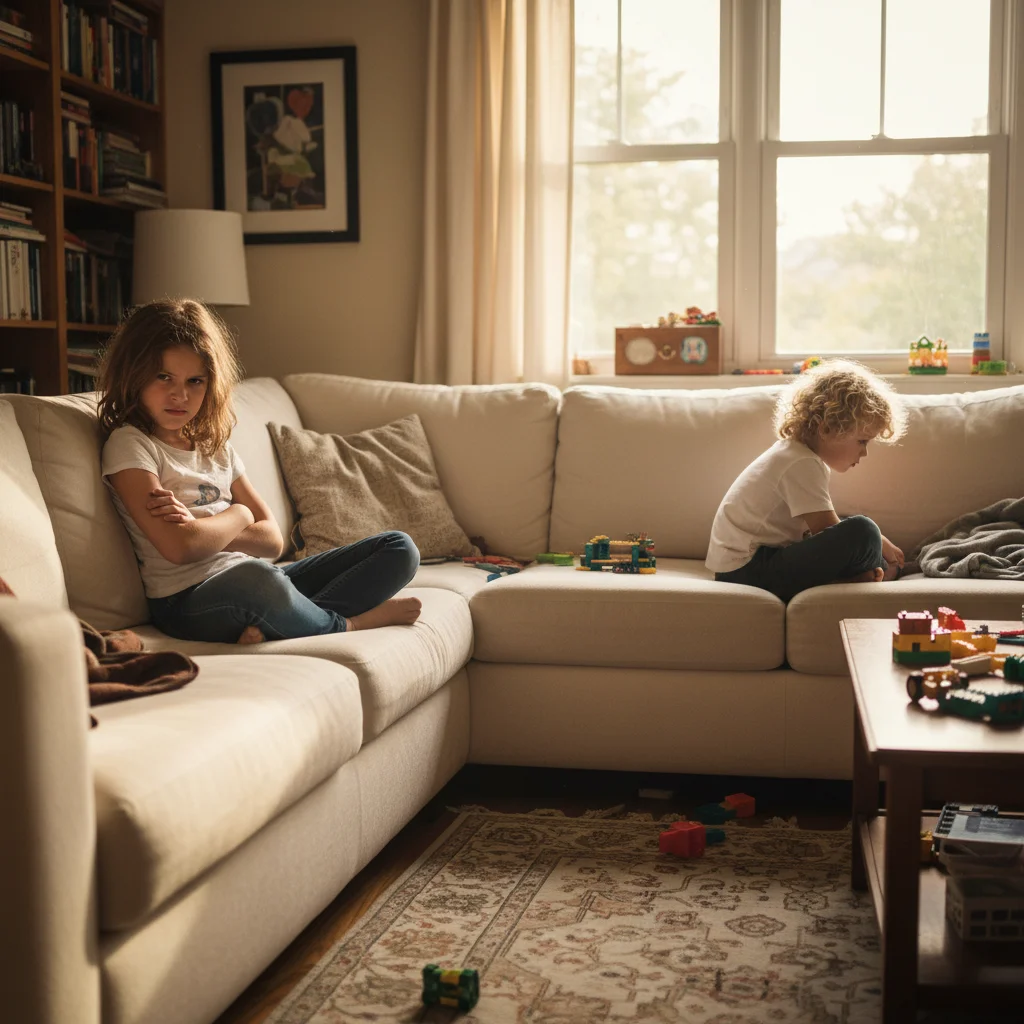
There was a Tuesday afternoon last spring when Oliver and his younger sister Maeve couldn't sit at the same kitchen table to do homework without it ending in screaming, a thrown pencil, and Maeve locking herself in the bathroom sobbing.
I stood in the hallway between them and thought: I am failing both of my children at the exact same time.
If that's where you are right now — please hear this first: you are not failing. ADHD isn't bad behavior — it's brain chemistry, and the sibling friction it creates isn't a parenting problem. It's a neurological one. That distinction matters, because it changes everything about how you respond.
Why ADHD sibling conflict is categorically different from normal rivalry
All siblings fight. That's not what this is.
What ADHD siblings can't get along looks like is this: your ADHD child goes from zero to one hundred over something that seems invisible — a sound, a look, a chair that got moved two inches. Your non-ADHD child retaliates or withdraws. And suddenly you have a full-scale explosion before anyone understands what triggered it.
The difference is dysregulation speed. A neurotypical child might feel annoyed and have several seconds — even minutes — to choose a response. An ADHD child's brain can go from calm to crisis in under three seconds, with almost no warning signal in between. By the time your non-ADHD child has processed what's happening, the ADHD sibling is already in full meltdown.
That gap — the one where a reasonable response used to live — is what you're actually managing.
What neither child can see (and why the ADHD child almost never means it)
Oliver never woke up planning to ruin Maeve's afternoon. But Maeve experienced it that way, every single time. That's the tragedy at the center of ADHD sibling dynamics.
The ADHD child is usually reacting to something their nervous system detected before their conscious mind did — a noise that was too sharp, a transition that came too fast, a sensory input that tipped an already-overwhelmed system over the edge. What looks like aggression is often a sensory processing crisis wearing the costume of a sibling fight.
At the same time, the non-ADHD sibling's anger is completely valid. They're living with unpredictability. They walk on eggshells. They learn to shrink themselves — avoiding certain topics, certain rooms, certain toys — just to keep the peace. That kind of chronic stress leaves marks.
The unfair dynamic in ADHD sibling households is real: one child's neurological needs can end up consuming the family's emotional oxygen. Both children need you to name that honestly.
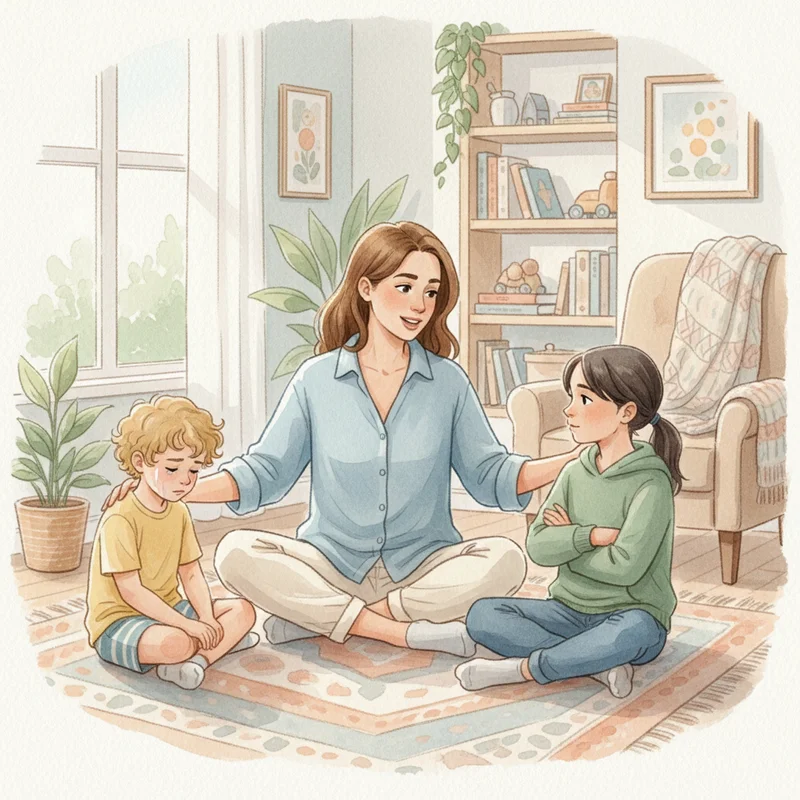
"Oliver, I know you didn't mean to scare her. And Maeve, I know it doesn't feel fair that this keeps happening. Both things are true."
Saying that out loud — to both of them, at the same time — was the first thing that actually started to shift something.
Structural changes that actually reduced daily collisions
Talking about feelings helps, but it doesn't prevent the next explosion. Structure does.
These are the three changes that made the biggest difference in our house:
- Scheduled separation before it's needed. We built "parallel play" time into the afternoon — 30 minutes where each kid is in their own space, not because anyone is in trouble, but as a daily reset. Oliver in his room, Maeve at the kitchen table. By the time they came back together, the post-school pressure had dropped enough that contact was survivable. After-school restraint collapse is real — proximity right after school is the highest-risk window. We stopped forcing togetherness during it.
- A physical buffer for shared spaces. We reorganized the living room so Oliver had a dedicated corner with his own sensory tools — a weighted blanket, headphones, a small bin of fidgets. It sounds simple. It reduced "he's touching my stuff" fights by probably 60%.
- Predictable transition warnings. Most sibling explosions in our house happened at transitions — dinner's ready, time to leave, TV off. We added a two-minute verbal warning before every transition, which sounds exhausting but became automatic within two weeks. Transition warnings genuinely reduce ADHD meltdowns — and when the meltdowns dropped, so did the sibling collisions that followed them.
Scripts for de-escalating sibling fights before they go physical
When Oliver and Maeve were already escalating, my instinct was to intervene with questions: "What happened? Who started it?" That made everything worse. Questions require executive function. Neither child had executive function available in that moment.
What worked instead was narration without blame:
- "I can see both of you are really upset right now."
- "We're going to take a break before anyone talks. Oliver, couch. Maeve, kitchen. I'll come to each of you in five minutes."
- "Nobody's in trouble. We just need to slow this down."
The key is physically separating them before speaking. Words don't land during dysregulation. Movement does. Get bodies into different rooms first, then circle back for the conversation.
For the ADHD child specifically, the repair conversation after a blowup matters more than anything said in the middle of it. Oliver needed to hear — once he was calm — that what happened wasn't who he was. That framing, repeated consistently over months, is the thing that eventually helped him start to catch himself earlier.
Giving each child what they need without the other feeling robbed
Maeve once told me, at age seven, that I loved Oliver more because I spent more time helping him.
That sentence sat in my chest for weeks.
What I eventually understood is that she didn't need equal time — she needed her own time that was predictable and protected. We started a Tuesday night tradition: after Oliver went to bed, Maeve and I would sit at the kitchen table and do something small together — a puzzle, a card game, painting her nails. Twenty minutes, every week, with no ADHD fires to put out.
She stopped saying I loved Oliver more.
For the ADHD child, what they need most is not to feel like a burden or a problem. Oliver needed regular moments where I engaged with him in his interests — not to manage behavior, but just because I wanted to. The self-esteem hit that ADHD kids carry is significant, and sibling conflict makes it worse. Small, consistent deposits into that account matter enormously.
When sibling dynamics signal something bigger
There's a difference between hard and harmful. Hard is what I've described above — daily friction that's exhausting but manageable with the right tools.
Harmful looks different. It looks like physical aggression toward a sibling that's escalating in frequency or severity. It looks like the non-ADHD sibling developing anxiety symptoms, refusing school, or showing signs of the kind of chronic stress burnout that doesn't resolve with a good weekend. It looks like one child who's genuinely frightened of the other.
If you're there, a family therapist who specializes in neurodevelopmental differences isn't a last resort — it's the right tool for the level of problem you have. There's no version of this that's too broken for outside support. We did a family OT consultation when Oliver was eight, and it was one of the most clarifying experiences we had as a family. The therapist helped Maeve articulate things she'd never been able to say to us directly.
You're not failing your kids by needing help navigating this. You're modeling exactly the kind of problem-solving you want them to learn.
Parent Training — Limited Spots
Ready to stop managing sibling explosions one day at a time?
The Unbreakable ADHD parent training gives you a step-by-step framework for reducing dysregulation — which means fewer sibling blowups, not just better tools for cleaning them up.
87 of 100 spots taken · 9 video modules · $9.99 trial
START YOUR $9.99 TRIAL →Is your ADHD child's dysregulation driving the sibling conflict?
The free 2-minute assessment helps identify which specific brain regulation challenges might be fueling the daily explosions — so you can support the root cause, not just the symptom.
TAKE THE FREE ASSESSMENT →