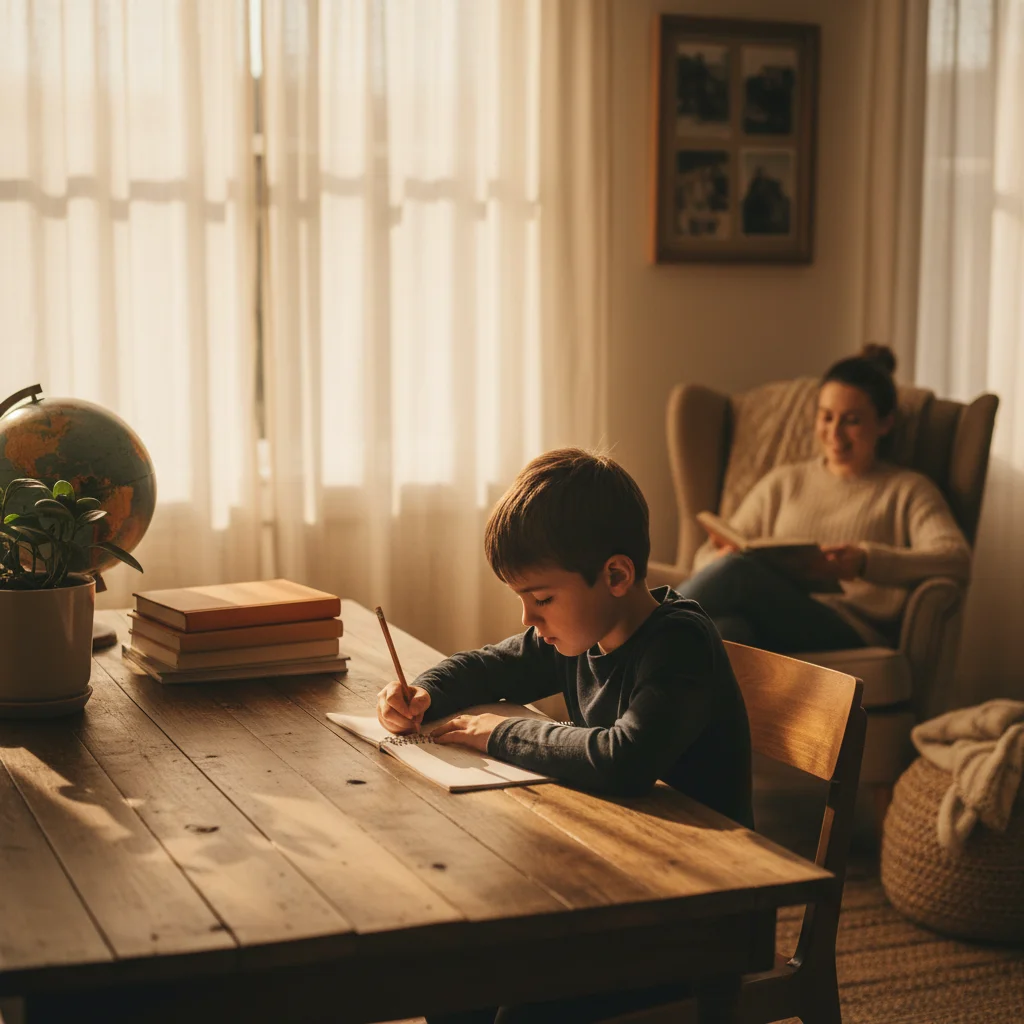
When Oliver was 7, his teacher pulled me aside after pickup and said — very gently — that he was "disrupting the whole table." Not because he was being mean. Because he simply could not stop moving, could not stop talking, could not land on a task for more than 90 seconds.
I went home and fell down the supplement rabbit hole. L-theanine kept coming up. Every ADHD parenting group I was in had at least one mom singing its praises. So I tried it. And here's the honest truth: it wasn't nothing. But it also wasn't enough — and understanding why changed how I thought about ADHD supplements entirely.
First: if your child is struggling, that is not a reflection of your parenting. ADHD isn't bad behavior — it's brain chemistry, and no amount of discipline or routine is going to patch a neurological gap. You are not failing your kid. You're here, researching, trying. That matters.
What L-Theanine Actually Does (And Doesn't Do) in the Brain
L-theanine is an amino acid found naturally in green tea. It promotes alpha brain wave activity — the relaxed-but-alert state you feel after a warm cup of tea. It also nudges GABA, the brain's main calming neurotransmitter, and has a mild effect on serotonin.
For a child who's in a constant state of hyperarousal — bouncing off the walls, unable to self-soothe, melting down over minor transitions — that calming signal can genuinely help. I saw it with Oliver. The edge came off. Bedtime got slightly less catastrophic.
But here's the gap nobody talks about in those Facebook groups: L-theanine does almost nothing for dopamine.
And dopamine is the engine of focus.
ADHD involves dysregulation across four brain pathways: dopamine (motivation and sustained attention), serotonin (mood and impulse control), GABA (calming and anxiety), and norepinephrine (alertness and executive function). L-theanine primarily addresses GABA — and to a lesser extent, serotonin. It leaves dopamine and norepinephrine largely untouched.
Which means a calmer child who still can't focus. A quieter classroom problem that hasn't actually been solved.
"He was less bouncy. But he still couldn't read three sentences without losing his place. The calm was real — the focus wasn't there."
That was me, in Oliver's second-grade year. Describing what l-theanine actually delivered.

What the Clinical Evidence Actually Says About L-Theanine and ADHD Focus
There is some research on l-theanine for ADHD children — but it's worth reading carefully before you get excited.
The most-cited study (Steenbergen et al., 2015) found improvements in attention-switching and reaction time when l-theanine was combined with caffeine — not l-theanine alone. Another small study showed modest improvements in sleep quality in boys with ADHD. That's genuinely useful data. But "better sleep" and "better sustained classroom focus" are very different outcomes.
When researchers look at attention scores specifically — the kind that matter when your child is sitting in a classroom trying to hold a math concept for 20 minutes — l-theanine alone consistently shows limited impact. The calm is real. The focus improvement is, at best, indirect (a less anxious child may find it slightly easier to attend) rather than a direct dopamine effect.
Compare that to what research suggests about saffron: a 2019 randomized controlled trial published in the Journal of Child and Adolescent Psychopharmacology (Baziar et al.) found saffron showed comparable efficacy to methylphenidate on ADHD symptom scores over six weeks. That's not a small finding. Saffron works on both serotonin and dopamine pathways — which is why researchers believe it addresses both the calm-and-mood piece and the focus-and-motivation piece simultaneously.
For a deeper breakdown of how different natural supplements stack up on clinical evidence, see how every natural ADHD supplement stacks up in our full comparison. It's the article I wish existed when I was starting this journey.
Saffron vs. L-Theanine: Why One Covers the Full ADHD Profile
Think of the four ADHD brain pathways like four flat tires. L-theanine inflates one, maybe one and a half. Your child is calmer — but still dragging on three flat tires when it comes to the focus, motivation, and executive function they need to actually succeed at school.
Saffron, based on the available research, appears to engage all four pathways: it influences serotonin reuptake (mood, impulse control), modulates dopamine (motivation, sustained attention), supports GABA activity (calming), and has downstream effects on norepinephrine (alertness, task-switching). That's the difference between a partial answer and a complete one.
This is why I eventually moved away from l-theanine as a standalone and started looking at saffron-based options. Saphire Happy Chews are the only saffron gummy I've found specifically formulated for children — and the one I now recommend to parents in my community who are looking for something that addresses calm and focus through the same supplement, rather than trying to patch together a supplement stack.
That said: l-theanine isn't useless. For bedtime wind-down specifically, it has a real role. I still use it occasionally for Oliver in that context. But if your goal is school performance, classroom attention, and getting through homework without a meltdown — l-theanine alone is going to leave you frustrated.
Can L-Theanine and Saffron Work Together?
This is a question I get a lot, and it's a fair one. Because if l-theanine is helping with sleep or edge-taking, why not keep it while adding something that addresses the dopamine gap?
Honestly? For many parents, the answer is yes — with a few caveats.
L-theanine is generally well-tolerated with no major interaction concerns flagged in the literature. If it's genuinely helping your child settle at night (which is real, documented, and meaningful — see how it compares to melatonin for ADHD sleep specifically), there's no strong reason to stop.
What I'd caution against is using l-theanine as a proxy for focus support during school hours. The calming effect can make a child appear more manageable, which can mask the fact that the underlying dopamine dysregulation is still fully present. You might think something is working when really only part of the problem is being addressed.
If your child is struggling to focus even in low-distraction environments, that's a strong signal that the dopamine pathway needs direct support — not just more calming.
The supplement stack question is also worth asking your pediatrician about before making changes. Every child's neurochemistry is different, and what I share here is what I've learned as a former OT and an ADHD mom — not clinical guidance for your specific child.
Before You Settle for Calmer-But-Still-Unfocused
Here's what I want you to take away from this:
L-theanine is not a scam. It does what it does — genuine GABA support, real calming effect, some sleep benefit. If that's what you need right now, it has a place.
But if you've been using it for months and your child is calmer-but-still-struggling in school, still getting teacher complaints, still melting down over homework — the calm was never the whole problem. Dopamine dysregulation doesn't get better with GABA support alone.
The research on saffron as a multi-pathway option is genuinely promising. The 2019 RCT comparing it to methylphenidate wasn't a small study funded by a supplement company — it was peer-reviewed, randomized, and published in a respected journal. That's a different category of evidence than most natural supplements can point to.
Saphire Happy Chews are how I've seen parents access that saffron research in a format their kids will actually take — a gummy, not a capsule, without the additives that make many supplement brands a non-starter for sensitive kids.
If you're not sure where your child's ADHD profile falls — whether it's primarily a calm issue, a focus issue, or both — the free assessment at trysaphire.com is a good starting point. It takes about two minutes and gives you a clearer picture of which pathways are most likely driving your child's specific symptoms.
For a full side-by-side of how l-theanine, magnesium, omega-3s, and saffron compare on clinical evidence and pathway coverage, see how every natural ADHD supplement stacks up. It's the resource I built after spending two years and more money than I want to admit working through them one by one.
You don't have to do this the hard way.
Not sure if l-theanine is addressing your child's full ADHD profile?
Take the free 2-minute assessment to see which of the 4 brain pathways are driving your child's specific symptoms — and what kind of support actually fits.
TAKE THE FREE ASSESSMENT →
