For almost two years, I punished Oliver — my then-8-year-old — every single time he forgot his homework folder, his chores, his backpack, his lunch. I took away screen time. I gave lectures. I made him sit and "think about it."
Nothing changed. He kept forgetting. I kept punishing. And the guilt on his face every evening broke something in me.
Here's what I didn't understand yet: he wasn't forgetting because he didn't care. He was forgetting because his brain literally could not hold that information the way mine does. Once I understood that, everything about our approach had to change.
This is not a parenting failure on your part. And it's almost certainly not defiance on theirs. If your ADHD child forgets responsibilities without punishment making any difference, read on — because what finally worked for us had nothing to do with consequences.
Why Punishment Was Making the Forgetting Worse
When Oliver forgot something and I punished him, I watched a predictable sequence unfold: shame, shutdown, then more forgetting.
That's not coincidence. When a child with ADHD feels shame, their already-taxed brain goes into threat mode. Stress hormones spike. And the very cognitive systems responsible for memory and planning — the ones already struggling — get even less oxygen.
What looks like selective hearing is actually a working memory crisis that punishment actively worsens. You're not reinforcing the lesson. You're flooding the exact system you need to work.
I also kept confusing "not remembering" with "not caring." Oliver cared enormously. He cried about it. He promised it wouldn't happen again — and meant it completely in that moment. The promises weren't lies. They were a kid with no reliable memory system trying to use willpower as a substitute for one. Willpower doesn't work that way for anyone, but especially not for an ADHD brain.
If you've been down the privilege-removal road and watched it backfire, you already know this. The behavior doesn't change because the underlying deficit hasn't been addressed.
The External Memory System That Replaced Nagging
The breakthrough came from my old OT training, actually. We build external scaffolding for physical limitations all the time — ramps, rails, glasses. Working memory deficits need the same thing: external scaffolding that replaces what the brain can't do internally.
We stopped relying on Oliver's brain to remember. We built systems that remember for him.
Here's exactly what we put in place:
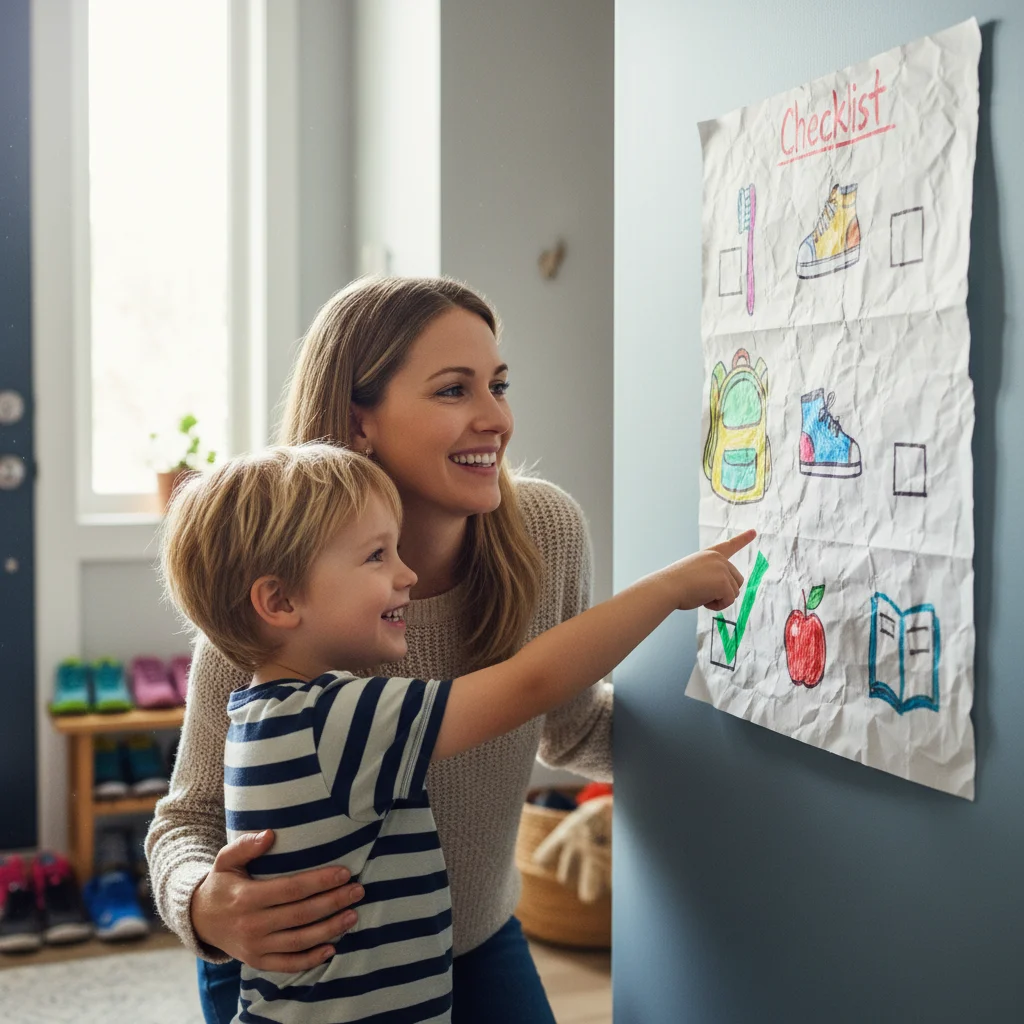
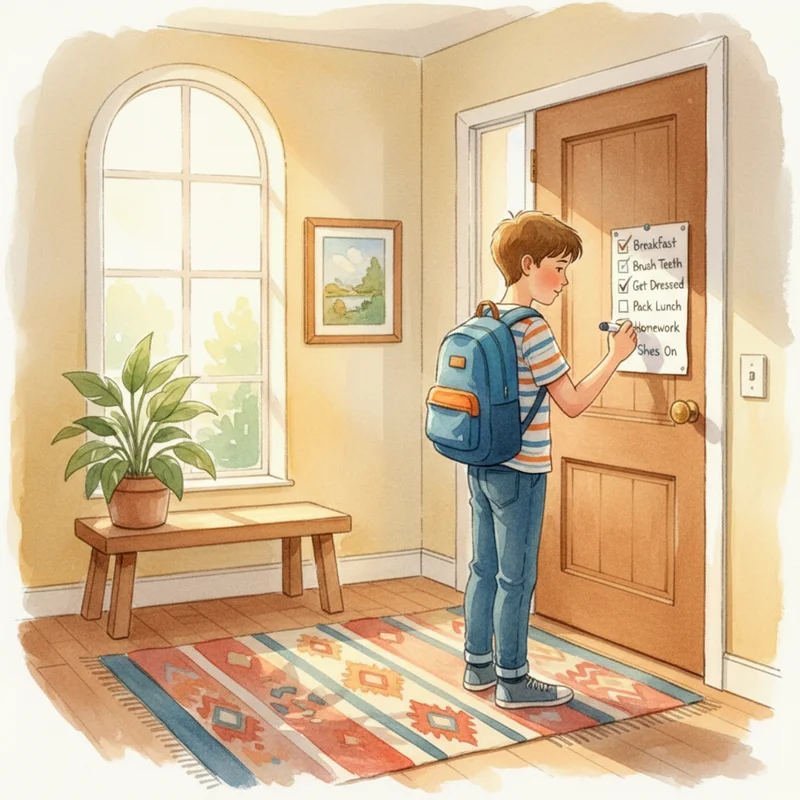
- A laminated visual checklist at the front door. Not a punishment chart, not a reward chart — just a checklist. Backpack. Folder. Lunch. Shoes. It lives at eye level by the door handle. His job is to look at it, not to remember the list.
- Designated "launch pads" for everything. Homework goes in one spot — the same spot, always. Shoes go in one spot. We stopped negotiating about where things live. They live in their spot, full stop. This cut the "where is my...?" panics by about 80%.
- A visual chore board with photo cards. Not words — photos. A picture of the trash can means take out the trash. When it's done, he flips the card. This was a game-changer. The chores responsibility system I now recommend to every ADHD parent is photo-based, not word-based.
- One reminder, then the system takes over. I stopped nagging. My one job is to point to the checklist. The checklist does the rest.
The key insight: the system becomes the parent. I'm no longer the one enforcing memory. The environment is.
Accountability Without Consequences That Backfire
Removing punishment doesn't mean removing accountability. This is the part that tripped me up the longest.
The goal is natural consequences that are proportionate and immediate — not punishments delivered hours after the fact. When Oliver forgot his library book, he couldn't check out a new one. That's a natural consequence. It happened in the moment. He felt it directly. I didn't add anything on top of it.
What I stopped doing: adding lectures, taking away unrelated privileges, or bringing it up at dinner. The natural consequence was enough. My job was to stay neutral — "That's a bummer. What could help you remember it next time?" — and then help him problem-solve.
That last question is the whole pivot. Punishment doesn't work for ADHD kids because it focuses on the past. Problem-solving focuses on the future. ADHD brains respond to future-focused thinking — it activates dopamine in a way that shame simply doesn't.
We also started separating the child from the behavior explicitly. "Your brain is still learning how to hold this information" is very different from "you need to be more responsible." One is accurate and neutral. One creates shame. ADHD isn't bad behavior — it's brain chemistry. Once Oliver heard that from me consistently, his willingness to engage with the systems went up dramatically.
The 3-Step Habit Loop That Sticks With ADHD Brains
We didn't just build external memory — we started building habits. Habits eventually become automatic, which is the only thing that actually reduces the cognitive load long-term.
The loop we use has three parts:
- Cue: Something in the environment triggers the behavior. For us, putting his backpack by the door each night is the cue for the next morning checklist. We don't rely on "remembering to check the list" — we placed the list where he physically can't miss it.
- Routine: A short, specific sequence. Check list. Pack bag. Flip card. Done. We practiced it together on weekends until it felt automatic. We timed it and made it a game — could he beat his last time?
- Reward: Immediate, small, consistent. For Oliver, it was two minutes of his choice of music on the drive to school if he completed the checklist without a reminder from me. Small reward. Immediate. Tied directly to the behavior. This is how dopamine works — why star charts fail for ADHD kids is that the reward is too delayed and too abstracted.
It took about three weeks of consistent practice before the morning checklist became genuinely automatic. Three weeks. That's it. But you have to be consistent for those three weeks — which is the hard part when you're exhausted.
When the system breaks down — and it will, especially after school breaks or illness — the fix is to restart the loop, not to punish. We treat it like a habit reset, not a moral failure. Structure collapse after breaks is one of the most predictable ADHD patterns there is. Building the restart into your expectations makes it survivable.
The system doesn't fail because your child is irresponsible. It fails because ADHD brains are uniquely sensitive to environmental disruption. Your job is to rebuild the scaffold, not punish the kid who lost their footing.
The Mindset Shift That Made Both of Us Better
The moment I stopped seeing Oliver's forgetting as willful or lazy — and started seeing it as a genuine neurological gap I could help him compensate for — our entire relationship changed.
He stopped dreading evenings. I stopped resenting him. We became a team problem-solving together instead of adversaries in a power struggle.
His third-grade teacher pulled me aside in November of that year. She said, "Whatever you're doing at home — his organizational skills have improved so much." I told her we'd built some systems together. She asked if I'd share them with the class.
He's still not perfect. He still forgets things. But now when he forgets, he has a system to catch it — and he knows how to reset when the system slips. That's the real win. Not a kid who never forgets. A kid who knows what to do when he does.
If you're looking for a deeper dive into the school side of this — especially if teachers are involved in tracking responsibilities — the ADHD 504 plan guide walks through exactly what accommodations you can request to extend these systems into the classroom. You don't have to fight this battle alone at home.
And if mornings are a particular war zone in your house, the complete ADHD morning routine guide maps out a structure that pairs well with everything above.
Parent Training — Limited Spots
Learn the Full System for Building ADHD Accountability Without Punishment
The Unbreakable ADHD course walks through accountability frameworks, habit-building strategies, and meltdown prevention in 9 video modules — built specifically for parents of ADHD kids.
87 of 100 spots taken · 9 video modules · $9.99 trial
START YOUR $9.99 TRIAL →Is forgetting just one part of what's happening with your child?
Working memory challenges in ADHD kids often show up alongside focus, mood, and impulse control struggles. A free 2-minute assessment can help clarify what's going on — and what kind of support might actually help.
TAKE THE FREE ASSESSMENT →

