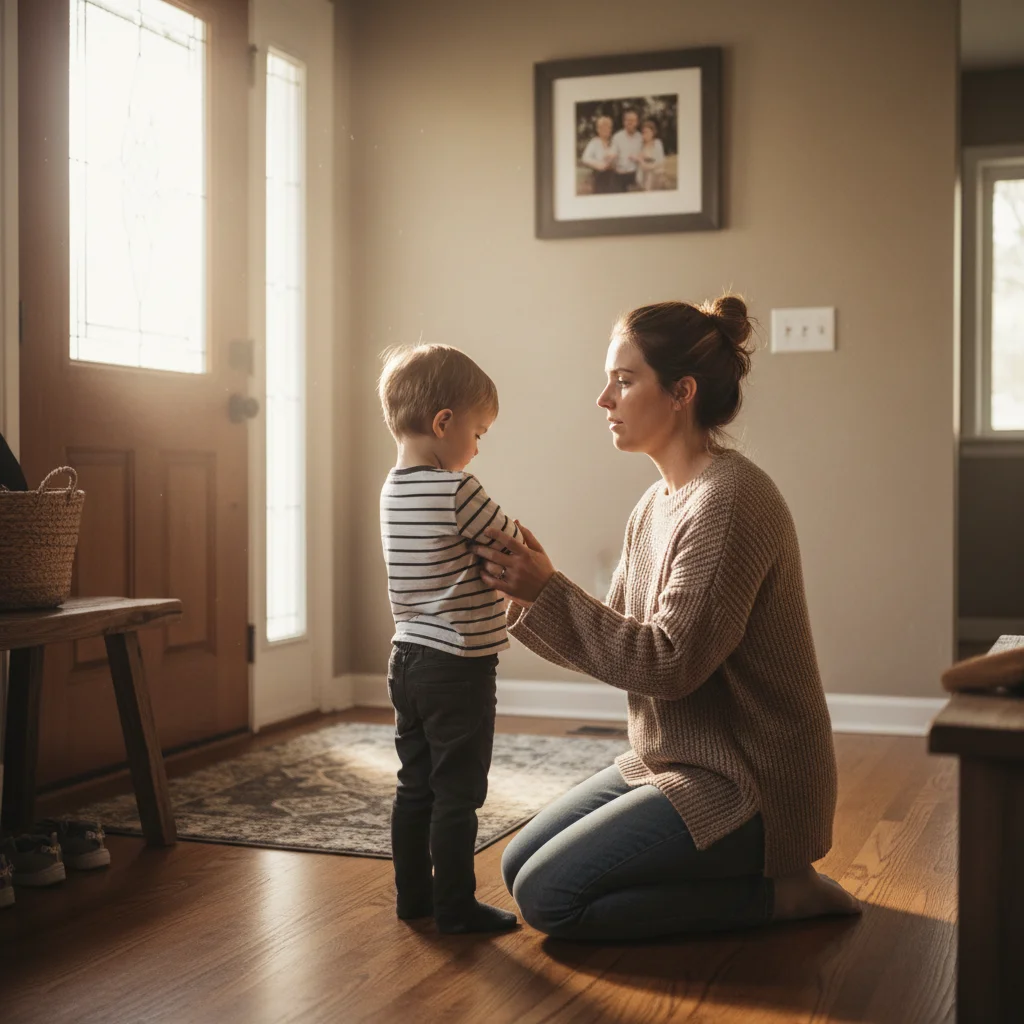
It was a Sunday afternoon in November, and Oliver was seven. My mother-in-law had been waiting for us for forty minutes. Oliver was face-down on the hallway floor, screaming that he wasn't going, that we were ruining his life, that Grandma's house was "too loud and wrong."
My husband was red-faced at the front door. I was somewhere between furious and completely heartbroken. And I remember thinking: What kind of child refuses to visit his own grandmother?
The answer, I'd eventually learn, had nothing to do with Grandma. And nothing to do with my parenting.
Why ADHD kids resist family visits more than other outings
Here's what nobody tells you: not all outings are equal for a child with ADHD, and family visits are uniquely hard.
A trip to the park has a clear purpose. A birthday party has a known script. But Grandma's house? It's unstructured time, in an unpredictable social environment, with adults who have different rules and different expectations — and no guaranteed exit time.
For a child whose brain is already struggling to regulate transitions, that combination is genuinely overwhelming. It's not defiance. It's the hidden anxiety that looks like defiance.
Family visits also carry an invisible emotional weight. Your child knows these people love them — which means the stakes feel higher. There's pressure to perform, to be "good," to sit still, to make conversation. That pressure lands on a nervous system that's already working overtime.
Transition panic vs. defiance — why the difference matters
When Oliver dug in at the door, my first instinct was that he was being manipulative. Choosing not to go because he'd rather stay home and play.
I was wrong.
Transition panic is a neurological event, not a behavioral choice. The ADHD brain has real difficulty shifting between mental states — leaving a preferred activity, entering an unpredictable environment, losing the sense of control that comes with a known routine. When that shift is forced, the stress response activates hard and fast.
This is the same brain dynamic behind meltdowns when leaving the house and after-school restraint collapse. The environment changes. The brain can't keep up. The body goes into crisis.
Understanding this changed everything for me — not because it made the behavior okay, but because it told me where to intervene. You can't reason a panicking child out of panic. But you can prevent the panic from escalating in the first place.
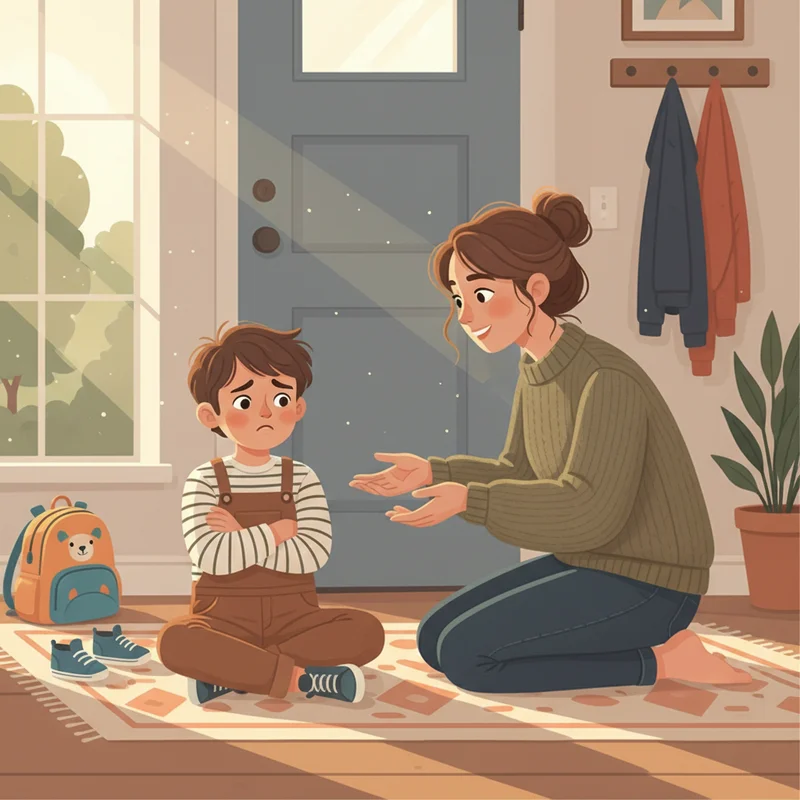
What's actually happening in their brain when they dig in
The short version: the ADHD brain has a harder time with what researchers call "cognitive shifting" — the mental gear-change required to move from one context to another.
Add in the anxiety that's so common alongside ADHD, and you get a child whose stress system fires before you've even put your shoes on.
Grandma's house triggers a cascade: What will it be like? Will there be something I can't eat? Will I have to hug people? Will I be forced to play something boring? When do we leave? These aren't irrational fears. They're a regulatory system in overdrive, trying to manage the unknown.
This is also why the refusal often escalates the more you push. Pressure increases cortisol. Cortisol makes regulation harder. The meltdown you were trying to avoid becomes inevitable.
The 5-step pre-visit routine that changed everything for us
I want to be honest: this took us about two months to build, and there were still hard days. But these five steps moved us from a 90% refusal rate to maybe one difficult visit every six or seven weeks.
- The preview conversation — two days before. Not the morning of. Not in the car. Two days before, I'd sit with Oliver and describe the visit like a movie trailer: "Sunday we're going to Grandma's. She'll probably have lunch. You can bring your Legos. We'll probably stay about two hours." That's it. No big deal. Just information.
- Give him one thing to look forward to and one thing he controls. "Grandma always has those crackers you like" (something positive). "You can pick one thing to bring" (autonomy). Autonomy is huge for ADHD kids — it reduces the sense of being dragged somewhere against their will.
- The day-of reminder — not an announcement. "Remember, today's the day we're going to Grandma's." Said casually, at breakfast, not at the front door. The front door is too late. By then, the panic is already in motion.
- A transition object and a clear exit time. Oliver brought his small backpack with two things he chose. And I always told him the exit time before we left: "We're leaving at 4. You can ask me what time it is whenever you want." That clock gave him something to hold onto.
- Acknowledge the hard part out loud. In the car, I'd say: "I know transitions are harder for you. Going to Grandma's is a big switch. That makes sense." Not a lecture. Just a sentence. It landed differently than "you're going to have fun, I promise."
This kind of structured approach to transitions is the same principle behind building an ADHD morning routine that actually works — predictability and advance warning are the two things that lower the neurological alarm before it fires.
How to talk to grandparents who think it's a discipline problem
This part was harder than managing Oliver, honestly.
My mother-in-law grew up in a house where you did what you were told, full stop. When Oliver melted down, she read it as permissive parenting. I heard it in her voice even when she didn't say it.
What helped was giving her one specific job instead of a general explanation. I stopped trying to educate her on ADHD neurology (she tuned out). Instead, I'd say: "Oliver does really well if he knows when we're leaving. Can you help me remind him at 3:30 that we're leaving at 4?" Grandma became part of the solution. That shifted everything.
I also stopped apologizing for Oliver's behavior and started describing it factually: "He has a harder time with transitions. It's not personal to you — he does this leaving school too." Removing the personal sting helped her hear it.
If your child also struggles with the aftermath of visits — falling apart when you get home — you're not alone. Restraint collapse after transitions is one of the most misunderstood ADHD patterns there is.
When refusal becomes a pattern: what to watch for
Occasional resistance to leaving the house is normal for ADHD kids. But there are signs that something more is going on.
- Refusal is escalating — getting worse over months, not better
- Your child is refusing all outings, not just family visits
- There are physical symptoms before visits: stomachaches, headaches, crying the night before
- The meltdowns are lasting longer than 30-40 minutes and happening daily
These can be signs of underlying anxiety that's showing up physically — or of ADHD burnout, which looks different from a typical meltdown but is just as real.
If that's where you are, it's worth talking to your pediatrician or a therapist who specializes in neurodivergent kids. Not because something is terribly wrong — but because your child is telling you they need more support than a routine adjustment can provide.
What I wish I'd known in year one
I wish someone had told me earlier that ADHD isn't bad behavior — it's brain chemistry. That my son wasn't choosing to ruin Sunday afternoons. That Grandma's house wasn't the enemy.
The refusal was information. It was telling me that the transition was too abrupt, the environment too unpredictable, the exit too uncertain. Once I started treating it as a problem to solve instead of a battle to win, we made progress.
Oliver is nine now. He still has harder days. But last month, he asked if we could go to Grandma's because she promised to teach him to play cards. I almost cried in the car on the way there.
That's the win. Not a perfect child. Just a child who trusts that you understand him.
Parent Training — Limited Spots
Learn to navigate ADHD transitions before they become meltdowns
The Unbreakable ADHD course gives you the exact scripts, routines, and strategies that work for transition-sensitive kids — so family visits stop being the thing everyone dreads.
87 of 100 spots taken · 9 video modules · $9.99 trial
START YOUR $9.99 TRIAL →Is transition panic driving your child's meltdowns?
Every ADHD child is different. Take this free 2-minute assessment to understand what's happening in your child's brain — and what kind of support fits their specific profile.
TAKE THE FREE ASSESSMENT →