
The summer Oliver was eight, I spent two weeks in May building the most beautiful color-coded schedule I had ever seen. I laminated it. I bought dry-erase markers in six colors. I was ready.
By day three, he had ripped it off the wall during a meltdown over screen time. I found it under his bed on day five, marker scribbles across every time block.
If your summer plan has already blown up — or you're bracing for it — I want you to know that is not a parenting failure. An ADHD brain isn't wired to follow rigid external schedules. The harder you try to force one, the harder it pushes back.
What I'm going to share isn't a schedule. It's an anchor routine — and there's a real difference.
Why Rigid Summer Schedules Always Fail ADHD Kids
Structure feels like the obvious solution when your child falls apart without it. But for kids with ADHD, a rigid minute-by-minute schedule creates a new problem: the anticipation of transitions.
Every time block on that laminated chart is another upcoming change — and ADHD kids experience changes in plans as genuine neurological threats. You're not making the day predictable. You're loading it with 14 future meltdown triggers.
Summer is also genuinely hard in ways that aren't obvious. When school ends, the external scaffolding — bells, transitions, teachers prompting the next thing — disappears overnight. For a child whose brain struggles to generate that scaffolding internally, the loss is disorienting. The hyperactivity spikes. The meltdowns escalate. The structure collapse is real, and it's neurological.
The answer isn't more structure. It's better-placed structure.
What "Anchor Routines" Actually Mean
An anchor routine doesn't tell your child what they're doing at 10:47 a.m. It gives the day a shape — a beginning, a middle, an end — without scheduling every moment in between.
Think of it like guardrails on a mountain road. The car can move freely between them. But it can't go off the cliff.
Our four anchors are the only non-negotiables in our summer day. Everything else floats.
Anchor 1: Morning Launch. Same wake time (within 30 minutes), breakfast together, and one "get-ready" task before any screens. That's it. The morning doesn't have to go smoothly. It just has to start the same way. If mornings have been a war zone for you, the ADHD morning routine guide has a 15-minute framework that helped us enormously.
Anchor 2: Midday Movement. Somewhere between 11 a.m. and 1 p.m., we do something physical. A walk, the trampoline, the pool, a bike ride. I don't schedule the time — I just make sure it happens before lunch. Exercise genuinely shifts ADHD brain chemistry, and skipping this anchor was the single biggest predictor of afternoon meltdowns for Oliver.
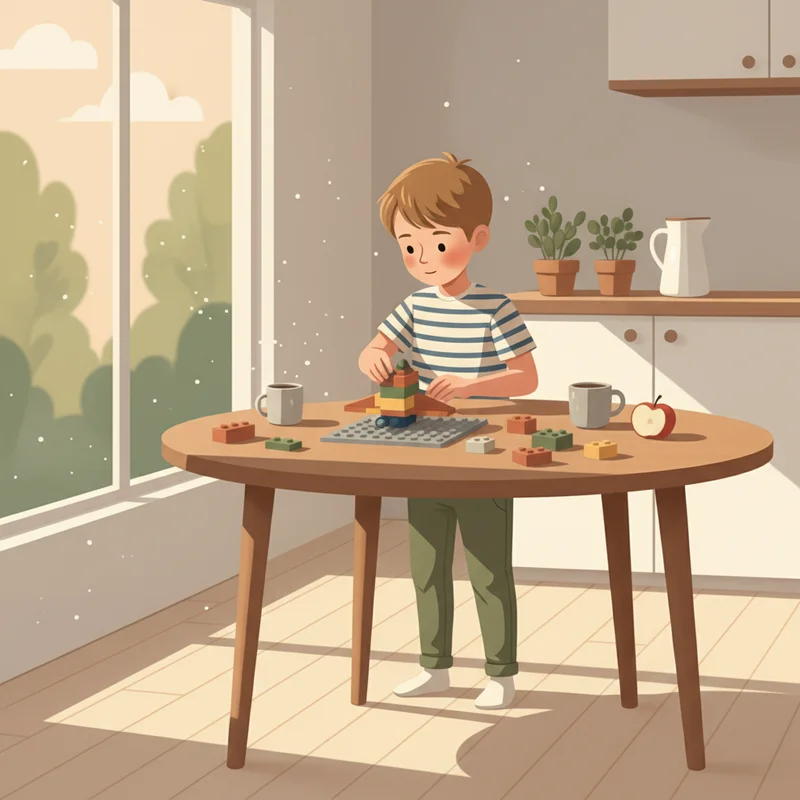
Anchor 3: Quiet Reset. After lunch, 20 minutes of independent, low-stimulation activity. No screens, no siblings, no requests. Oliver does Legos. My daughter draws. This isn't nap time — it's a nervous system reset before the afternoon ramps up. If your child resists this, start with 10 minutes and frame it as "your time to do whatever you want, as long as it's quiet."
Anchor 4: Evening Wind-Down. At 7 p.m., screens off, low lights, and a short predictable sequence before bed. For us: bath, 15 minutes of reading together, lights out. The bedtime script that works for ADHD kids helped me build this anchor without a fight.
When the Routine Still Falls Apart (Our Reset Protocol)
Anchors break. Someone gets sick. You're on vacation. A playdate runs until 4 p.m. and blows up the entire afternoon sequence.
The mistake I used to make was trying to recover the whole day. Once the midday anchor was gone, I'd scramble to rebuild everything — and Oliver could feel my stress, which made his regulation worse.
Now we have a one-rule reset: just find the next anchor.
If the morning launch falls apart, don't try to fix it. Move toward the midday movement. If the afternoon quiet reset gets skipped, move toward the evening wind-down. You're not restarting the day — you're locating the next handhold.
This works because ADHD kids don't need a perfect day. They need to know the day has a shape they recognize, even if it's dented.
It's also worth keeping an eye out for when summer dysregulation tips into something deeper. ADHD burnout in kids can look like extended summer collapse — and it's worth knowing the warning signs before it gets there.
The Guilt I Wish I'd Let Go of Sooner
I spent two summers believing that if I just found the right system, the right chart, the right reward structure, I could engineer a peaceful summer for Oliver.
What I actually needed to do was stop treating his dysregulation as a problem I was failing to solve, and start treating it as information about what his nervous system needed in that moment.
The end-of-school transition anxiety is real. The unstructured time experiment I ran last August taught me more about Oliver's actual regulation needs than any schedule ever did. Sometimes the most useful thing I can do at 2 p.m. on a Tuesday is take him outside and throw a ball for ten minutes.
You are not failing your child by not having a perfect summer. You are showing up, adjusting, and finding the next anchor. That's the whole job.
Your Flexible Summer Anchor Routine (Copy This)
Here's the exact framework we use. Adjust the times to fit your family — what matters is the sequence, not the clock.
- Morning Launch (7:30–9:00 a.m.) — Wake within 30-minute window, breakfast, one get-ready task before any screens.
- Free Time Block 1 (9:00–11:30 a.m.) — Mostly unstructured. Screens, play, creative projects. Your child leads.
- Midday Movement (Before lunch, non-negotiable) — Physical activity for at least 20 minutes. Outside if possible.
- Lunch + Quiet Reset (12:00–1:00 p.m.) — Eat together, then 20 minutes of independent quiet time.
- Free Time Block 2 (1:00–5:00 p.m.) — Playdates, outings, more screens, whatever the day brings.
- Dinner Anchor (5:30–6:30 p.m.) — Family dinner at roughly the same time. Even 15 minutes together counts.
- Evening Wind-Down (7:00 p.m.) — Screens off, low stimulation, predictable bed sequence.
That's four hard anchors and two free blocks. The free blocks absorb all the chaos. The anchors give the day its shape.
Print it, write it on a whiteboard, or just keep it in your head. The format doesn't matter. The consistency does.
Parent Training — Limited Spots
Stop Surviving Summer. Start Understanding What Your ADHD Kid Actually Needs.
The Unbreakable ADHD parent training walks you through the exact regulation strategies that work for ADHD brains — so you're not reinventing the wheel every July.
87 of 100 spots taken · 9 video modules · $9.99 trial
START YOUR $9.99 TRIAL →Is summer dysregulation a brain chemistry issue for your child?
A free 2-minute assessment can help you understand which of your child's ADHD symptoms are being driven by neurological imbalances — and what kind of support might actually help.
TAKE THE FREE ASSESSMENT →

