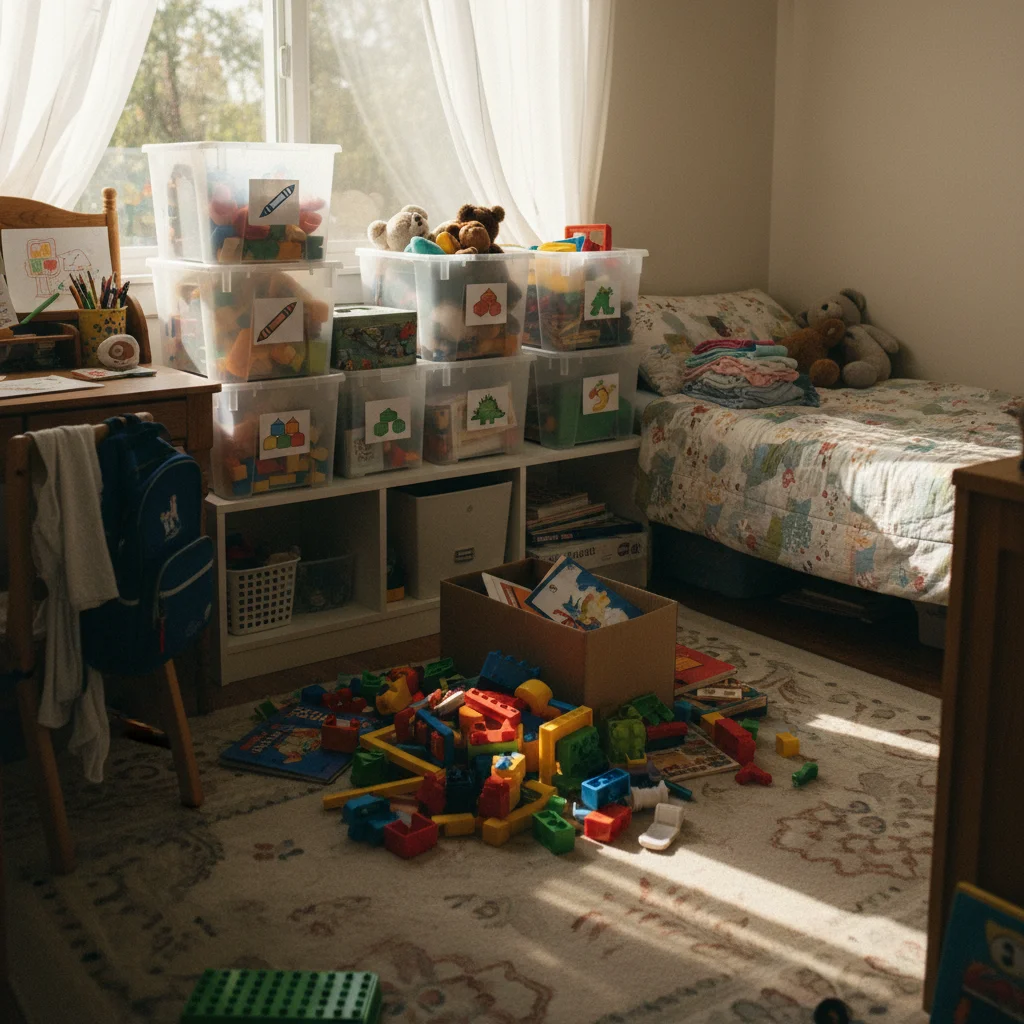
When Oliver was 8, his room looked like a tornado had hit it daily. Clothes on the floor, Legos everywhere, school papers buried under video games. I'd say "clean your room" and he'd stand in the doorway, frozen.
I thought he was being defiant. I was wrong. ADHD isn't bad behavior — it's brain chemistry, and what I was asking him to do was neurologically impossible.
If your ADHD child's room is chaos and nothing you've tried works, you're not failing as a parent. Their brain literally can't process "clean your room" the way neurotypical brains do.
Why 'Just Clean Your Room' Doesn't Work for ADHD Brains
Here's what happens when you tell an ADHD child to clean their room: their brain sees everything at once and nothing specifically.
Neurotypical kids can automatically break "clean your room" into steps: pick up clothes, make bed, put books away. ADHD brains can't do this executive function breakdown. They see the whole overwhelming mess instead of manageable pieces.
It's like asking someone to "just fix the car" when they can see the engine but don't know which part to touch first. The overwhelm triggers shutdown, not defiance.
"He'd stand there for 20 minutes, pick up one sock, then get distracted by a comic book under his bed."
The Executive Function Skills Missing from Room Organization
Room cleaning requires multiple executive function skills that ADHD brains struggle with:
- Task initiation: Starting without getting overwhelmed
- Working memory: Remembering what they were doing after getting distracted
- Cognitive flexibility: Switching between different types of tasks (clothes vs. toys)
- Organization: Categorizing items and knowing where things belong
- Time awareness: Understanding how long cleaning will actually take
When I understood this wasn't willful defiance but neurological wiring, everything changed. Instead of fighting Oliver's brain, I started working with it.
Breaking Down the Overwhelming Task Into Brain-Sized Chunks
The game-changer was what I call "single-category cleaning." Instead of "clean your room," I'd say "pick up all the red Legos." That's it.
ADHD brains can hyperfocus on specific, concrete tasks. "All the books" works. "Everything on the floor" doesn't because it's too broad.
Our categories that worked:
- All dirty clothes (not "clean clothes" — too abstract)
- Everything with wheels (cars, trucks, trains)
- All the pencils and pens
- Books with animals on the cover
The specificity matters. ADHD working memory can hold one clear instruction, not five vague ones.

The 15-Minute Timer Method That Actually Works
Time blindness makes room cleaning feel infinite to ADHD kids. When Oliver couldn't see the endpoint, he couldn't start.
The 15-minute timer became our secret weapon. Not because we finished in 15 minutes, but because his brain could commit to 15 minutes of anything.
Here's how we did it:
- Set timer for 15 minutes
- Choose ONE category (red blocks, dirty socks, etc.)
- Race the timer — make it a game
- When timer goes off, STOP immediately
- Celebrate what got done
The stopping part is crucial. Even if he was on a roll, we stopped. This built trust that the task had boundaries, making it easier to start next time.
Creating Systems That Work With ADHD, Not Against It
Traditional organization advice assumes kids will maintain complex systems. ADHD kids need systems so simple they can't fail.
What didn't work: labeled bins for "shirts," "pants," "pajamas." Too many decisions.
What worked: two laundry baskets — "clean" and "dirty." That's it. If it's clean and on the floor, it goes in the clean basket to be hung up later. One decision, not twenty.
For toys, we used the "one-minute rule." If it takes longer than one minute to put away, the system is too complicated. Toy bins got broad labels: "blocks," "cars," "everything else."
ADHD morning routines taught me that simpler is always better than perfect.
When to Help vs. When to Step Back
This was my biggest struggle. When do you help without creating dependency?
I learned to help with the executive function parts Oliver couldn't do yet: breaking down the task, setting the timer, choosing the category. He did the physical work.
Body doubling worked magic. I'd fold laundry in his room while he cleaned. Not helping directly, just being present so his brain didn't have to sustain attention alone.
Red flag: if I was doing more of the cleaning than he was, I was helping too much. Green flag: if he could start without me but liked having me nearby, that was appropriate support.
Visual Organization Systems That Stick
ADHD brains are visual. If Oliver couldn't see where things belonged, they ended up on the floor.
What worked better than labels: clear bins and open shelving. He could see exactly what was inside and where things went.
Photo labels on bins helped too. Instead of the word "Legos," a photo of Legos. His brain processed the image faster than reading.
Color coding by room zones: blue bins for the desk area, red bins for the bed area. Visual cues his brain could follow without thinking.
"When everything has a visual home, there's no decision fatigue about where it belongs."
Celebrating Small Wins Without Creating Perfectionism Pressure
The praise had to be specific and effort-focused, not outcome-focused. "You picked up every single crayon" instead of "your room looks perfect."
ADHD kids are sensitive to criticism and rejection. If I showed disappointment about what didn't get done, he'd shut down next time.
We celebrated weird wins: "You found that library book we thought was lost forever!" Even if the room was still messy, finding one important thing was worth acknowledging.
Progress photos helped too. Before and after shots of just the desk area or just one corner. Visual proof that his efforts mattered, even if the whole room wasn't magazine-perfect.
Parent Training — Limited Spots
Stop Fighting Your ADHD Child's Brain
Learn the executive function strategies that work WITH ADHD, not against it. Real solutions from parents who've been there.
87 of 100 spots taken · 9 video modules · $9.99 trial
START YOUR $9.99 TRIAL →Room organization isn't about perfect spaces. It's about giving your child's brain the support it needs to function. When we stopped fighting Oliver's executive function differences and started accommodating them, both the room and our relationship got better.
Your child isn't lazy or defiant. Their brain just needs different instructions. What looks like defiance is often neurological overwhelm asking for help.
Is your ADHD child struggling with more than just room organization?
Take our free assessment to understand what's really going on in their brain and get personalized strategies that work.
TAKE THE FREE ASSESSMENT →

