
I want to say something before anything else: the fact that you're here, reading this, already means you're not the parent you're afraid you've become.
You haven't checked out. You're fighting for your child every single day — even when that fight looks like white-knuckling through a meltdown in a parking lot, or lying awake at midnight trying to figure out what you did wrong. That's not failure. That's love under impossible pressure.
But I also know what it feels like when love starts to curdle into something you don't recognize. When you're physically present — making lunches, doing pickups, reading bedtime stories — but somewhere else entirely in your head.
That was me and Oliver for about two years.
I Was Getting Through the Days — But I Wasn't Actually There
Oliver was eight when things were at their worst. The mornings alone were a battle I mentally suited up for before my feet hit the floor. By the time we made it through breakfast, getting dressed, and the walk to the car, I had already spent more emotional energy than most people use in a whole day.
I wasn't connecting with him. I was managing him.
There's a difference — and it took me a long time to see it. Managing is transaction-based. It's about getting from one moment to the next without an explosion. Connection requires presence, softness, the willingness to really see your kid. And I was so deep in defensive mode that I'd lost access to that entirely.
The guilt that came with that realization was enormous. I'm a former pediatric OT. I knew better. I'd worked with ADHD families for years. And here I was, flinching when my own son walked into the room, bracing for whatever was coming next.
If you've felt that flinch, you know exactly what I mean. And I want you to understand — it doesn't mean you love your child less. It means your nervous system is exhausted. There's a very real difference.
What ADHD Parenting Guilt Actually Looks Like
We talk about guilt like it's one thing. But ADHD parent guilt has layers that other parents don't always see.
There's the obvious kind — guilt about yelling, about losing your patience, about the moments you're not proud of. I've written about what ADHD parent rage actually looks like and why it happens, and the comments on that post made me realize how universal this is.
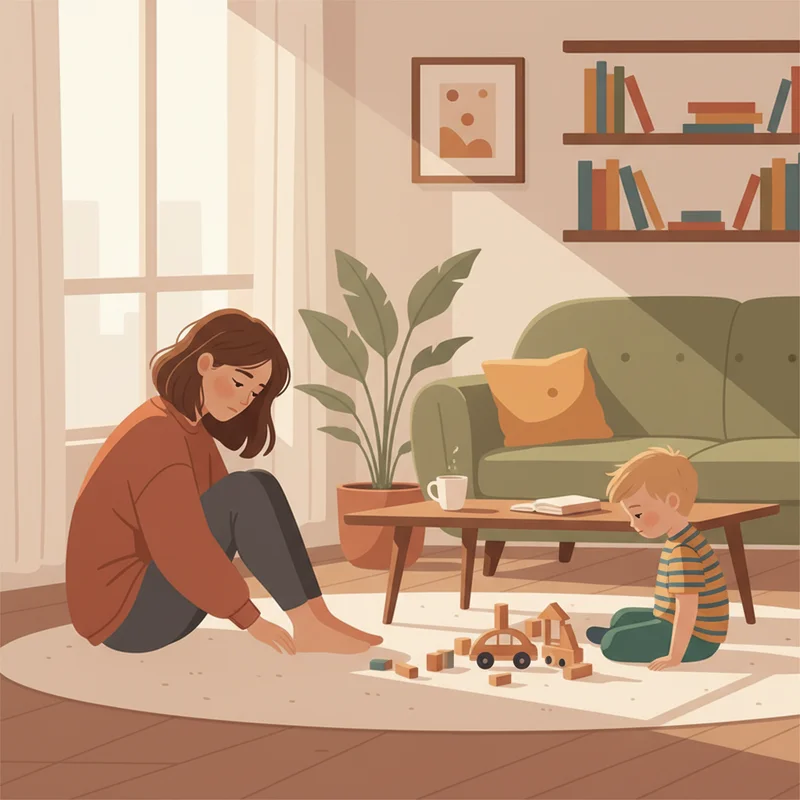
But there's a quieter guilt underneath that one. The guilt of emotional distance. Of realizing you've been looking through your child instead of at them. Of noticing that when things are calm, you don't quite know how to just be with them anymore — because calm has started to feel like a trap, a temporary pause before the next crisis.
That second kind of guilt is harder to talk about. And it's far more common than anyone admits.
When your child's ADHD meltdown cycle is relentless, your brain starts to wire itself around threat-detection. Every interaction becomes a risk assessment. You stop being a parent and start being a de-escalation specialist in your own home — and that role doesn't leave much room for tenderness.
The Moment I Saw Myself Through Oliver's Eyes
I remember the exact moment it cracked open for me.
Oliver had just turned nine. We'd had a relatively calm afternoon — no meltdowns, no blowups. He was drawing at the kitchen table and he looked up and said, "Mom, do you like being around me?"
Not angry. Not manipulative. Just genuinely curious. The way a kid asks when they've been trying to read a situation for a long time and they need help understanding it.
I said "of course I do, buddy" on autopilot. But later that night I sat with the actual question. Did my behavior — my body language, my guardedness, the way I went stiff when he started getting loud — communicate something different than what I felt?
I think it did.
This is what emotional shutdown in ADHD kids sometimes looks like from the inside — not a dramatic withdrawal, but a slow, quiet wondering. Does she want to be here with me?
That question from Oliver was the beginning of something. Not the fix. Just the beginning of being honest about what had happened to us.
Why Guilt Without Action Just Feeds the Cycle
Here's something I learned the hard way: guilt, on its own, makes things worse.
When I felt guilty about being disconnected, my instinct was to overcompensate — to suddenly flood Oliver with warmth and affection that probably felt inconsistent and confusing to him. Or I'd spiral into self-criticism that made me even more anxious and reactive, which led to more dysregulation in both of us.
Guilt without a plan is just another form of chaos. It keeps you stuck in the emotional loop rather than moving forward.
ADHD parent burnout isn't just about being tired. It's about the way prolonged survival mode reshapes how you interact — and those patterns don't automatically reverse when you recognize them. They need to be actively replaced.
The rebuilding work is real. And it starts with the environment, not the relationship.
What I Had to Change in the Environment First
I used to think connection was something I could willpower my way into. That if I just tried harder to be present, to be patient, to be the parent I wanted to be — it would happen.
It doesn't work that way. Not when your household is running at a constant crisis level.
You cannot do the slow, intentional work of rebuilding your relationship with your ADHD child while you're also putting out fires every twenty minutes. The relational repair work requires a baseline of calm that daily meltdowns simply don't allow.
So the first thing I worked on wasn't connection — it was reducing the meltdown load. That meant looking at every part of our day and asking: where are the pressure points? What's predictable? What can I change?
Some of it was structural — morning routine overhauls, visual schedules, reducing transition friction. But I also started looking seriously at what was happening in Oliver's brain that was making everything so volatile.
That's when I went deep on the research around saffron. I'd been skeptical — we'd tried so many supplements by that point — but the 2019 clinical trial comparing saffron to methylphenidate was hard to dismiss. What struck me wasn't just the efficacy data. It was how saffron works: it supports dopamine, serotonin, GABA, and norepinephrine simultaneously. All four of the neurotransmitter pathways that drive mood regulation, impulse control, and the ability to self-soothe.
We'd been trying magnesium for over a year. Magnesium is primarily a GABA supporter — one pathway. When your child's dysregulation is being driven by all four pathways being out of balance, one pathway isn't enough. It's like trying to fix a car with four flat tires by inflating one.
We started Oliver on Saphire Happy Chews — a saffron-based gummy that targets all four pathways — in the fall of his third-grade year. I wasn't expecting a dramatic change. I'd been burned too many times.
Within three weeks, the frequency of the big blowouts dropped noticeably. Not gone. But fewer. Shorter. He started recovering faster after he got dysregulated, which meant our evenings stopped being one long extended crisis.
That breathing room? It changed everything. Not because a supplement fixed our relationship — but because it cleared enough space for me to actually show up differently.
The Small Shifts That Created Real Moments
Once the daily chaos became slightly more manageable, I could start doing the actual connection work. And what I found is that it didn't require grand gestures.
It required small moments of genuine presence, repeated consistently.
For us, it started with five minutes after school where I put my phone in another room and just sat near him. No agenda. No questions about his day. No problem-solving. Just existing in the same space without bracing for impact.
It felt awkward at first — for both of us. We'd both been so conditioned to expect tension that calm felt unfamiliar. But over weeks, something started to soften.
He started talking. Not about school or ADHD or feelings — just about Minecraft, about a funny thing his friend said, about whether sharks dream. Regular kid stuff. The stuff I'd been too exhausted and guarded to receive for two years.
I cried in the shower the first time he told me something just because he wanted to, not because he needed something from me.
If you want to go deeper on the specific strategies that helped us rebuild, I've written a full guide on how to rebuild your relationship with your ADHD child after daily battles have broken the trust — it covers the exact framework we used, in order.
How Our Connection Changed When the Chaos Became Manageable
Here's what I want you to know: the distance you feel from your child right now is not permanent. It's a symptom of the environment you're both trapped in, not evidence of some fundamental failure in your relationship.
For us, the shift happened in layers. The Saphire reduced the meltdown frequency enough that I stopped walking through our house in constant anticipation of the next explosion. That allowed my own nervous system to start downregulating. Which made me more available. Which made Oliver feel safer. Which made him more regulated.
It's a cycle — and it works in the positive direction too, once you can get a foothold.
Oliver is eleven now. Last month he asked if we could have a "mom and me day" — just the two of us, no siblings, no agenda. We went to a bookstore and got lunch. He talked the entire time. I didn't manage a single thing. I just listened.
That's what I was fighting for, even in the years when I couldn't see it.
And it started — not with a relationship strategy, not with a parenting book — but with getting the daily chaos to a level where connection was even possible. The neurological support came first. The relationship work followed. Both mattered.
If You're Reading This at 11pm Feeling Like a Failure
You're not failing. You're exhausted in a way that most people around you don't understand.
Your child's meltdowns are not a reflection of your parenting. They're a reflection of neurological dysregulation that needs support — not punishment, not willpower, not a different parenting philosophy.
The guilt you feel about the distance between you and your child? That guilt is actually love. It's your love recognizing that something important has been lost and wanting it back.
Hold onto that. It means the connection isn't gone — it's just buried under survival mode.
The path back is real. It starts with reducing the chaos enough to create space for the repair. And it continues with the slow, intentional work of showing up — imperfectly, consistently, with honesty about where you've been.
You can do this. Not because you're a perfect parent. Because you love your kid enough to still be reading at 11pm trying to figure it out.
That's enough. That's more than enough.
Parent Training — Limited Spots
Ready to Stop Surviving and Start Connecting?
The Unbreakable ADHD course walks you through the exact framework for moving from daily crisis management to actual connection — nine video modules built for parents who are exhausted and need practical tools, not theory.
87 of 100 spots taken · 9 video modules · $9.99 trial
START YOUR $9.99 TRIAL →Is neurological dysregulation driving the daily chaos in your house?
Take the free 2-minute assessment to understand which brain pathways may be contributing to your child's meltdowns — and what kind of support is most likely to help.
TAKE THE FREE ASSESSMENT →

