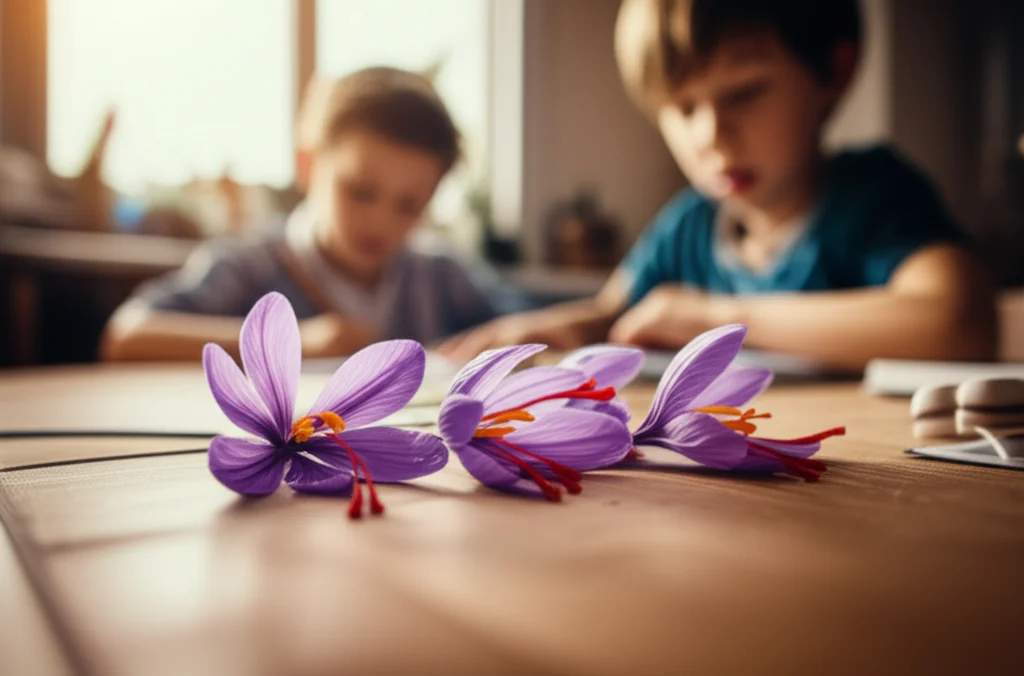
When my son Oliver was seven, I sat in a pediatrician's office listening to the words "attention deficit hyperactivity disorder" for the first time. The doctor handed me a prescription for methylphenidate. I took it. I filled it. But I also went home and started searching.
"Natural ADHD treatment for kids." "Supplements for ADHD children." "Anything besides stimulants."
That search eventually led me to saffron — the bright red spice most people associate with paella and Persian rice. And what I found in the research genuinely surprised me. Not vague wellness claims. Not mommy-blog anecdotes. Actual randomized controlled trials comparing saffron head-to-head with Ritalin in children.
This article is everything I wish someone had handed me in that pediatrician's office. Every clinical trial. Every mechanism. Every dosing detail. All of it in plain language, because you shouldn't need a PhD to understand what might help your child.
What Is Saffron, and Why Are Researchers Studying It for ADHD?
Saffron (Crocus sativus L.) is a flowering plant whose stigmas have been used in traditional medicine for over 3,000 years. It's the world's most expensive spice by weight — and it turns out there's more to it than flavor.
The reason researchers started looking at saffron for ADHD is its active compounds: crocin, crocetin, and safranal. These compounds have been shown in laboratory studies to influence the same neurotransmitter systems that ADHD medications target — but through a different, gentler mechanism.[1]
Unlike stimulant medications that primarily boost dopamine by blocking its reuptake, saffron's bioactive compounds appear to modulate multiple neurotransmitter pathways simultaneously. This is important, and I'll explain why in a moment.
The 4-Pathway Model: Why Saffron's Multi-Target Approach Matters
ADHD isn't a single-pathway disorder. Your child's symptoms — the impulsivity, the inattention, the emotional dysregulation, the hyperactivity — are driven by imbalances across four key neurotransmitter systems:
1. Dopamine — controls motivation, reward processing, and sustained attention. When dopamine is low, your child can't focus on "boring" tasks but can hyperfocus on video games for hours. Saffron's crocin has been shown to modulate dopamine receptor activity and inhibit dopamine reuptake in animal models.[2]
2. Serotonin — regulates mood, emotional control, and impulse regulation. Low serotonin contributes to the emotional meltdowns, irritability, and rejection sensitivity that many ADHD children experience. Safranal, one of saffron's key compounds, has demonstrated serotonin reuptake inhibition properties.[3]
3. GABA — the brain's primary "calm down" signal. Low GABA activity contributes to hyperactivity, restlessness, and the inability to self-regulate. Saffron extracts have shown GABAergic activity in preclinical studies, which may explain why some children appear calmer.[4]
4. Norepinephrine — governs alertness, executive function, and working memory. This is the pathway that non-stimulant ADHD medications like Strattera target. Crocin has been shown to modulate noradrenergic signaling.[5]
Here's why this matters: most natural supplements only target one or two of these pathways. Magnesium? Primarily GABA. Omega-3? Mostly dopamine and serotonin, and weakly. L-theanine? GABA and a bit of dopamine.
Saffron is the only natural compound studied in clinical trials that appears to modulate all four pathways. This multi-target mechanism may explain why it performed comparably to methylphenidate in head-to-head trials — something no other supplement has achieved.
The Clinical Evidence: All 4 Trials on Saffron and ADHD
As of 2026, there are four published clinical trials examining saffron for ADHD. I'm going to walk through each one, because the details matter.
Trial 1: Baziar et al. (2019) — Saffron vs. Methylphenidate, Head-to-Head
This is the trial that changed everything. Published in the Journal of Child and Adolescent Psychopharmacology, this was a randomized, double-blind pilot study comparing saffron directly against methylphenidate (Ritalin) in children.[6]
- Participants: 54 children ages 6-17 with DSM-5 ADHD diagnosis
- Design: 6-week, randomized, double-blind
- Saffron dose: 20 mg/day (children under 30 kg) or 30 mg/day (children over 30 kg)
- Comparator: Methylphenidate at equivalent dosing
- Measurement: Parent and Teacher ADHD Rating Scale-IV
The result: Statistical analysis showed no significant difference between the saffron group and the methylphenidate group on either the Parent or Teacher rating scales. Both groups improved. Adverse effects were similar between groups.
"Short-term therapy with saffron capsule showed the same efficacy compared with methylphenidate."
— Baziar et al., 2019
Let me be clear about what this means and doesn't mean. This was a pilot study with 54 children over 6 weeks. It doesn't prove saffron is "just as good as Ritalin" in all cases. But it does show that in a properly controlled trial, saffron performed comparably — and that's remarkable for any natural compound.
Trial 2: Khaksarian et al. (2021) — Saffron + Medication Works Better Than Medication Alone
This Iranian study asked a different question: what happens when you add saffron to standard ADHD medication?[7]
- Participants: 70 children ages 6-16
- Design: 8-week, randomized, double-blind, parallel-group
- Group 1: Methylphenidate 20-30 mg/day alone
- Group 2: Methylphenidate 20-30 mg/day + Saffron 20-30 mg/day
The result: By week 4, children taking methylphenidate plus saffron had significantly lower ADHD symptom scores than children taking methylphenidate alone (P < 0.05). The combination appeared to produce meaningful effects faster — 4 weeks instead of the typical 8.
"Using MPH combined with saffron proved to be more effective in the treatment of patients suffering from ADHD compared to separate treatments. It appears that the duration of therapy can be reduced."
— Khaksarian et al., 2021
This is particularly relevant for parents whose children are already on medication. Saffron isn't necessarily an either/or choice — it may enhance what medication is already doing.
Trial 3: Blasco-Fontecilla et al. (2022) — Saffron Beats Ritalin for Hyperactivity and Sleep
Published in Nutrients, this Spanish study was the most detailed, measuring not just ADHD symptoms but executive function, objective attention (via computerized testing), and sleep quality.[8]
- Participants: 63 children and adolescents ages 7-17
- Duration: 3 months (the longest saffron ADHD study to date)
- Saffron group: Saffr'Activ extract, 30 mg/day
- Methylphenidate group: Extended-release, titrated to 1 mg/kg/day
The nuanced results:
- Inattention: Methylphenidate was superior
- Hyperactivity: Saffron was superior (saffron reduced hyperactivity scores by -1.37 while methylphenidate actually increased them by +0.77)
- Executive function: Both groups improved comparably (~9-10 point reductions, P < 0.001)
- Sustained attention (CPT-3): Saffron slightly better
- Sleep: Saffron improved time to fall asleep by ~15 minutes. Methylphenidate showed no sleep improvement.
- Parent-reported behavior (Conners): Both groups improved comparably
This study is fascinating because it shows saffron and methylphenidate have different strength profiles. Medication is better for pure inattention. Saffron appears better for hyperactivity and sleep — two of the symptoms that make daily life hardest for ADHD families.
Trial 4: Pazoki et al. (2022) — Saffron as Adjunctive Therapy
This randomized, double-blind, placebo-controlled trial tested saffron (30 mg/day) added to Ritalin versus Ritalin plus placebo in adults with ADHD.[9]
While this study was conducted in adults rather than children, its findings reinforce the adjunctive benefit: by week 6, the saffron + Ritalin group showed significantly greater symptom improvement than the Ritalin + placebo group (P = 0.024). Side effect profiles were identical between groups.
What the Research Tells Us — Honestly
I want to be straight with you, because I know what it's like to read miracle claims when you're desperate for answers at midnight.
What the evidence supports:
- Saffron (20-30 mg/day) has shown ADHD symptom reduction comparable to methylphenidate in controlled trials
- It may be particularly effective for hyperactivity, emotional regulation, and sleep
- Adding saffron to existing medication may produce faster and greater improvement
- Side effects in clinical trials were mild and comparable to placebo
- It works across all four neurotransmitter pathways implicated in ADHD
What we don't know yet:
- Long-term effects beyond 3 months (the longest study)
- Optimal dosing by age and weight (studies used general ranges)
- Whether results vary by ADHD subtype (inattentive vs. combined vs. hyperactive-impulsive)
- How saffron interacts with all ADHD medications (studied with methylphenidate, not amphetamines)
The research is promising — genuinely, unusually promising for a natural compound. But it's still early. No supplement should replace a conversation with your child's doctor.
Saffron Dosing for Children: What the Studies Used
Every parent's first question: how much? Here's what the clinical trials actually used:
| Child's Weight | Daily Dose | Source |
|---|---|---|
| Under 30 kg (~66 lbs) | 20 mg/day | Baziar 2019, Khaksarian 2021 |
| Over 30 kg (~66 lbs) | 30 mg/day | Baziar 2019, Khaksarian 2021 |
| Children & adolescents (7-17) | 30 mg/day | Blasco-Fontecilla 2022 |
A few important notes on dosing:
- These doses used standardized saffron extract, not cooking saffron. Supplement-grade saffron is standardized to specific levels of crocin and safranal.
- In studies, saffron was taken with food.
- Effects typically emerged by weeks 3-4 — don't expect overnight changes.
- Doses above 200 mg/day can cause adverse effects. Clinical ADHD doses (20-30 mg) are well below this threshold.[10]
Safety: Is Saffron Safe for Kids?
Across all four clinical trials:
- No serious adverse events were reported in any saffron group
- Side effect rates were comparable to or lower than methylphenidate
- Unlike stimulants, saffron did not cause appetite suppression or insomnia — it actually improved sleep in one study
- Mild side effects (occasional GI discomfort, headache) occurred at rates similar to placebo
The Children's Hospital of Philadelphia (CHOP) notes that while the safety data is encouraging, supplements are not FDA-regulated, so product quality varies.[11] This is why choosing a saffron supplement with standardized extract is critical — not all saffron products contain the same active compounds at the same concentrations.
Always consult your child's pediatrician before starting saffron, especially if your child takes any medications.
How Saffron Compares to Other ADHD Supplements
Parents often ask me how saffron stacks up against the other supplements they've tried (or been told to try). Here's an honest comparison:
| Supplement | Pathways | Head-to-Head vs. Meds? | Pediatric RCTs |
|---|---|---|---|
| Saffron | All 4 (Dopamine, Serotonin, GABA, Norepinephrine) | Yes — comparable to methylphenidate | 3 pediatric trials |
| Omega-3 (Fish Oil) | 2 (Dopamine, Serotonin — weak) | No | Multiple, small effects |
| Magnesium | 1 (GABA) | No | A few, mixed results |
| L-Theanine | 1-2 (GABA, some Dopamine) | No | Very limited |
| Zinc | 1 (Dopamine modulation) | No | A few, modest effects |
| Iron | 1 (Dopamine synthesis) | No | Limited to deficient kids |
This doesn't mean other supplements are useless. Magnesium helped Oliver sleep. Omega-3 has solid general brain health evidence. But when it comes to clinical trial data specifically for ADHD symptoms in children, saffron stands alone.
What to Look for in a Children's Saffron Supplement
Not all saffron supplements are created equal. The clinical trials used pharmaceutical-grade, standardized extracts. Here's what to look for:
- Standardized extract with specified levels of crocin and safranal (the active compounds)
- Dosage of 20-30 mg of saffron extract per serving (matching clinical trial doses)
- Third-party tested for purity and potency
- Kid-friendly delivery — if your child won't swallow capsules, gummies are the practical choice
- No unnecessary fillers or artificial colors
This is exactly why I started giving Oliver Saphire Happy Chews. They're the only US-based saffron gummy specifically formulated for children, using standardized saffron extract at clinically relevant doses. Oliver actually likes the taste, which — if you've ever tried to get an ADHD kid to take a supplement — you know is half the battle.
Which of the 4 ADHD Brain Pathways Is Your Child Struggling With Most?
Take our free 2-minute quiz to find out which pathways — dopamine, serotonin, GABA, or norepinephrine — are most likely driving your child's specific symptoms. Built by a pediatric researcher for parents who want answers, not guesswork.
TAKE THE FREE ASSESSMENT →Saffron vs. Ritalin: Should You Choose One or Both?
This is the question I get asked most, and the answer is: it depends on your child and your family.
Saffron alone may be worth trying if:
- Your child has mild to moderate ADHD symptoms
- You want to try a natural approach before medication
- Hyperactivity, emotional regulation, or sleep are the primary concerns
- Your child has had side effects from stimulant medications
Adding saffron to medication may help if:
- Your child is on medication but still struggling
- You want to potentially reduce the medication dose (with your doctor's guidance)
- Medication helps with focus but not with emotional meltdowns or sleep
- You're looking for a gentler transition off medication
Medication alone may be the right choice if:
- Your child has severe ADHD symptoms affecting safety or development
- Inattention is the dominant symptom (medication showed an edge here)
- Your doctor recommends it based on your child's specific situation
Whatever you choose, involve your pediatrician. I learned this the hard way — trying to figure it all out alone makes everything harder.
What We Saw With Oliver
I want to share our experience, but with a caveat: one family's story is not clinical evidence. Still, I know this is what most parents want to hear.
Oliver started saffron (via Saphire Happy Chews) when he was eight. He'd been on methylphenidate for about a year. It helped his focus at school, but it killed his appetite, and by 4 PM every day he'd have what I called "the crash" — a window of irritability and emotional volatility when the medication wore off.
After about three weeks on saffron, here's what we noticed:
- The after-school emotional crash was noticeably less intense
- He was falling asleep 20-30 minutes earlier (huge for us)
- Weekend behavior (when he wasn't on medication) was more manageable
- No change in appetite or any other side effects
After two months, his pediatrician agreed to try a lower dose of methylphenidate. Oliver's teacher didn't notice a decline. That doesn't mean this will be your child's experience. But it was ours.
Frequently Asked Questions
Is saffron FDA-approved for ADHD?
No. Saffron is classified as a dietary supplement, not a medication. The FDA does not approve supplements for treating specific conditions. However, multiple clinical trials have demonstrated its efficacy for ADHD symptoms in children, and it has an excellent safety profile at recommended doses (20-30 mg/day).
How long does saffron take to work for ADHD?
In clinical trials, parents and teachers began noticing improvements at weeks 3-4. The Khaksarian 2021 study showed statistically significant differences by week 4 when saffron was combined with methylphenidate. Give it at least 4-6 weeks before evaluating whether it's helping your child.
Can my child take saffron with their ADHD medication?
The clinical evidence actually supports combining saffron with methylphenidate. The Khaksarian 2021 study found that the combination worked better than medication alone. However, always consult your child's prescribing physician before adding any supplement to their medication regimen.
What's the right saffron dose for my child?
Clinical trials used 20 mg/day for children under 30 kg (about 66 lbs) and 30 mg/day for children over 30 kg. Look for supplements that use standardized saffron extract to ensure you're getting the active compounds (crocin, crocetin, safranal) at therapeutic levels.
Is saffron the same as turmeric or curcumin?
No. Despite both being yellow-orange spices, saffron (Crocus sativus) and turmeric (Curcuma longa) are completely different plants with different active compounds. Turmeric/curcumin has not been studied for ADHD. Saffron's ADHD benefits come from crocin and safranal, which are unique to saffron.
Are there any children who should NOT take saffron?
Saffron is generally well-tolerated, but consult your pediatrician if your child is taking blood-thinning medications, has a bleeding disorder, or is pregnant/nursing (for adolescents). Children with known allergies to Crocus species should avoid saffron. Always start with a lower dose and monitor for any adverse reactions.
Is cooking saffron the same as supplement saffron?
No. Cooking saffron contains the same base compounds, but supplement-grade saffron extract is concentrated and standardized to contain specific levels of crocin and safranal. You would need to consume impractical (and expensive) amounts of cooking saffron to match the doses used in clinical trials.
Can saffron help with ADHD in girls specifically?
The clinical trials included both boys and girls. While ADHD often presents differently in girls (more inattention, less hyperactivity), saffron's multi-pathway mechanism targets both symptom profiles. The Blasco-Fontecilla 2022 study had a mixed-gender sample (67.5% male, 32.5% female) and found benefits across participants.
What if saffron doesn't work for my child?
Not every intervention works for every child. If you've tried saffron for 6+ weeks with no noticeable improvement, it may not be the right fit for your child's specific neurochemistry. Discuss other options with your pediatrician, including other natural approaches, behavioral therapy, or medication adjustments.
How does saffron compare to prescription ADHD medications?
In the Baziar 2019 trial, saffron performed comparably to methylphenidate over 6 weeks. In the Blasco-Fontecilla 2022 study, methylphenidate was superior for inattention while saffron was superior for hyperactivity and sleep. Saffron has significantly fewer side effects than stimulant medications. It may work best as a complement to medication, or as a standalone option for mild-to-moderate ADHD.
Where can I find saffron gummies for kids?
Saphire Happy Chews are currently the only US-based saffron gummy formulated specifically for children with ADHD, using standardized saffron extract at clinical doses.
Does saffron help with ADHD-related anxiety?
Saffron has been studied separately for anxiety and depression in youth, with positive results. Its GABAergic and serotonergic activity — two of the four pathways discussed above — are the same systems involved in anxiety. Many parents report improvements in both ADHD symptoms and co-occurring anxiety, though more research specifically on comorbid ADHD+anxiety is needed.
Is there a difference between saffron extract brands?
Yes. The two most-studied branded extracts are affron (Pharmactive, Spain) and Saffr'Activ (Green Plants Extracts, Spain). Both are standardized for active compounds. Generic saffron supplements may not contain consistent levels of crocin and safranal. Always choose a supplement that specifies its extract standardization on the label.
The Bottom Line
Saffron is the most clinically supported natural compound for ADHD in children. Three pediatric trials and one adult trial have demonstrated meaningful symptom reduction, with a safety profile that puts most supplements to shame.
It won't replace your child's entire treatment plan. But it may be the missing piece that makes everything else work better — whether that's medication, therapy, school accommodations, or just getting through dinner without a meltdown.
That's what it was for us.
Ready to Try Saffron for Your Child?
Saphire Happy Chews deliver clinically studied saffron in a gummy your kid will actually eat. Take our free quiz to see which brain pathways need the most support.
TAKE THE FREE ASSESSMENT →References
- Lopresti AL, Drummond PD. "Saffron (Crocus sativus) for depression: a systematic review of clinical studies and examination of underlying antidepressant mechanisms of action." Human Psychopharmacology. 2014;29(6):517-27. PubMed
- Ettehadi H, et al. "Aqueous extract of saffron (Crocus sativus) increases brain dopamine and glutamate concentrations in rats." J Behav Brain Sci. 2013;3(3):315-319.
- Hosseinzadeh H, Noraei NB. "Anxiolytic and hypnotic effect of Crocus sativus aqueous extract and its constituents, crocin and safranal, in mice." Phytother Res. 2009;23(6):768-74. PubMed
- Hosseinzadeh H, Sadeghnia HR. "Safranal, a constituent of Crocus sativus, attenuated cerebral ischemia induced oxidative damage in rat hippocampus." J Pharm Pharm Sci. 2005;8(3):394-9. PubMed
- Pitsikas N. "The Effect of Crocus sativus L. and Its Constituents on Memory: Basic Studies and Clinical Applications." Evid Based Complement Alternat Med. 2015;2015:926284. PubMed
- Baziar S, et al. "Crocus sativus L. Versus Methylphenidate in Treatment of Children with Attention-Deficit/Hyperactivity Disorder: A Randomized, Double-Blind Pilot Study." J Child Adolesc Psychopharmacol. 2019;29(3):205-212. PubMed
- Khaksarian M, et al. "A Comparison of Methylphenidate and Combined Methylphenidate with Crocus sativus in the Treatment of Children and Adolescents with ADHD." Iran J Psychiatry Behav Sci. 2021;15(3):e108390.
- Blasco-Fontecilla H, et al. "Effectivity of Saffron Extract (Saffr'Activ) on Treatment for Children and Adolescents with ADHD." Nutrients. 2022;14(19):4046. PMC
- Pazoki B, et al. "Efficacy and safety of saffron as adjunctive therapy in adults with ADHD: A randomized, double-blind, placebo-controlled clinical trial." Adv Integr Med. 2022;9:37-43.
- Schmidt M, Betti G, Hensel A. "Saffron in phytotherapy: pharmacology and clinical uses." Wien Med Wochenschr. 2007;157(13-14):315-9. PubMed
- Children's Hospital of Philadelphia. "Saffron for the treatment of ADHD." CHOP.edu
- Seyedi-Sahebari S, et al. "A Systematic Review of Saffron for ADHD." J Atten Disord. 2024. PubMed