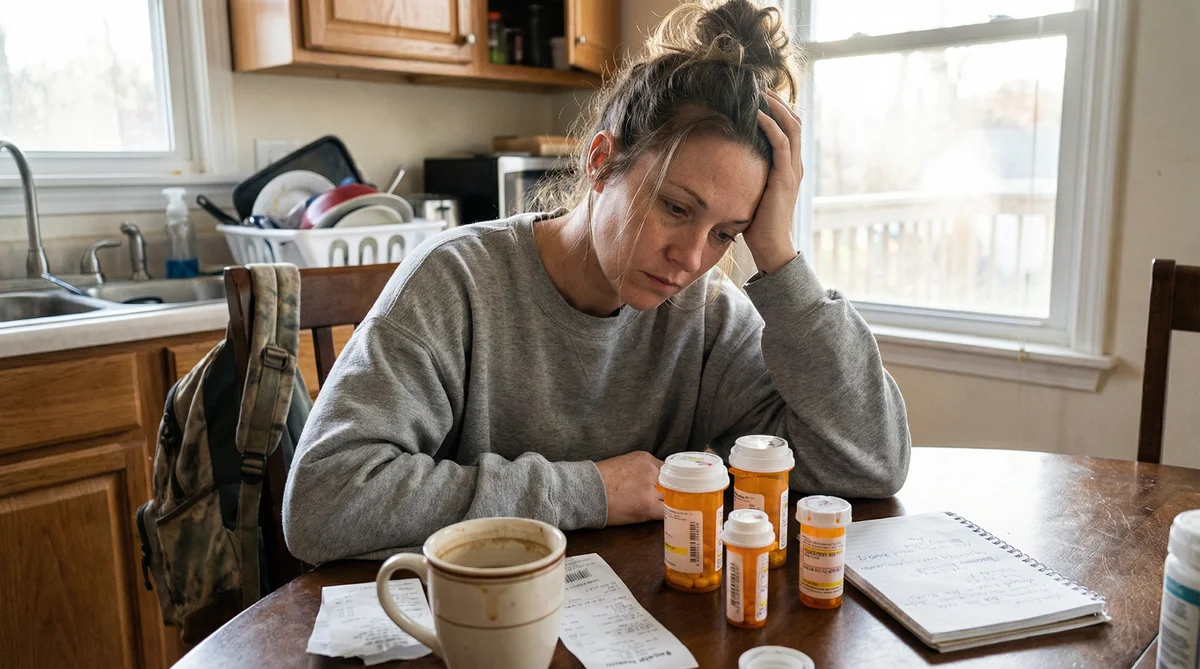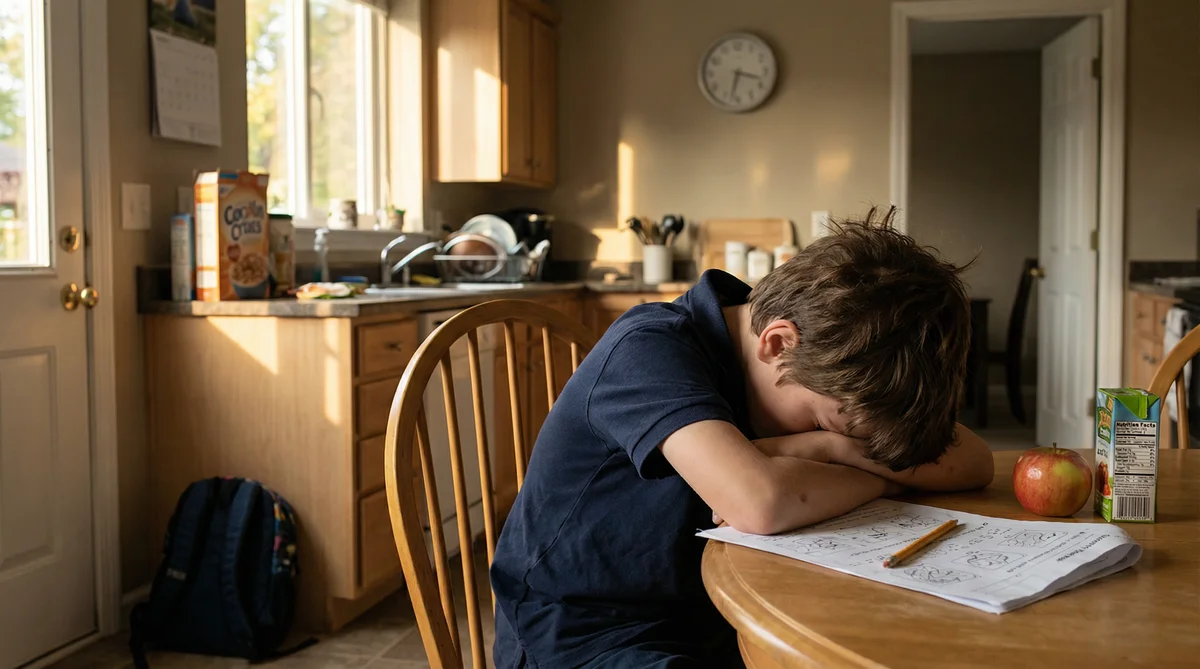
It happens like clockwork. Your child comes home from school and within 30 minutes, it's like someone flipped a switch. The calm, focused kid the teacher raved about at pickup is now screaming, throwing things, picking fights with siblings, and melting down over nothing.
You look at the clock. It's 4 PM. Again.
If this is your life right now, I need you to hear this: you are not imagining it, and your child is not doing this on purpose. What you're seeing is called the medication rebound — and it's the single most common complaint I found when I spent weeks reading through ADHD parent support groups.
What the Crash Actually Looks Like
Every parent describes it slightly differently, but the pattern is unmistakable. Here's what I heard from real parents, over and over:
One mom with an 8-year-old on Focalin XR described the daily whiplash:
"His whole personality is like a 180 since starting medication."
At school, her son was focused, engaged, following directions. The teacher was thrilled. But by the time he got home? Extreme hyperactivity. Defiance. Emotional outbursts. Physical aggression toward his sibling. It was like two completely different children living in the same body — one during medication hours, one after.
Another parent with an almost-8-year-old on Vyvanse 10mg told a story that broke my heart:
"Today, he didn't want to take his meds because it makes everything worse. Which is a complete 180 from when he first started taking it, where he wanted to take it because it made him feel better."
Let that sink in. A child who asked to take his medication because it helped him — now refuses it because the crash has become worse than the untreated ADHD symptoms.
A third parent watched her son's Adderall XR wear off mid-school day:
The teacher noted the child struggled to focus during the second half of the school day. In the evenings, he became "very dysregulated — cranky and all over the place."
Why the Crash Happens (The Brain Science)
Here's what's actually going on in your child's brain during the crash, in plain language.
Stimulant ADHD medications work by boosting dopamine and norepinephrine — neurotransmitters that help with focus, attention, and impulse control. When the medication is active, your child's brain has the chemical support it needs to function. They can sit still, listen, filter out distractions, and regulate their emotions.
But stimulant medications don't last forever. They peak and then they drop. And here's the cruel part: when the medication wears off, dopamine levels don't just return to baseline — they temporarily drop below baseline.
Think of it like a rubber band being stretched. The further you pull it in one direction (medication boosting dopamine), the harder it snaps back in the other direction (the crash). Your child's brain is temporarily running on less dopamine than it had before the medication kicked in that morning.
This is why the crash often feels worse than untreated ADHD. Because for a brief window, it literally is. Your child's brain is in a dopamine deficit — and everything that requires dopamine (emotional regulation, impulse control, frustration tolerance, transitions) falls apart.
The Crash vs. True Medication Failure
This is an important distinction that took me too long to understand with Oliver. Not every bad afternoon is a crash. Sometimes the medication genuinely isn't working. Here's how to tell the difference:
It's a crash if:
- Your child is calm and focused during medication hours, then falls apart at a predictable time each day
- The bad behavior happens within a 1-3 hour window as the medication wears off
- Symptoms seem worse than pre-medication baseline, but only during that window
- Mornings (before or just after medication kicks in) are generally okay
It might be medication failure if:
- Your child is irritable, aggressive, or emotionally dysregulated while the medication is active
- New behavioral problems appear that didn't exist before medication
- There's no "good window" — things are bad throughout the day
- Symptoms have been getting progressively worse over weeks
If you're seeing true medication failure, read what to do when ADHD medication makes symptoms worse. If it's the crash — keep reading.
What Parents in the Group Actually Did About It
The parents I talked to aren't just suffering through this. They're problem-solving. Here are the strategies that came up most often:
1. Switching to extended-release formulations
One parent whose child was struggling with Adderall XR wearing off too early worked with their doctor to try a longer-acting option. Extended-release medications are designed to release the drug more slowly, extending the therapeutic window and softening the crash. But as multiple parents noted, "extended release" doesn't always extend enough — some kids metabolize the medication faster than expected.
2. Adding a non-stimulant like Guanfacine
This was the single most positive recommendation I found. Guanfacine (brand name Intuniv) is an alpha-2 agonist that doesn't work on dopamine directly — instead, it helps regulate the prefrontal cortex through a different mechanism. Multiple parents described it as the missing piece that smoothed out their child's evenings. One psychiatrist in the group specifically recommended it as an add-on to prevent stimulant crashes.
3. Timing medication differently
Some parents worked with their doctors to adjust when the medication was taken — earlier in the morning to push the crash earlier, or adding a small "booster dose" of short-acting medication in the early afternoon to bridge the gap.
4. Building a crash-proof after-school routine
Several parents learned to anticipate the crash and plan accordingly: high-protein snack immediately after school (since the child probably didn't eat much at lunch due to appetite suppression), 20-30 minutes of physical activity to burn off the rebound energy, and absolutely no homework or demanding tasks during the crash window.
Is your child's brain getting support across all 4 pathways?
Stimulant medications target dopamine and norepinephrine — but ADHD involves four brain pathways, not two. Take our free assessment to see where the gaps might be.
TAKE THE FREE ASSESSMENT →The Two Pathways Nobody Talks About
Here's something that changed how I think about the medication crash entirely.
Stimulant medications boost dopamine and norepinephrine. That's two of the four neurotransmitter pathways involved in ADHD. But what about the other two?
Serotonin — responsible for mood regulation, impulse control, and emotional stability. When medication wears off and dopamine drops, your child's serotonin system is left unsupported. This is why the crash often looks like emotional dysregulation more than inattention.
GABA — the brain's primary calming neurotransmitter. It's responsible for reducing anxiety, promoting relaxation, and helping the nervous system settle. During the crash, with dopamine plummeting and GABA unsupported, your child's brain has lost its brakes and its shock absorbers at the same time.
This is why the crash doesn't just look like "ADHD returning." It looks worse. Because the medication created a temporary imbalance — boosting two pathways while the other two were left to fend for themselves. When the boost drops out, the whole system is destabilized.
Understanding this changed our approach with Oliver. Instead of just trying to manage the crash through behavioral strategies (which helped but weren't enough), we started looking at ways to support all four pathways — not just the two his medication was targeting.
The Nutrition Factor You're Probably Missing
Here's something that came up in the support group that doctors rarely mention: the appetite crash feeds the behavioral crash.
Stimulant medications suppress appetite. Most kids on stimulants barely eat lunch. By 3 PM, your child hasn't had a real meal in 8+ hours. Their blood sugar is low. Their brain is running on fumes. And right at that moment — the medication wears off.
You're not just dealing with a dopamine rebound. You're dealing with a hungry, blood-sugar-crashed, exhausted child whose medication is simultaneously wearing off. No wonder the afternoons are a disaster.
The parents who figured this out shared a consistent strategy: meet your child at the door with a high-protein, high-fat snack. Not a granola bar. Think cheese and crackers, peanut butter on toast, a smoothie with protein powder. Something that will hit their bloodstream fast and give their brain fuel during the most vulnerable window.
It won't eliminate the crash. But every parent who tried this said it took the edge off significantly.
When Oliver's Crash Was at Its Worst
I remember the worst of Oliver's medication crash period like it was yesterday. He'd come home from school and I'd brace myself. Not because he was a bad kid — but because I knew what was coming. The door would open, and within minutes he'd be screaming at his sister, throwing his backpack, refusing to do anything I asked.
I cried in the bathroom more times than I can count during that phase. I wondered if we'd made the right choice. I wondered if the medication was doing more harm than good.
What I eventually learned was that the crash wasn't a sign the medication was wrong — it was a sign his brain needed more support than the medication alone could provide. The medication was doing its job during the day. But it was only addressing part of the problem. His serotonin, his GABA, his nutritional needs, his sleep — all of those were either unsupported or actively disrupted by the medication.
Once we addressed the full picture — not just the dopamine piece — the afternoons got better. Not perfect. But livable. The meltdowns went from daily explosions to occasional rough patches. Oliver stopped dreading his own after-school hours.
If your child is living through the 4 PM crash right now, please know: this is solvable. It takes some detective work, some doctor conversations, and a willingness to look beyond medication alone. But it gets better.
Ready to support the brain pathways your child's medication can't reach?
Take our free 2-minute assessment to understand which of the 4 ADHD brain pathways might need additional support for your child.
TAKE THE FREE ASSESSMENT →